



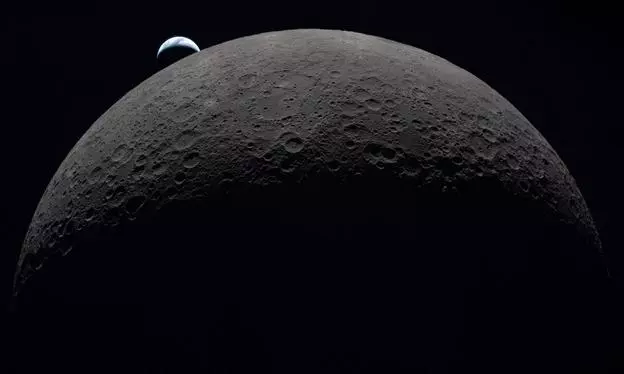
As Artemis II flew around the far side of the Moon, the crew captured a new view of home. These images show Earthset, when Earth dips below the lunar horizon. Photos/Videos: NASA/@NASAArtemis
Artemis II photo essay: In the shadow of the Moon
The astronauts viewed never-before-seen parts of the moon’s surface: areas on the far side that aren’t visible from Earth. And they beamed photographs they took

Four NASA astronauts lifted off on April 1 from Kennedy Space Center in Cape Canaveral, Florida aboard the Orion spacecraft for a flyby around the Moon on a ten-day mission.
A week later, the Artemis II crew has made history by travelling farther from Earth than any humans have gone before. They have come closer to the Moon than any human has been in over half a century. For about seven hours, they observed features of the lunar service and took photos. From this unique vantage point and environment, the Artemis II crew will eventually work with scientists on Earth to lay the groundwork for the Artemis III lunar landing and future missions to Mars.
The flight is intended as a step toward a planned moon landing in 2028.
At their closest, the crew members flew within 4,067 miles of the moon's surface. They broke the Apollo 13 record for the greatest distance any humans have travelled from our planet.
Also read: Artemis II makes a call to space station as it heads home from Moon
The crew is expected to return to Earth on Friday evening with a splashdown in the Pacific Ocean.
Astronauts are using high-resolution cameras to document the Moon's far side and surface, providing new imagery of lunar features. Here are some images and videos of what Artemis Mission took:
The Artemis II eclipse: From lunar orbit, the Moon eclipses the Sun, revealing a view few in human history have ever witnessed. The three "stars" to the lower right of the Moon are actually planets. The middle one has a slightly red tint.
That's Mars.
Here's another stunning picture of the eclipse photographed by the Artemis II team:
The Moon, backlit by the Sun during a solar eclipse, is photographed by NASA’s Orion spacecraft on Monday, April 6, 2026, during the Artemis II mission. Orion is visible in the foreground on the left. Earth is reflecting sunlight at the left edge of the Moon, which is slightly brighter than the rest of the disk. The bright spot visible just below the Moon’s bottom right edge is Saturn. Beyond that, the bright spot at the right edge of the image is Mars.
Peeking at Earth
As NASA's Artemis II crew came close to passing behind the Moon and experiencing a planned loss of singal on April 6,they captured this image of a crescent Earth's setting on the Moon's limb. In this photo, the dark portion of Earth is experiencing nighttime, while Australia and Oceania are in the daylight. In the foreground, the Ohm crater is visible with terraced edges and a flat floor interrupted by central peaks.
The Artemis II crew captured this view of an Earthset on April 6, 2026, as they flew around the Moon. The image is reminiscent of the iconic Earthrise image taken by astronaut Bill Anders 58 years earlier as the Apollo 8 crew flew around the Moon.
The incredible close-ups of the moon: The new imagery also will help NASA better understand the Moon’s geology and inform future exploration and science missions that will lay the foundation for an enduring presence on the Moon ahead of future astronaut missions to Mars.
Sky full of stars. Following a successful lunar flyby, the Artemis II astronauts captured this breathtaking photo of our galaxy, the Milky Way, on April 7, 2026.
Also read: Artemis II astronauts break Apollo 13 record, capture stunning lunar far-side views
Hello Earth!
NASA astronaut and Artemis II Commander Reid Wiseman took this picture of Earth from the Orion spacecraft’s window after completing the translunar injection burn. Photo: NASA/Reid Wiseman