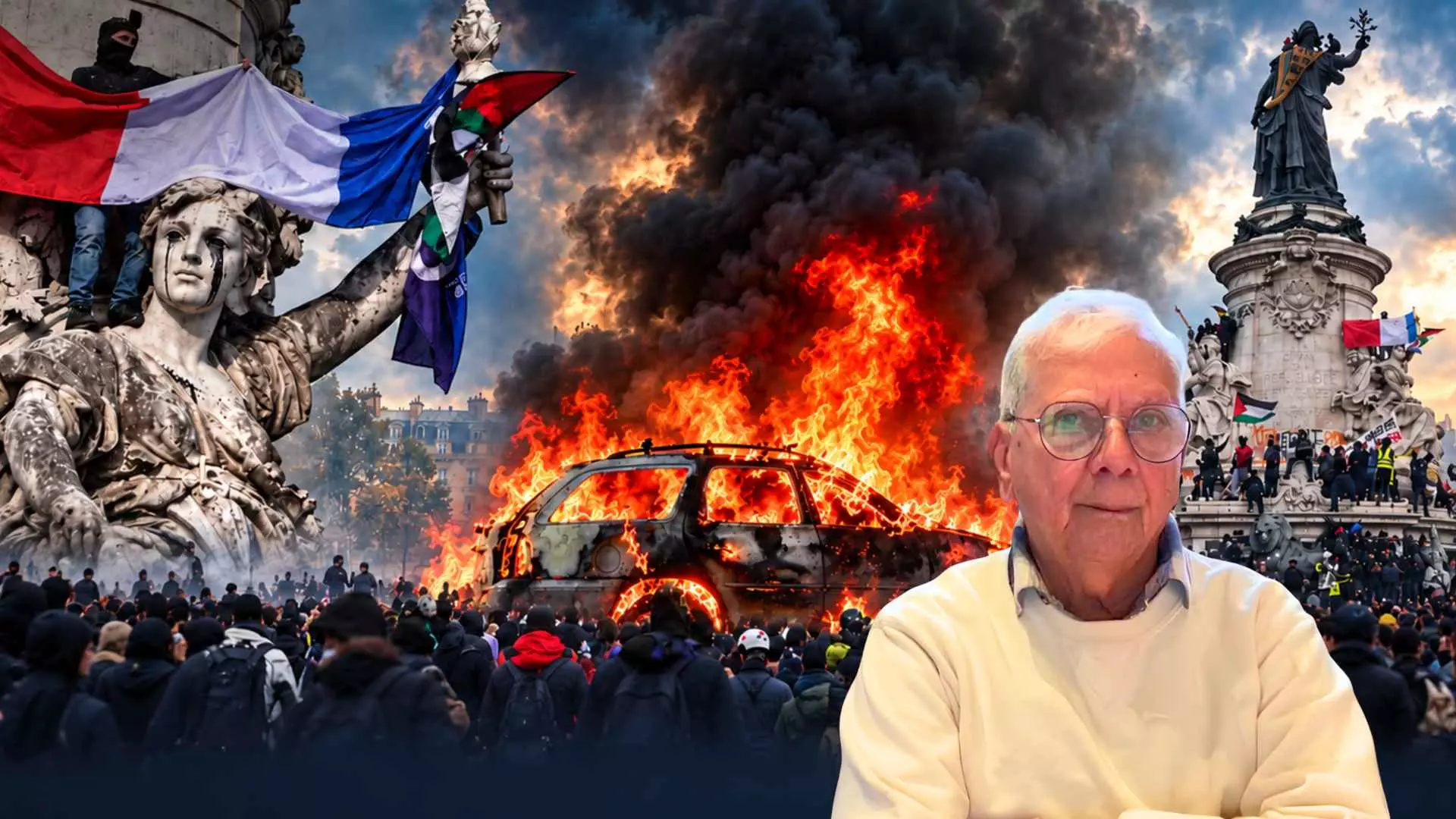
‘State silence is violence’: Filmmaker Vijay Singh on French student protests
The writer examines how educational inequality and police repression have fuelled student anger in France, and how the unrest could strengthen the far right across Europe

State silence and police overreaction against peaceful student demonstrators are fuelling popular revolt, potentially pushing public opinion towards the far right across Europe. As high school students take to the streets over crumbling educational infrastructure and unfair academic selection criteria, governments face a deepening crisis of institutional neglect and democratic alienation.
The Federal spoke to Vijay Singh, writer, journalist and filmmaker, to examine the roots of the French student unrest, the sudden escalation of street violence, and the wider political fallout for democracies grappling with growing public discontent.
Edited excerpts:
How would you describe the current wave of protests taking place across France?
It is the expression of the lycéens’ anger. Having lived in France for about 40 years, this is only the fifth or sixth time I have witnessed a student movement of this scale. French lycéens are far more politically engaged than Indian high school students, due to higher literacy rates and civic education levels.
Previous major demonstrations usually originated in central Paris. But there is a specific reason this wave began on the periphery. There is an invisible boundary — a Lakshman Rekha — surrounding the capital, beyond which state resources drop sharply. A large percentage of France’s immigrant population lives in these suburbs, where schools suffer from severe teacher shortages, delayed renovations, and poor maintenance.
Fifteen years ago, as a guest of the French Ministry of Culture, I was invited to speak at a suburban school about immigrant achievements. The students were wonderful, but the structural disparity was stark compared to elite Parisian public schools or international bilingual schools. That long-standing inequality is where this deep anger originates.
Beyond decaying infrastructure and poor scheduling, the immediate trigger was Parcoursup – the state's higher-education platform that filters students into university tracks. It effectively segregates applicants, creating a rigid system where students from disadvantaged backgrounds are locked out of elite higher education. It functions like an academic caste system, trapping individuals at the bottom by birth and location. Students are now demanding the complete repeal of these selection criteria.
Also read: What’s driving Europe’s protests and what is US link?
How did these peaceful student demonstrations escalate into widespread violence?
Initially, the student demonstrations were filled with bonhomie, humour, and satire. They shared the satirical spirit of the recent Indian student demonstrations. While any crowd contains individuals who may lose control, the explosion of violence was primarily provoked by the state.
The government deployed hundreds of police officers to repress the rallies, turning civic expression into an aggressive display of force. One student lost an eye, female protesters were mistreated, and national television broadcast images of police heavy-handedness across the country.
This brutality outraged the public. Every group with a grievance against the state joined the movement. The yellow vest movement, women's rights groups, university students, citizens protesting rising fuel prices, farmers, and major trade unions all poured into the streets. Teachers and parents joined as well because they face those same economic pressures at home.
There was also severe operational mismanagement by authorities. After heavy-handed repression at the start, police presence mysteriously vanished when a quarter of a million people rallied in Paris. Centuries-old historic landmarks, like the Limoges Town Hall, were left to burn because police failed to respond for 45 minutes.
How are ordinary French citizens reacting to this destruction, and who benefits politically?
Public opinion has shifted significantly over the last few days. While high school students want to protest until their legitimate demands are met, widespread arson and looting have alienated the general public. This destruction is pushing mass opinion toward the political center and right.
The biggest loser in this dynamic is the far left, specifically Jean-Luc Mélenchon’s La France Insoumise (LFI). Mélenchon’s policy platform is not radically different from François Mitterrand’s 1981 nationalisation agenda, but his aggressive rhetoric during nationwide arson and mayhem has turned voters away.
Conversely, the far right is delighted and is capitalising on the chaos by blaming the left and immigration. Marine Le Pen, leader of the National Rally, has played her hand strategically. She has moderated her rhetoric and toned down her party's anti-Semitic legacy to position herself as a mainstream alternative.
The extreme violence on the streets is not coming from average students, but from "Black Blocs"—an accumulation of ultra-left anarchists who reject parliamentary politics and seek pure disruption, reminiscent of Mikhail Bakunin’s anarchism. These Black Blocs included international agitators from Switzerland, Belgium, Sweden, and Britain who joined the unrest to cause destruction.
Also read: Why Europe’s youth are taking to the streets: A crisis beyond politics
What has been the reaction in France to Donald Trump blaming the protests on European immigration policies?
Donald Trump is not widely admired in France, even among the far right. While Marine Le Pen’s party was initially enthusiastic about Trump, they distanced themselves when he attacked the European Union.
Voters across Europe are yearning for a strong, stable centre to govern. However, because centrist leaders like Emmanuel Macron have failed to deliver on economic promises, political space has fractured toward the far left and far right. The recent violence is now accelerating a shift from the far left directly toward the right.
Unrest and student protests are spreading across European nations like Spain, Italy, Albania, and Portugal. Why is this happening simultaneously?
The underlying economic anger and social questions are identical across the globe. A while ago, global attention was on the US following the killing of George Floyd. In Albania, protesters recently set fire to the Supreme Court. In Italy, major demonstrations have hit Milan. Social media and global news allow youth in different countries to echo each other's grievances.
During my time as a student at JNU, when roofs began leaking in newly constructed halls, students symbolically seated the university chancellor — who was then the President of India — at his office desk with an open umbrella over his head. The instinct of young people to challenge administrative neglect is the same everywhere.
Where do you see this movement heading in France, and what lessons should governments take from it?
The primary lesson for any government is that state silence is violence. Refusing to engage with opponents, spending weeks traveling abroad, or ignoring public anger only transforms frustration into open revolt. Governments must open channels of communication before public grievances spill into uncontrollable violence.
When political manipulation, electoral suspicion, or "magouille" — a French term for underhanded cheating — takes hold, leadership must provide immediate transparency rather than hiding behind silence.
The French government has begun meeting with student representatives, trade unions, and key stakeholders, with the Prime Minister directly leading discussions. Authorities will likely allocate emergency funding to address educational grievances, despite national deficits incurred from COVID-19 subsidies. As with most mass movements, street energy will eventually wane, and judicial processing will take its course.
The critical difference between developed and developing democracies lies in institutional responsiveness. In France, parliamentary inquiries into police excesses and urgent judicial reviews kick in immediately. In contrast, developing democracies often allow controversies to linger without transparent resolution. A true democracy cannot function when top-level wealth doubles while the rest of society stagnates without transparency or accountability.