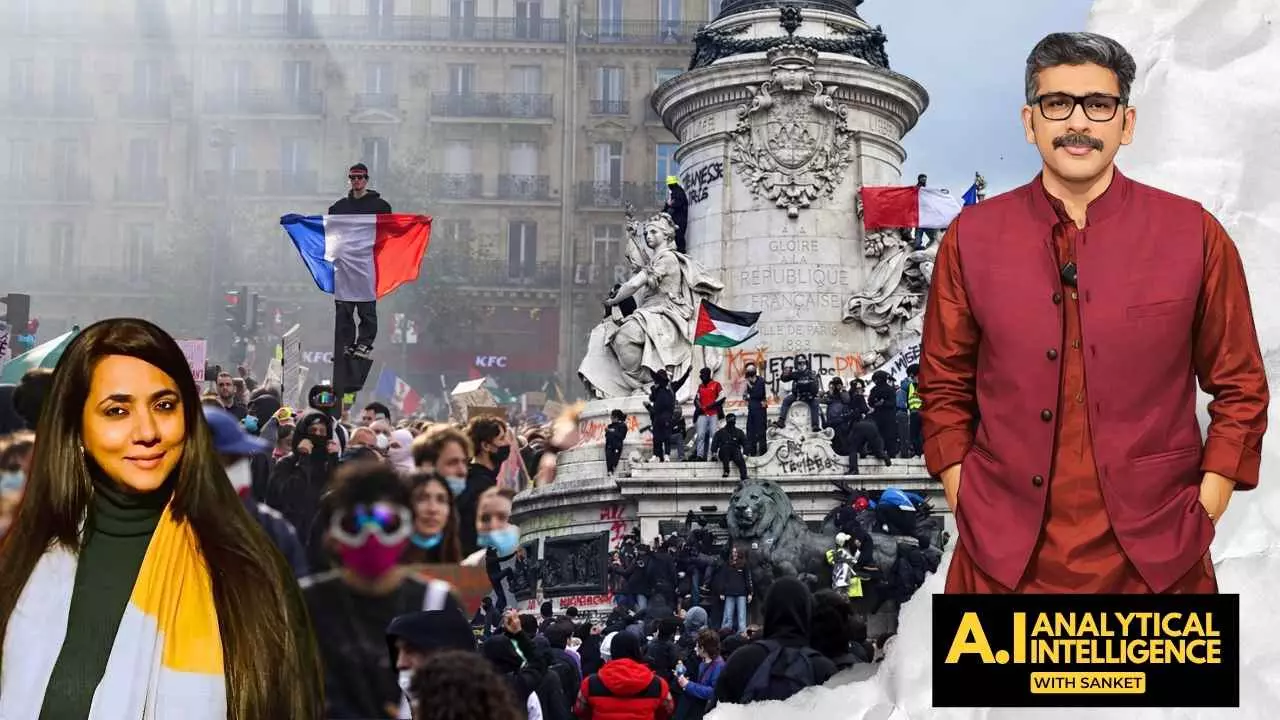
What’s driving Europe’s protests and what is US link? | Interview
Naghma Sahar, senior journalist, breaks down the key factors behind the protests and the stark contrast with non-violent demonstrations in India

Protests across Europe have brought young people onto the streets over rising living costs, housing unaffordability, education, and public services, with demonstrations in several countries escalating into violence.
In an interview with The Federal’s Sanket Upadhyay on AI With Sanket, senior journalist Naghma Sahar discusses the common thread of youth discontent, the political debate over immigration, the response of European governments and the possible implications for Europe’s relationship with the United States, and the stark contrast with non-violent demonstrations in India.
Edited excerpts from the interview.
What should one expect from these protests taking place across the world, what are they about, and why are they happening?
When we call this the season of protest, it is very rightly so. We have seen young people out on the streets in India, and it seems as though the protests have spilled over across Europe—in France, Italy, Belgium, and Albania. Europe is on the boil. While these demonstrations are taking place for different reasons, at the heart of it all is deep-seated discontent. Existing fault lines were already present, and whatever little trigger occurred, it sparked massive protests.
If you look at it country by country, Paris was the epicentre in France, but it is heartbreaking to see iconic places up in flames. Centuries-old town halls, like the one in Limoges, and towns like Bordeaux were burned down. People initially started protesting over rising school fees or inadequate educational facilities, but there was a much harder, underlying discontent.
It is easy for some far-right leaders to blame immigration policies. American President Donald Trump, for instance, termed the protests a result of Europe's immigration policy and urged French President Emmanuel Macron to close the borders immediately. Europe has maintained a very liberal immigration policy, and a large majority of immigrants live in these countries. However, as soon as schoolchildren and young people began protesting, the French Prime Minister accused the ultra-left of fueling the unrest. We see that same discontent in Italy, in Albania, and in Spain, which is facing a severe housing crisis.
Also read: Why Europe’s youth are taking to the streets: A crisis beyond politics
Are these protests taking place across Europe linked in any way, or are these just individual citizens protesting separately in their respective countries?
It is not formally coordinated, but it is quite a coincidence that these protests are happening simultaneously. Interestingly, when India was witnessing protests, almost at the exact same time, Gen Z and young people across Europe took to the streets.
At the heart of these protests are young people. The reasons include rising fuel costs, discontent with the state of schools, and declining public services, which have been major concerns across Europe.
Europe has been going through a severe economic crisis. For years, it was said that Europe was sleeping, but now you see the results on the street. Citizens are enduring a tough time, compounded by an acute housing crisis. In some places, the protests are against corruption.
In Albania, for example, there is a student movement in Tirana protesting against corruption linked to the "Flamingo" project. That luxury development project, which is linked to Donald Trump's son-in-law Jared Kushner, was designated on land meant for flamingos. People are protesting and demanding that Socialist Prime Minister Edi Rama step down over this corruption.
So while these protests are not directly connected, the common thread is youth discontent. Young people are not ready to take things lying down; they want change and accountability.
Unlike the largely peaceful protests in India, demonstrations in European countries like France and Albania have seen widespread violence, arson, and looting. Why are European protests so violent?
That is the stark difference. Though France has a long history of protests, seeing this level of violence is shocking. France has been a very liberal society, but President Emmanuel Macron rightly noted that while citizens can protest, burning public property is unacceptable. Italian Prime Minister Giorgia Meloni similarly stated that demonstration is a right, but burning public property is not.
In Limoges, a town hall was burned down, and overall, 143 town halls were targeted. Luxury establishments—symbols of wealth and capitalism like Louis Vuitton, Apple stores, and Galeries Lafayette in central Paris—were looted and set ablaze.
Thankfully, this has not happened in India. Protests here have been largely peaceful, and we can be proud that young people came out without destroying public property, despite facing police confrontations or detentions.
Given the economic crisis, domestic unrest, and shift in US relations under Donald Trump, could this domestic backlash lead to a fundamental shift in European foreign policy?
I do think so. Europe's relationship with America is undergoing a major turn, and Europe will have to re-evaluate its engagement with the US.
Europe is facing massive challenges due to American decisions, whether in the handling of the Russia-Ukraine war or military actions against Iran, for which the world continues to pay a price. As Donald Trump prepared for mid-term elections and faced gas price pressures at home, he made a deal with Russia to protect his voter base. Simultaneously, the MAGA narrative has gathered momentum, accompanied by a rise in hostility towards foreign professionals, including qualified Indians securing jobs.
What Europe is witnessing right now is a moment of reckoning and intense internal churn. Key economic drivers of Europe—such as Germany, Italy, and France—must re-evaluate how they view the rest of the world and how they engage with America.
How are European governments responding to this crisis? Is their approach strictly a law-enforcement measure, or are they introducing policy changes to address economic grievances?
Right now, European leadership appears caught off guard. Spain, for instance, has struggled with a housing crisis for a long time. A poignant case involved an 87-year-old woman evicted from her deceased father's house after a rent policy change made it unaffordable. She lived in a protest camp, was hospitalised, and passed away, triggering wide protests.
In France, the response has leaned heavily on police action because the clashes turned violent. Authorities made over 2,400 arrests in France and pledged stern law-and-order measures. Similar strict warnings were issued by Italian leadership.
At present, state actions remain reactionary and focused on controlling rioters. We have not seen concrete policy statements regarding systemic reform. Eventually, Europe will have to re-examine its socialist and welfare state model.
Watch the full interview here.