



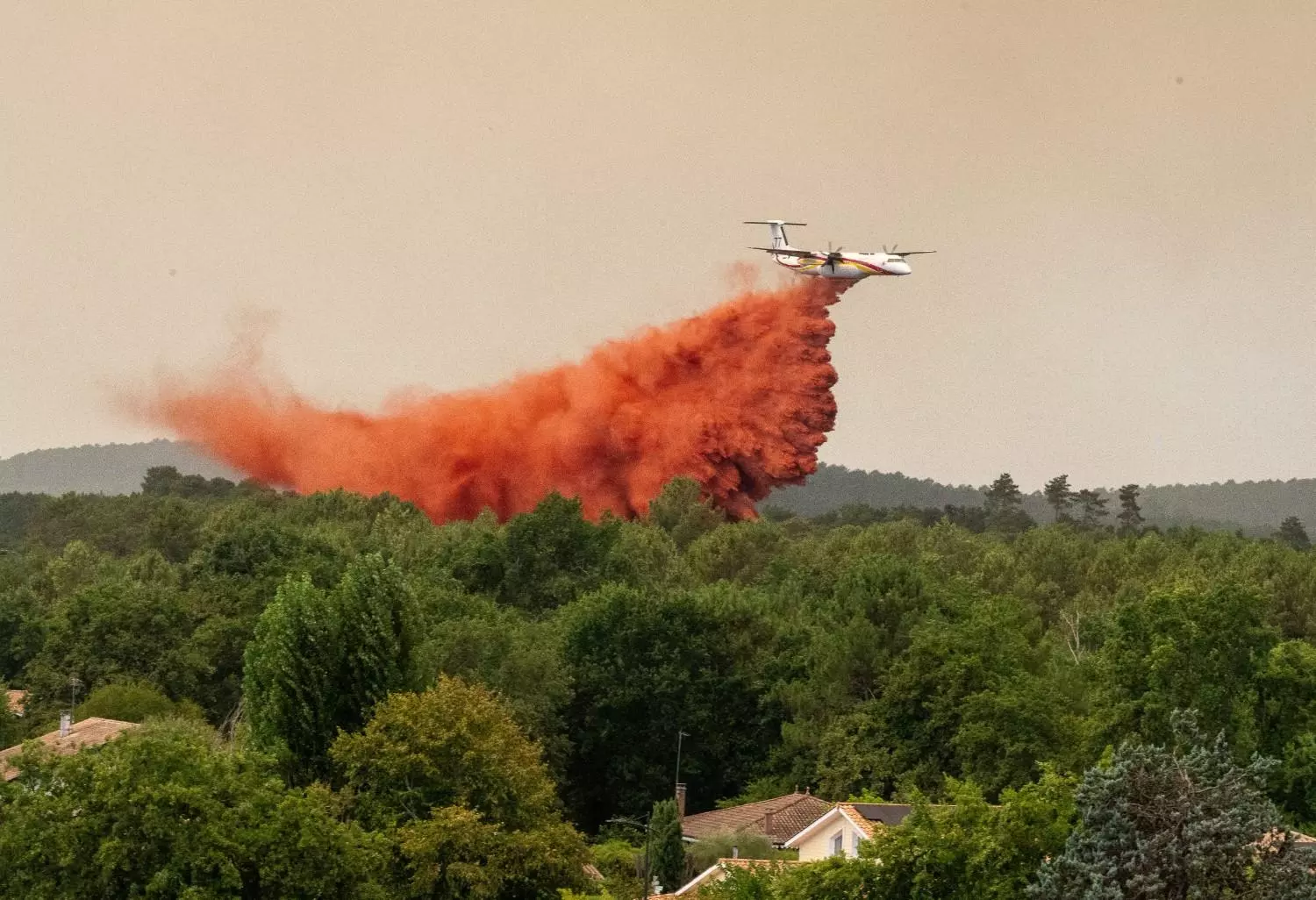
An aircraft drops water while fighting wildfires in the Lège-Cap-Ferret region in western France on July 23, 2026. Photo: AP/PTI
Unprecedented wildfire crisis displaces over 3,00,000 in France, Spain
Armed with military jets, emergency alerts, and continental aid, authorities battle unprecedented firestorms that have disrupted the Tour de France and forced mass evacuations

More than 3,00,000 people have been displaced across France and Spain this week as climate-change-driven wildfires tear through swathes of southern Europe, compelling authorities to carry out mass evacuations, a military response, and even curtail one of the world's biggest bicycle race events, the Tour de France. Of the total displaced, more than 2,20,000 are in France.
Fresh evacuation orders were given as temperatures are forecast to climb further this week, particularly in the worst-hit regions. Fires are burning in several parts of the continent simultaneously, but the epicentres of the crisis are the Gironde region near Bordeaux in southwestern France, and two blazes west of Madrid in neighbouring Spain.
Also read: Support for Spain in FIFA World Cup final transcended football, thanks to PM Pedro Sanchez
Around 7,000 people are currently sheltering in Bordeaux alone — France's largest evacuation since the Second World War — while roughly 70,000 have been evacuated in central Spain.
One dead in Spain
One fatality was also confirmed in Spain, where one man died in Manises, in the Valencia region, according to the local civic officials. It was reported to be the first death in the blazes.
In a striking escalation to counter the deadly fires, France sent a giant A400M military transport aircraft — specially converted for firefighting — to dump tons of flame retardant over drought-stricken woodland in the country's southwest. The aircraft joined at least 18 other water- and retardant-dropping aircraft and helicopters rotating through smoke-filled skies over Gironde, French Interior Minister Laurent Nunez said, AP reported.
Nunez added the fire was about 30 kilometres west of Bordeaux city and lost some of its intensity overnight. Local authorities of the Gironde region, which includes the urban centre, said the blaze transformed into “a firestorm" after igniting earlier this week and causing fires that French Prime Minister Sébastien Lecornu called "unprecedented".
With winds expected to shift and potentially push flames closer to Bordeaux, crews resorted to digging trenches and laying retardant lines, bracing for what Nunez called a "long and very difficult" battle.
France mobilises military to fight fire
Besides deploying airpower, the French government has mobilised 1,500 troops to reinforce firefighting crews and rushed 1.5 million face masks to the region to protect residents from choking smoke.
Evacuation orders were pushed directly to mobile phones via emergency alerts, Gironde Prefect Sophie Brocas said, adding that around 140 homes have already been destroyed. Bordeaux's airport remains operational, though its bus and tram services have been suspended, and the city says it could shelter as many as 10,000 evacuees if needed.
Also read: Spain win second FIFA World Cup: How La Roja built a gold-digging football system
French President Emmanuel Macron on Saturday vowed in a post on X that the country would rebuild. "We will rebuild, we will repair and we will be there for as long as is needed," he wrote.
Tour de France affected
The scale of the emergency even reshaped the Tour de France. Organisers and Paris police announced a shortened final, 21st stage of the event, cutting the planned Sunday (July 26) route from 133 kilometres to 89 kilometres and relocating the start into Paris itself, rather than the originally planned Thoiry, located west of Paris.
Security personnel freed up by the change are being asked to reinforce firefighting efforts in the affected areas.
Spain runs against time to fight fires
Spain has deployed 2,600 firefighters, police, and emergency personnel, backed by 19 water-dropping aircraft and helicopters, to contain two fires burning west of Madrid that authorities are trying to prevent from merging into one.
Firefighters say the fires have spread with a speed and violence that made direct confrontation impossible in places.
In El Tiemblo, west of capital Madrid, a resident named Javier Organista described flames encircling the town with almost no escape route, forcing neighbours to band together to try and halt the fire's advance. "We've never seen anything like this," he said, calling the experience "just really sad," the AP report added.
Spanish Prime Minister Pedro Sánchez on Saturday said 130,000 hectares of forest have already burned in Spain this year, well above the decade's annual average of 100,000 hectares.
Difficult hours ahead: Spain PM
The PM, who expressed optimism that favourable weather on Saturday offered “a window of opportunity” for fire crews to bring the dangerous blazes under control, remarked on Sunday that "difficult hours lie ahead", The Guardian reported. He was in Avila province in central-western Spain, one of the country's worst affected areas.
Also read: India among global hotspots for climate-related sleep loss, highest in TN: Report
Spain’s King Felipe and Queen Letizia were likely to meet those displaced by the natural disaster at La Chopera sports centre in Villamanta, a municipality in Madrid, on Sunday, The Guardian added.
Climate change threat, international response
The wildfires in two of Europe's biggest nations, which have been fuelled by high temperatures and the long-term effects of climate change, caught fire crews and governments off guard.
In Europe, which is witnessing an alarming rate of warming in recent times, a trend directly linked to the early and intense heatwaves that have turned forests and scrubland into tinderboxes this year, according to official sources.
Temperatures across France and Spain remained steady on Sunday, with local weather experts forecasting a surge up to 42-degree Celsius next week — offering little relief, CNN reported.
Meanwhile, several European nations — including Italy, Greece, the Netherlands, Portugal, Croatia, the Czech Republic, Sweden, Slovakia, Germany, and Switzerland — have sent or are preparing to send water-dumping aircraft and personnel to help France and Spain's firefighting efforts, underscoring how quickly a national emergency has become a continent-wide alert.
(With agency inputs)