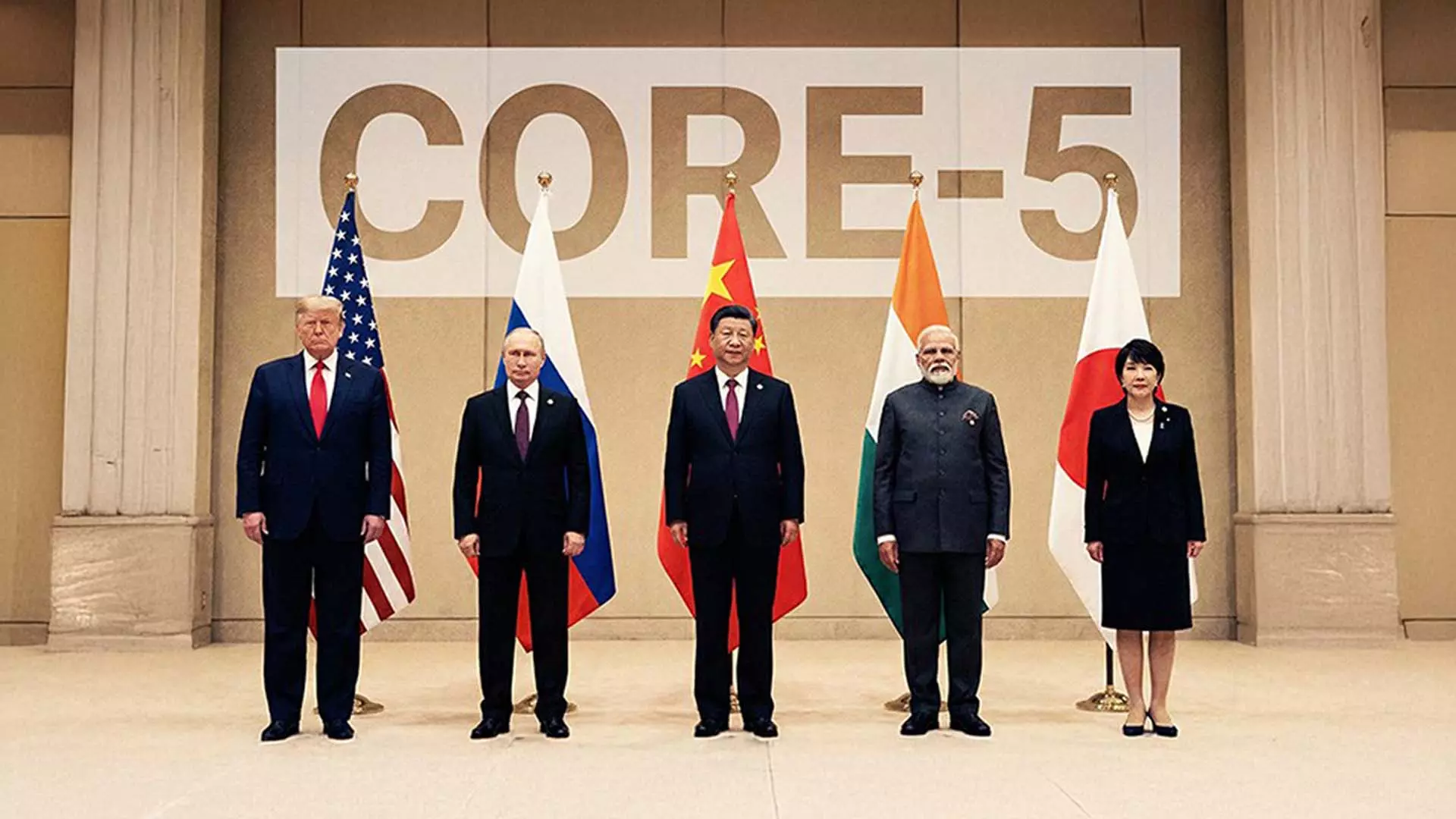
India’s reported inclusion in C5 has also raised eyebrows. File photo
Wordly Wise | Trump to woo India with 'Core 5' membership?
A proposed 'Core 5' group, the US, China, Russia, Japan and India, may rival G7, but its existence is unconfirmed and its logic questioned. What’s driving the talk?

The talk of a new global group called Core 5 or C5 has generated discussion internationally, as the world watches shifting alliances under Donald Trump’s US leadership.
According to reports drawn from an extended version of a US national security strategy paper, C5 may comprise the United States, China, Russia, Japan and India, potentially positioning it as a rival to the powerful Group of Seven (G7).
While the White House has denied that such a proposal exists, speculation has persisted because the original draft of the US strategy paper reportedly contained the C5 concept. The version released to the media omitted any reference to Core 5, but the US media has cited unnamed sources asserting its presence in the longer document.
Trump and geopolitical logic
Observers see the C5 idea as fitting a particular strategic mindset associated with the Trump administration, particularly, its apparent shift away from traditional alliances. The absence of the European Union historically aligned with the US would reflect Trump’s broader scepticism toward European partners.
This detachment has been visible in recent diplomatic efforts, including negotiations linked to the Russia–Ukraine conflict. The administration has at times positioned Vladimir Putin’s demands as part of peace proposals, a stance that has puzzled Ukraine and its European partners.
Roping in rival powers
Roping in Russia and China alongside the United States in a single grouping would be unusual,. given the longstanding global rivalry among these powers. Trump’s relationship with Putin has been a subject of repeated attention, and China remains the US establishment’s principal strategic rival, even as punitive tariffs have been applied.
Also read: Trump postpones G7 summit, wants India, others to join group
Yet, reports suggest the C5 concept would bring all three together in a formalised constellation, raising questions about the underlying logic of such an alignment.
Unexpected inclusion
India’s reported inclusion in C5 has also raised eyebrows. Recent tensions between New Delhi and Washington had led some to believe India’s position might be sidelined. However, the transcript notes that New Delhi’s ongoing ties with Russia highlighted by Narendra Modi’s engagement with Putin do not appear to have deterred the C5 speculation.
Also read: With Putin visit, India walks tightrope between Russia-US as China watches
Media reports suggest that Trump’s consideration of India for C5 could be linked to its status as the world’s largest democracy with a massive population, but the logic remains unclear given that the grouping is framed as an alternative to the G7 in terms of development and military power.
Economic incentives
Another explanation offered in the discussion is that India’s large market might attract US interest, especially in the context of trade negotiations. Reports quoting US officials indicate that India has offered the Trump administration favourable terms in the ongoing trade talks.
If C5 gains traction in policy circles, such positioning could potentially make Indian negotiators more amenable to a deal.
This dynamic suggests that while any benefits for India may be incidental, the concept of C5 could serve multiple strategic and economic ends for the US.
Competitive blocs
The C5 speculation arrives at a moment when global power structures are in flux. If a C5 grouping were to emerge alongside the existing G7, it could signal a shift toward multiple competing multilateral arrangements, each reflecting different strategic priorities and partnerships.
Yet, without formal confirmation from the White House or participating governments, C5 remains in the realm of media speculation drawn from draft policy documents and unnamed sources.
Broader implications
Regional reactions to the C5 talk vary across regions.
Also read: 'Putin–Modi summit won't go down well with Trump and US'
Europe, excluded from the proposed grouping, has faced marginalisation in some high-level negotiations, including those related to the Ukraine conflict. For countries like India and Japan, inclusion in C5, if real, would represent engagement with powers that have historically been both partners and rivals of the US.
The grouping’s potential emergence also raises questions about the future of global governance and how power-sharing arrangements may evolve in the coming years.
Strategic recalibration
At its core, the C5 discussion reflects a recalibration of strategic priorities under the current US administration. By foregrounding emerging powers and longstanding rivals alike, the idea challenges conventional alliance frameworks.
Whether this concept moves beyond speculation will depend on future policy announcements and diplomatic signals from the countries involved.
For now, the world watches as conversations continue around a grouping that could reshape geopolitical alignments if indeed it ever gains formal recognition.
The content above has been transcribed from video using a fine-tuned AI model. To ensure accuracy, quality, and editorial integrity, we employ a Human-In-The-Loop (HITL) process. While AI assists in creating the initial draft, our experienced editorial team carefully reviews, edits, and refines the content before publication. At The Federal, we combine the efficiency of AI with the expertise of human editors to deliver reliable and insightful journalism.