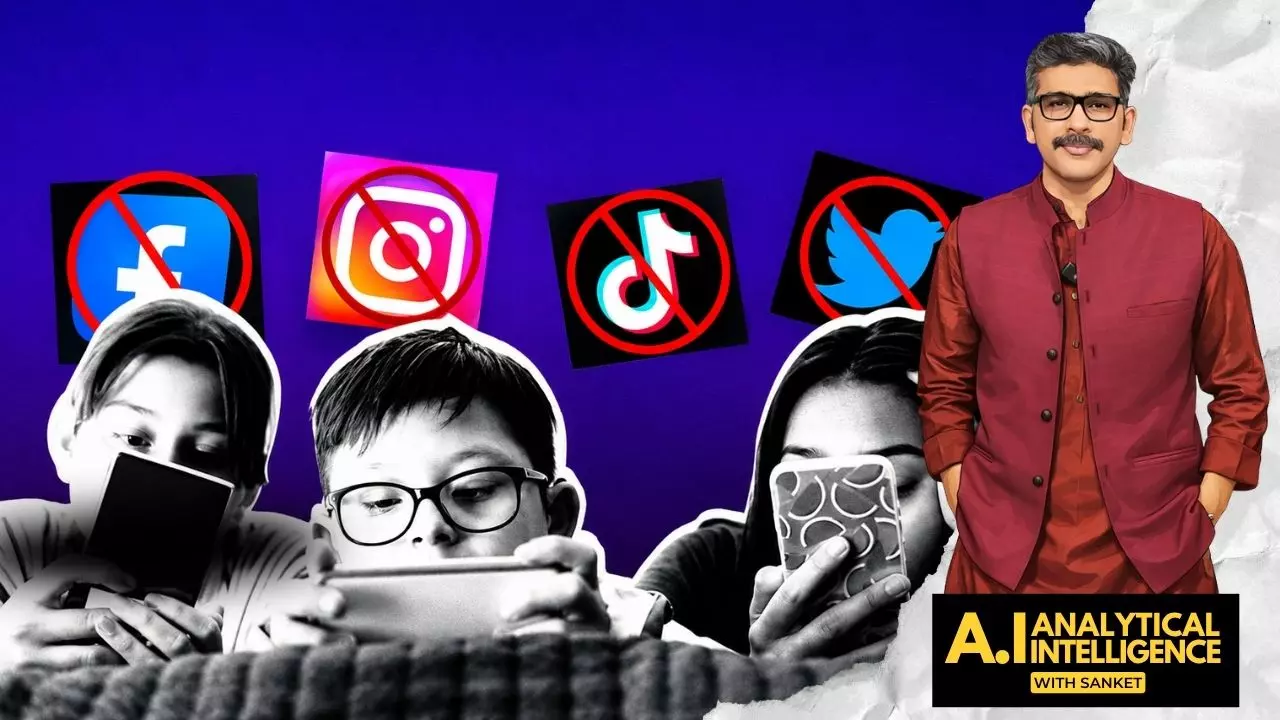
Ban social media for children? Experts split on the answer
While concerns over addiction, anxiety and cyber harms are widely acknowledged, experts remain sharply divided on whether India should impose an outright ban on social media for children.

The debate over children's access to social media has reached a critical point as several countries move towards restricting or banning social media use among minors. While concerns around mental health, addiction and online safety are increasingly difficult to ignore, experts remain divided on whether an outright ban is the right answer.
Speaking to The Federal, psychiatrist Dr Sameer Parikh argued that children's well-being must take precedence over all other considerations, warning that delays in addressing the issue could expose generations of young people to avoidable harm. The discussion, hosted by Sanket Upadhyay, also featured MediaNama founder and editor Nikhil Pahwa and cyber law expert Khushbu Jain.
Mental health concerns
Dr Parikh said there is little room left for debate on whether excessive social media exposure affects children and teenagers. According to him, concerns range from attention deficits and neurocognitive impacts to self-esteem issues, body image concerns, cyberbullying and the influence social media can have on developing worldviews.
"The impact of digital social media engagement in children and teenagers is a cause of concern. There are no two ways about it," he said.
Drawing parallels with age restrictions imposed on activities such as driving and alcohol consumption, Dr Parikh argued that society routinely accepts safeguards when individuals are not yet equipped to handle risks independently.
He stressed that children today are navigating a digital environment without the skills needed to manage its challenges. Parents and educators, he said, are also struggling to keep pace with technological changes that have emerged over the past two decades.
Ban or reform
Nikhil Pahwa agreed that the harms associated with social media are real but questioned whether banning platforms would solve the problem.
He pointed to research suggesting that constant exposure to dopamine-driven content, endless scrolling and rapidly changing visual stimuli can affect children's concentration and cognitive development. However, he argued that these harmful experiences are features designed into platforms and can therefore be redesigned.
According to Pahwa, banning mainstream platforms may simply push children towards less regulated and potentially more dangerous alternatives.
"A ban will only move things to the extreme," he said, adding that children are likely to migrate to platforms that are outside regulatory oversight.
He argued that platforms should be required to strengthen safety mechanisms, improve age-appropriate design and implement stronger parental controls rather than face blanket prohibitions.
Pahwa also highlighted the educational value of certain digital platforms, noting that services such as YouTube can serve as powerful learning tools for children when used responsibly.
India's legal position
Khushbu Jain noted that India currently has no law that specifically bans or regulates children's access to social media.
While discussions have taken place at various political levels and some legislative proposals have been floated, no nationwide framework has yet been adopted.
Jain pointed to the Digital Personal Data Protection Act (DPDP Act), which is expected to come into force in 2027, as one of the few legal developments that could affect how children are treated online.
She explained that the law seeks to address certain forms of behavioural targeting and data processing involving children and could impose significant penalties on entities found violating the provisions.
Despite the absence of a dedicated social media ban, Jain said policymakers, legal experts and lawmakers are increasingly discussing the risks posed by digital platforms to young users.
Gradual exposure
A major point of disagreement during the discussion centred on whether children should be gradually introduced to social media or kept away entirely until a certain age.
Pahwa argued that childhood development is gradual and that digital access should reflect that reality.
"A 16-year-old is not a 13-year-old, a 13-year-old is not an eight-year-old," he said, advocating a graded framework that gives parents greater control over how children access online services.
He also rejected comparisons between social media and substances such as alcohol or tobacco, arguing that social interaction is fundamentally different from products that are inherently harmful.
According to Pahwa, digital literacy should become part of school curricula so that children learn to identify online risks before gaining broader access to social media platforms.
He cited examples of online communities that have provided support, anonymity and social connection, including safe spaces for vulnerable groups who may struggle to express themselves in traditional environments.
The influencer problem
Jain highlighted another growing concern: the rise of the child influencer economy.
She argued that many parents now expose children online in pursuit of engagement, visibility and income without fully understanding the long-term consequences.
According to Jain, children are increasingly appearing in content that remains permanently accessible online, potentially affecting future educational, professional and personal opportunities.
She referred to cases where individuals continued facing consequences years after past incidents remained searchable online, warning that children may face even greater challenges because they often have no say in what is shared about them.
Jain suggested India could explore mechanisms that allow individuals, upon reaching adulthood, to seek deletion of content uploaded about them during childhood.
She described this as one of the "invisible harms" of social media, arguing that parents, teachers and even children frequently fail to recognise the long-term implications of permanent digital footprints.
Parents and platforms
The discussion also examined the extent to which responsibility should fall on parents versus technology companies.
Pahwa argued that many parents, schools and institutions themselves contribute to privacy violations by publicly sharing children's photographs and information online.
Also Read: Are students paying the price of India's broken exam system?
He recounted withdrawing consent from a preschool application that used facial recognition technology to manage photographs of children.
At the same time, he maintained that parental responsibility cannot be completely outsourced to platforms or governments.
According to him, regulators should focus on restricting behavioural targeting, strengthening privacy protections and improving platform design rather than pursuing an immediate ban.
He also warned that technological solutions such as facial recognition-based age verification are themselves imperfect and vulnerable to circumvention.
No easy answers
By the end of the discussion, all three panellists agreed on one point: social media can cause significant harm to children.
Where they differed was on the remedy.
Jain argued that the evidence of harm is already strong enough to justify restrictions similar to those adopted elsewhere. Dr Parikh called for urgent action focused on protecting children's wellbeing. Pahwa, meanwhile, warned that bans could create new risks while failing to address underlying problems.
As India continues debating the issue, the discussion highlighted the complexity of balancing children's safety, parental rights, digital literacy, technological realities and individual freedoms in an increasingly connected world.
The content above has been transcribed from video using a fine-tuned AI model. To ensure accuracy, quality, and editorial integrity, we employ a Human-In-The-Loop (HITL) process. While AI assists in creating the initial draft, our experienced editorial team carefully reviews, edits, and refines the content before publication. At The Federal, we combine the efficiency of AI with the expertise of human editors to deliver reliable and insightful journalism.