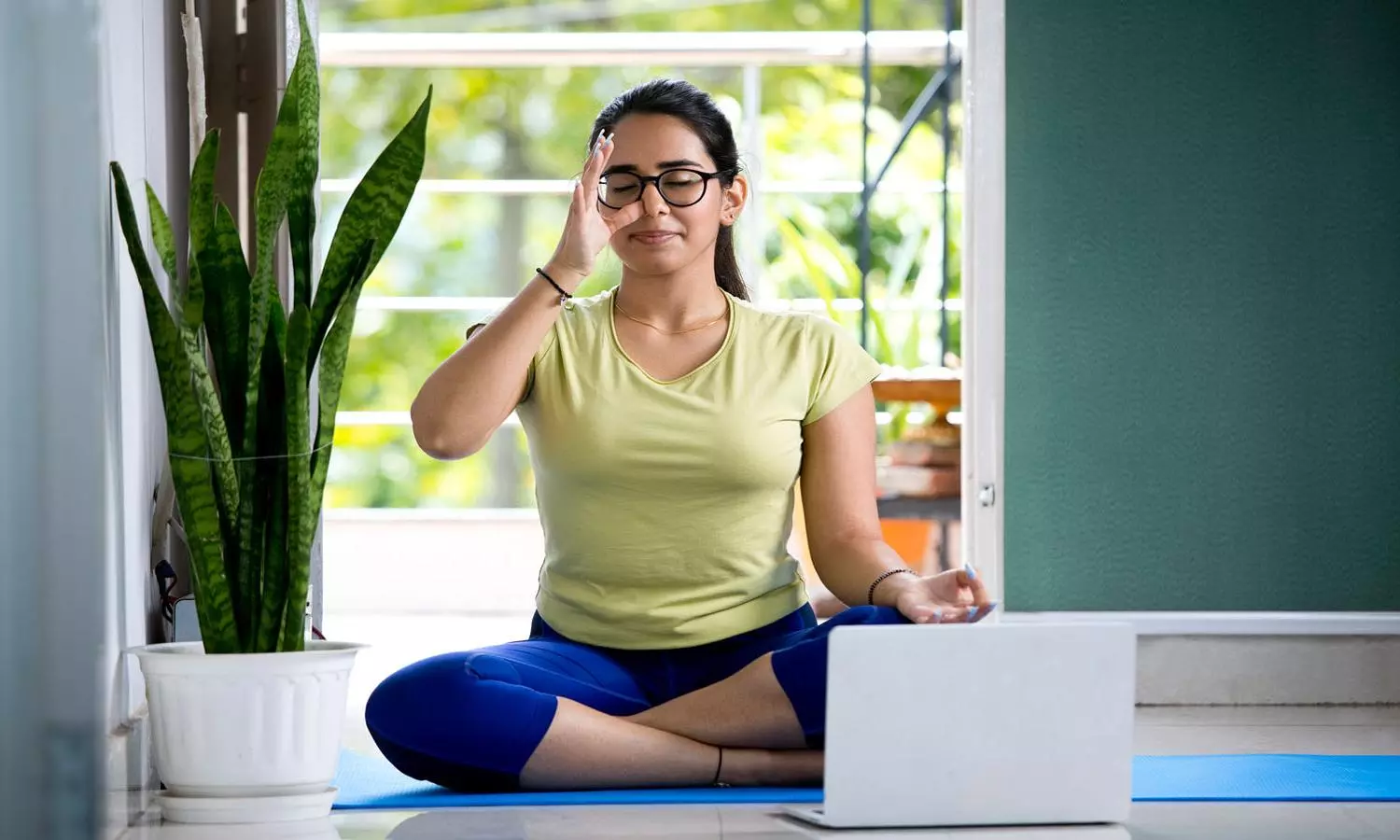
Is online yoga worth the hype or is it just more screen time?
Digital classes are catching on in a big way, but is trading the studio for a screen actually effective for your health and practice? Experts weigh in

Yoga is meant to be a personal, inward journey to achieve mind and body balance, yet the modern studio turned this ancient practice into a shared physical and upbeat community activity. In the digital era, yoga has undergone another significant transformation.
High-definition streams and living room spaces have made it possible for people running to beat the clock everyday, to completely bypass the brick-and-mortar space altogether. Why set aside time and lug your yoga mats to the nearest fitness centre? Instead, there are options today for enthusiasts to just switch on a digital screen in the comfort of their homes, and at a time suitable to them, to hit the yoga mats.
Online yoga classes today are offering a combination of asanas, surya namaskaras, breathing exercises and even end with one of the most deeply relaxing practices in yoga, the yoga nidra (yogic sleep).
Advantages of online yoga
The advantages of online yoga are rooted in accessibility and personal autonomy. By removing the time-consuming commute and allowing practitioners to access world-class instructors regardless of geography, digital platforms are offering unparalleled flexibility for those with busy schedules.
Take the case of Kamini Bobde, a yoga teacher, who follows the Bihar School of Yoga. She has been teaching yoga for more than a decade, and juggling her class timings travelling between her homes in Delhi, Bengaluru and Chennai. Three years back, she decided to go online.
Also read: How Saurabh Bothra built a yoga startup ecosystem around a 5-minute mantra
“My clients too were requesting me for online classes since they had health issues. It’s now so convenient that I can take the class from anywhere. I save on commute and I can take more classes,” she told The Federal, adding it is time people accept online yoga.
The convenience
Chennai resident Rukmini Amirapu, writer and editor, and a yoga enthusiast says that the barrier to entry for the ancient practice has never been lower.
“One should not look down on online yoga. It is so convenient and it’s just another way to motivate people to practise yoga. A friend has moved her group yoga sessions from home to a neighbourhood park, preferring an outdoor space. One should do what suits them,” she told The Federal. Amirapu, who also admits that nothing can beat a one-on-one yoga session, (which can be an expensive proposition, she admits), has been recently logging onto yoga trainer Saurabh Bothra’s online classes.
She loves it because of the many class timings they offer in a day. “It is so convenient for me. I like Bothra’s classes for he has two versions going on simultaneously on the screen. While one person in the back is doing the advanced version, Bothra does the simpler one, to encourage those who cannot do it. It’s a positive and inclusive approach,” pointed out Amirapu.
Also read: Hatha to Vinyasa to Iyengar, a guide to finding your ideal yoga practice
Bothra, however, does not believe there is a boom in online yoga. “It feels like it has caught on in a big way but look, India’s population is 150 crore, and it is nothing comparable to 5 crore people concurrently watching IPL. Yoga is nowhere close, I would say just 10 per cent are logged onto online yoga today,” he said in an interview with The Federal.
Lack of supervision
Despite all the buzz around online yoga, transitioning from a studio environment to a home setup requires users to examine whether the digital format can truly be safe and fulfilling. Though many beginners may feel practising from the privacy of a home environment can be beneficial, intimidated by the scrutiny of a shared studio space, conversely, the lack of real-time, physical supervision can be a drawback.
In a traditional setting, a qualified instructor provides tactile cues that are essential for correcting posture and preventing long-term injury. When practising online, that safety net is replaced by verbal instructions, which can sometimes be difficult to interpret, especially for those who are new to the discipline.
Bobde says that initially she doubted if she could pass on the subtler aspects of yoga to her clients. “But I realised I could even do the yoga nidra with them, which involves strong visualisation lulling them into a complete state of relaxation. Or, take pranayama or breath regulation, I am also able to convey the subtle points in these exercises as well,” said the yoga instructor, who feels that people should accept online yoga as it has come to stay.
Key phrase: Never push
However, her advice to online yoga users is not to push your body. “Stop if you have any unpleasant feeling, don’t push your body. I make my clients give a thumbs down to signal any unpleasantness. They have to adjust their camera suitably even as I keep correcting them. I have known people who have got into major trouble with their backs attempting Dhanurasans (bend like a bow) while doing classes elsewhere,” she said. Bobde restricts the number of people she takes online and watches each one of her students carefully.
Replying to this question of lack of physical supervision, Bothra says his classes involve simple basic movements that can be done without supervision. “Lifting up your hands or moving your legs up and down does not require supervision, our exercises are as simple as that. They are not hard that it requires posture correction,” he explains.
"And, if people want to go deeper into the practice, we recommend them to go to an offline class. We are just trying to add value to people’s lives, if they feel they are getting something out of it, they will retain," he added.
Checklist
Ultimately, the effectiveness of online yoga depends on the user's ability to create a focussed, safe environment in their own home. To ensure you are choosing a path that keeps you safe and supported, consider the following checklist before you hit subscribe.
1) Define your health goals, such as flexibility, stress relief, or strength, to ensure you select the appropriate style of practice.
2) Verify the instructor’s credentials, focusing on their training in anatomy and safe sequencing rather than just social media popularity.
3) Sample free introductory classes to assess the teacher’s communication style, audio clarity, and pacing.
4) Decide between live interactive classes, which offer better feedback, or on-demand libraries for greater schedule flexibility.
5) Read detailed user reviews to confirm that the platform emphasizes safety modifications and technical reliability.
6) Prepare your physical space to ensure you have adequate room and a stable, high-quality internet connection.
7) Prioritise foundational or alignment-focused classes if you are a beginner or managing a physical injury.
Asanas we should not try online
Yoga instructor Preeti Ganeriwal says the following asanas should never be attempted by an online learner:
• Sirsasana (Headstand)
•. Sarvangasana (Shoulder Stand)
• Ustrasana (Camel Pose)
•. Eka Pada Rajakapotasana (Pigeon Pose)
• Mayurasana (Forearm Stand) or Handstands
Online yoga acts as a powerful tool for modern self-care, provided it is approached with discipline and a discerning eye.
By carefully evaluating your needs and verifying the quality of the instruction, you can successfully integrate a digital practice into your routine that is both sustainable and transformative.