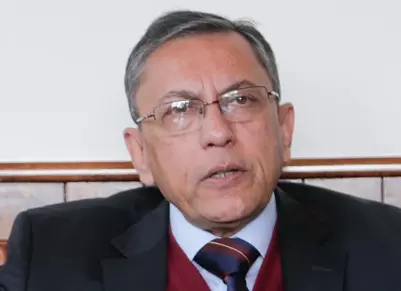
In this excerpt from Shared Bonds, Strategic Interests: India-Nepal Relations in a Strategic World, Ranjit Rae writes how the months ahead in Nepal hinge on restoring order and delivering elections by March 2026

The most significant rupture in recent memory is the Gen Z uprising of 8-9 September 2025 — in Nepal, it is being referred to as a revolution— that overthrew the K. P. Sharma Oli-led coalition government and unleashed death and destruction in Nepal. Virtually all institutional structures of democratic governance, from Parliament, the Singha Durbar (the Rana-era seat of government), Sheetal Niwas (the presidential palace), the Supreme Court to critical documents and archives were gutted.
Newspaper offices of Kantipur and Annapurna Post, two major dailies, as well as Hilton Hotel and a chain of supermarkets were burnt down. The arson extended to other towns of Nepal, including in the Terai. Apart from state property, homes of leaders were burnt down, some leaders were severely assaulted physically, the Rashtriya Swatantra Party (RSP) chief was forcibly freed from jail — in the process, some 13,000 criminals were also released (at the time of writing, more than half the prisoners have been recaptured or have voluntarily returned to jail) — and stacks of currency, foreign and Nepali, were found in the ashes and debris of burnt-out residences.
Though the trigger for the uprising was the ban on several social media apps, including YouTube, WhatsApp, Instagram and Messenger, used by the vast majority of Nepalese in their lives and for their livelihoods, public discontent as mentioned earlier had been brewing and seething for a considerable period of time. The young generation was also angered by the luxurious lives of Nepo kids’, those children of political leaders and power brokers who constantly lived the high life on social media such as Instagram and TikTok, while ordinary people struggled to meet their daily needs. Gen Z youngsters used some of the social media apps that had not been banned, such as Viber and TikTok, as a tool for social mobilisation for protests on 8 September 2025.
Role of a foreign hand?
The protests were largely home grown. There has, however, been speculation in Nepal, as well as India, about a foreign hand in the protests, though no significant evidence has been presented. PM Oli and a former Deputy PM Bam Dev Gautam, both communist leaders, have made the ludicrous claim that India was behind the protests since Oli had raised the question of the disputed boundary in the Kalapani-Lipulekh region with China. Some have referred to a US hand since some of the NGOs involved may have received funding from Western sources. The fact of the matter is that most NGOs in Nepal receive funds from Western and Chinese sources. Many are linked to Oli's party, the CPN (UML).
Allegations have also been raised about the Barbara Adams Foundation, named after a naturalised Nepali citizen of US origin who spent almost her entire life in Nepal and bequeathed her property to the foundation. Other than undertaking small development projects, the foundation also provides annual cash awards to journalists who expose corruption in high places. It is alleged that the foundation supported an NGO, Hami Nepal led by Sudan Gurung, which was instrumental in mobilising the youth for the protests. The reality is that the foundation, a Nepali NGO, is led by eminent and greatly respected individuals from Nepal and raises resources domestically for its activities. Also, other than providing some facility to Hami Gurung to store COVID-related material during the pandemic for a few months, it is not clear that there was an organic relationship between the two. Until the matter is investigated and/ or more evidence is forthcoming, it is difficult to conclude that there was a foreign hand directing the protests.
Also read: How India’s linguistic federalism shaped the conflict over a national language
The external influence that did exist related to the impact of similar events in Sri Lanka, Bangladesh, Indonesia and elsewhere. Events in these countries demonstrated that the youth have the agency to bring about significant political change. Some of the youngsters in Gen Z carried a flag similar to the one carried by protesters in Indonesia? The use of the Discord social media platform was inspired by the youth protests in Hong Kong. Further a large Nepali diaspora influences public opinion within the home country and in a sense brings the world to Nepal’s doorstep. It remains to be seen however, whether sustainable political change will be brought about by the Gen Z protests.
Gen Z distances from mayhem
That trouble was brewing in Nepal was evident when several months ago this author visited the country after the Bangladesh uprising, a question often asked by several journalists and others was whether a similar situation could arise in Nepal. Of course, Nepali political leaders in power were in a state of denial.
To begin with, the protests were peaceful with youngsters marching and singing on the streets in a folksy atmosphere. It is only after the mishandling of the protests by security forces that resulted in the killing of nineteen youth in the evening of September 8 that a spasm of rage and fury engulfed the nation the following day, when widespread arson, destruction and looting took place. It was only several hours after the mayhem had begun that Oli, after sustained pressure from the security forces, resigned.
The Army took charge and brought a semblance of calm, thereby preparing the way for the appointment of an interim government led by former Chief Justice Sushila Karki. In response to criticism that the Army should have acted earlier to prevent the arson and looting on 9 September, the Army chief has reportedly stated that he wanted to prevent bloodshed on the streets. Gen Z has also distanced itself from the mayhem and looting of 9 September, raising questions about people that infiltrated the movement and took advantage of the situation.
Also read: The Eleventh Hour review: Rushdie returns to peak form with tales of decline and death
The other significant fact is that there was considerable delay between the resignation of Oli on September 9 and the formation of the Sushila Karki government on the evening of September 12. The intervening period, extremely sensitive, was used by the Army for consultations with Gen Z and, somewhat inexplicably, some controversial royalists and the RSP; it was used by the president for consultations with political parties; and the Gen Z themselves, through the social media app Discord, were engaged in the process of selecting their nominee for PM.
There were rumours that the president was under pressure to resign and refused to do so. He, together with Parliament, remained the only tangible link to the 2015 Constitution. The president also did not want Parliament to be dissolved; he wanted the new cabinet to include persons with high integrity from political parties to ensure wider political ownership of the new political processes being adopted.
Questions that remain unanswered
This was not acceptable to Karki, the influential mayor of Kathmandu, Balendra Shah, and elements of Gen Z. Meanwhile, a lot of rumours floated around in Kathmandu that martial law would be declared, resulting in a takeover by the Army and / or reinstallation of the king. A former PM Madhav Nepal has suggested that the king conveyed that he would assume office only if endorsed by the political parties. It has also been suggested that the Nepalese Army was in touch with their Indian and, possibly, US counterparts. It is impossible to confirm the veracity of these rumours; eventually however, Nepal did find a way out of the political impasse without jettisoning the Constitution.
Even though Justice Karki’s appointment is not in conformity with the Constitution, which explicitly forbids a Chief Justice and a non-member of the lower house of Parliament from being appointed prime minister, it has been rationalised on the basis of the ‘doctrine of necessity’ and is perhaps the best possible outcome in a difficult situation. This situation is not entirely unknown in Nepal since in 2013, a sitting Chief Justice had been appointed, with the consent of political parties, to organise elections to the Constituent Assembly.
Further, the person of Justice Karki represents a widely respected jurist and democrat with high integrity who has worked in accordance with the law and the Constitution over her entire career. She also has the backing of Balendra Shah, who was a favoured nominee of Gen Z members. Hours after the new government assumed office, Parliament was dissolved by the president on the advice of the Karki government, much against the wishes of the political parties. Karki has announced that her principal task was to organise elections for a new parliament within six months, i.e. by 5 March 2026. She has put together a group of well-known non-political personalities of Nepal in a small cabinet.
At the same time, investigations have been launched into corruption allegations of top-level political leaders, including Sher Bahadur Deuba, Oli and Prachanda. Passports of former Oli and former Home Minister Lekhak have been impounded pending an inquiry into the killings of unarmed protestors on September 8. In the aftermath of the uprising there remain several unanswered questions. How were leaders whose homes were torched identified and by whom? How was the location of their homes in different parts of Kathmandu identified by mobs? How is it that only homes of leaders of the main political parties were targeted, whereas leaders of some of the smaller parties such as the RSP and the royalist Rashtriya Prajatantra Party (RPP) remained unaffected. How could arson be organised on such a large scale without detailed prior planning and preparation? In due course and after government enquiries, the situation may become clearer. For the time being though, these questions remain.
(Excerpted from Shared Bonds, Strategic Interests: India-Nepal Relations in a Strategic World, edited by Ranjit Rae, with permission from Simon & Schuster India)