How a Tamil folk performer is taking the art form beyond epics, highlighting climate change, health
A folk art form from the villages of North Tamil Nadu, Kattaikkuttu is traditionally performed all night on open-air stages, as audiences gather to watch episodes from the epic Mahabharata unfold through music, dance and dialogue. But National Award-winning Kattaikkuttu artist P Thilagavathy is using the centuries-old folk theatre form to confront issues such as climate change, gender equality, menstrual hygiene and sexual abuse.

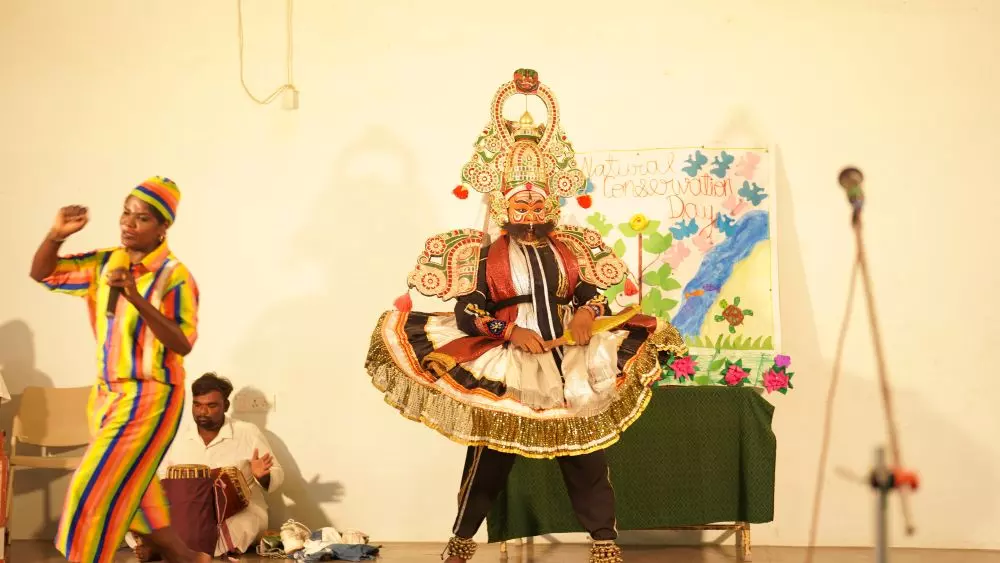
Thilagavathy (left) in a performance on conserving nature. Photo: By special arrangement
The drum beats start around 10 pm, drawing nearly 18 performers to the village square. Dressed in elaborate costumes, their faces painted in vibrant colours, they prepare for a Kattaikkuttu performance that will continue until dawn. A folk art form from the villages of northern Tamil Nadu, Kattaikkuttu is traditionally performed all night on open-air stages, as audiences gather to watch episodes from the epic Mahabharata unfold through music, dance and dialogue. By sunrise, an entire chapter of the epic has come alive.
But for National Award-winning Kattaikkuttu artist P Thilagavathy, 36, the stage is no longer reserved only for mythological battles. With her, the centuries-old Tamil folk theatre form is confronting real-time problems such as climate change, gender equality in the workplace, menstrual hygiene and sexual abuse.
Her own journey has been as remarkable as that of the stories she performs. Kattaikkuttu has historically been an all-male art form. Women rarely appeared on stage, largely because of deep-rooted social prejudices against female performers, she explains. “I became the first woman Kattaikkuttu artist to receive a National Award,” says Thilagavathy, crediting her guru, P. Rajagopal, for encouraging women to enter the field.
Named after wooden ornaments
The folk performing art form derives its name from the accessories worn by the artistes; made of ‘kattai’, Tamil for wood, the performance came to be known as Kattaikkuttu.
For every piece that she performs, Thilagavathy puts in meticulous research into the subject matter, meeting domain experts, before penning the scripts that blend data and engaging story-telling. Dialogues, songs, comedy scenes and emotional tear-jerkers are mixed in the right proportion, based on the subject. Costumes are also adapted to suit the subject.
Also read: How a centuries-old song is travelling from Golconda to Cannes and Toronto
A 45-minute performance on extreme heat and climate change, staged at her village, Ranipet, and across colleges and science forums in Chennai, saw her putting in six months of research work.
Sometimes, she brings in a character from the epics to suit the narrative.
An artiste from Thilagavathy's troupe dressed by as 'Agni Dev' during a performance on extreme heat. Photo: By special arrangement
In a recent performance on extreme heat stress, she introduced Agni, the Hindu deity of fire, as a central character whose impact is felt by children, pregnant women and elders in a village.
“People read about rising temperatures on social media or in newspapers,” she explains. “But when they experience it through an art form, the impact is much deeper. I weave real-life instances like the loss of green cover, water bodies and miscarriages owing to intense heat exposure into my scripts,” Thilagavathy told The Federal.
The Kattaikkuttu performer has also worked with organisations like the Chennai-based MS Swaminathan Research Foundation and Bengaluru’s Asar Social Impact Advisors Private Limited to communicate the impact of climate change through her and her troupe’s performances.
Not a ‘fading’ art
While Kattaikkuttu, as many other folk performing art forms, is often described as a fading tradition, for Thilagavathy nothing could be farther than the truth.
Temple festivals still see troupes in demand and during the Tamil month of Aadi, artistes travel almost every night from village to village, she says.
“Our calendar is packed. In recent years, apart from traditional performances as part of temple festivals in villages, we have been asked to perform at corporate events and various institutions. We are taking our performances [traditionally done in the open] indoors, to reach a wider audience,” says Thilagavathy.
Thilagavathy presents a show on the impact of extreme heat on pregnancies. Photo: By special arrangement
According to the performer, nearly 15 Kattaikkuttu companies in her hometown of Ranipet continue to perform throughout the year. Each troupe stages close to 200 performances annually during the festival season. “This is not a dying art,” she insists. “It is still a living ritual.” She points out that changing themes and audiences are also opening up new spaces for the traditional art form.
Her claims find validation from Pralayan Shanmugasundaram, a pioneer of the political street theatre movement in Tamil Nadu, who says that live performances offer an experience that today’s digital media cannot replicate.
“Digital videos, reels and films are consumed at people’s convenience. But a live performance, staged before an audience, creates a tangible experience in a specific place and time. It evokes emotions and the audience connects with it; that is the true measure of its success,” he says.
According to him, audiences absorb the message more deeply when they emotionally engage with a live performance. “Compared to reels, video clips or documentaries, live performances may have limitations. They may reach only about 100 people at a time, but they stay in the audience’s minds long after the performance ends,” he insists.
As a woman performer of Kattaikkuttu, the road, however, was anything but easy for Thilagavathy.
Relatives repeatedly pressured her family to arrange her marriage instead of allowing her to perform. Even her father worried that society would disrespect women working in traditional stage performances.
“I finally told him, ‘If you trust me, send me. Otherwise, don’t’,” she recalls. Eventually, her parents stood by her.
More than a decade ago, Thilagavathy made a conscious decision to take Kattaikkuttu beyond entertainment. Since then, she has created productions on drug abuse, gender equality, menstrual health, anaemia, leprosy and even Covid-19 awareness and vaccination. And of course, climate change.
At a performance by Thilagavathy’s troupe R Sumathi, a member of the audience watches the presentation with rapt attention. “I remember I used to play all day under the big banyan tree near my house. Our parents would have to drag us home for lunch. But now, I can’t send my son to play in the sun because of the extreme heat,” she says, as the show draws to an end.
When the drums beat again, Thilagavathy will return with another performance, another message wrapped engagingly in dance and drama.