Why this Onam, Keralam’s regional non-veg sadhya ‘additions’ deserve a mention
The image of an Onam sadhya, or feast, is almost universally associated with a magnificent vegetarian spread arranged on a banana leaf. Yet, in parts of northern Keralam, particularly Malabar, fish and meat often find a place alongside the traditional vegetarian preparations.

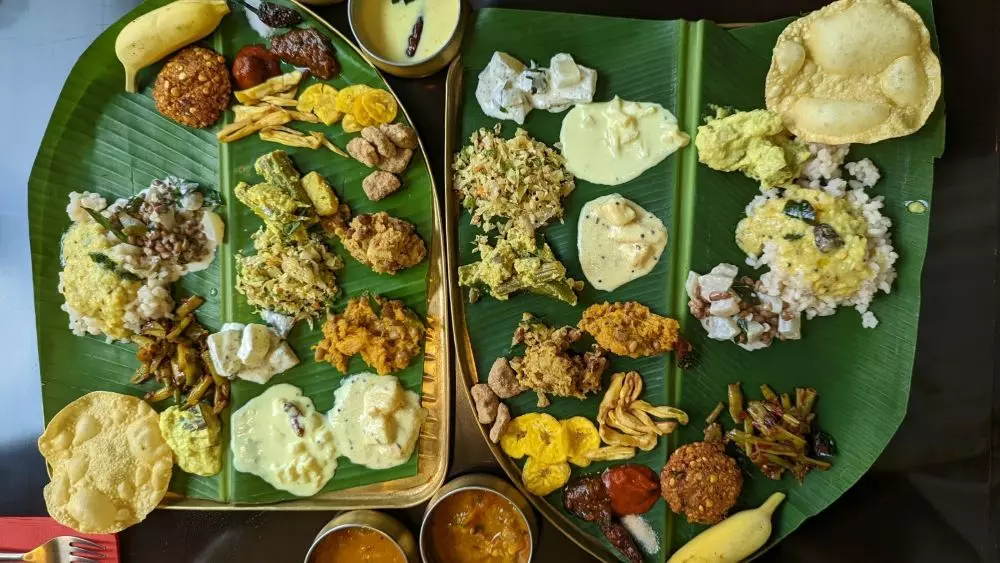
A traditional Onam sadhya. Photo: Ayandrali Dutta
For most Malayalis, the annual Onam festival, which is being celebrated today (August 26) this year, is incomplete without a grand ‘sadhya’, or feast. There is even an old saying: ‘Kaanam vittum Onam unnanam’, which translates to ‘one must have the Onam feast even if it means selling one’s property to arrange it’. The phrase captures just how deeply food is woven into the festival, which celebrates the yearly homecoming of the mythical King Mahabali — described in early Hindu texts as a benevolent and generous ruler — and, equally, Keralam’s agricultural abundance.
The image of an Onam sadhya, however, is almost universally associated with a magnificent vegetarian spread: rice, parippu (dal), sambar, avial (mixed vegetable stew), olan (pumpkin, cowpeas and coconut milk curry), thoran (vegetable stir fry), erissery (sweet and savoury curry), pickles, pappadam and payasam, all arranged on a banana leaf.
Yet travel beyond the familiar and another culinary tradition emerges. In parts of northern Keralam, particularly Malabar, fish and meat often find a place alongside the traditional vegetarian preparations. This isn't necessarily a case of a vegetarian sadhya getting a non-vegetarian makeover. Rather, it is a reflection of Keralam's deeply regional food culture — one in which geography, community, family traditions, local produce and centuries of culinary exchange have shaped what appears on the festive banana leaf.
One sadhya, many Keralam stories
“Non-vegetarian Sadhya is not a traditional way of eating in Keralam,” concedes Ruchira Hoon, chef and partner at a “pan-South Indian cuisine” restaurant in Delhi. “On Thiru Onam, the 10th and final day of Onam especially, the sadhya is vegetarian. But there are many parts of Keralam, like Kannur and Kozhikode, that add a non-vegetarian element.”
That distinction is important. The classic ‘Onasadhya’, prepared on the last day of the festival, remains a vegetarian feast, particularly in temple and ritual contexts. But in many homes, festive meals have evolved differently.
“You can add a side of fried fish, some chicken, fried chicken, all those things,” Ruchira explains. “Traditionally, sadhya is 100 per cent vegetarian because the whole point is that it is a harvest festival. You are celebrating a lot of the harvest.”
Yet Keralam's relationship with meat and seafood cannot simply be separated from its festive food traditions. In regions where fish, meat and seafood form part of everyday eating, they can naturally make an appearance at celebrations too.
“So the sadhya is still your 25-item meal and then you still have three or four items of non-vegetarian things,” she adds. “It is not like the entire meal becomes meat.”
Also read: How Partition left its mark on the culinary tradition of Punjab
To understand the non-vegetarian sadhya, one has to look north.
Zachariah Jacob, co-founder of a Keralam-cuisine-centric restaurant chain, points out that there is no single Keralam food culture. “Travel even 50 or 100 kilometres and the food and the terrain can change quite dramatically.”
In Malabar and parts of north Keralam — including Kannur, Kozhikode and Kasaragod — fish and meat have historically had a stronger presence on festive tables. The region's culinary identity has also been influenced by its coastal geography and centuries of interaction with Arab, Persian and European traders.
“The traditional ‘Onasadhya’ that most of us know is vegetarian,” says Jacob. “But particularly in Malabar and parts of north Keralam, including Kannur, Kozhikode and Kasaragod, fish and meat have long found their way onto festive banana leaves.”
For Jacob, family and community traditions matter just as much. Coming from a Syrian Christian household, he grew up with meat-centric celebratory meals. “At home, it is quite natural for us to serve non-vegetarian dishes such as chicken fry, buff preparations and fish alongside the traditional vegetarian sadhya,” he explains.
The key, he says, is that these dishes don't replace the sadhya. They sit alongside it.
What does a non-veg sadhya actually look like?
A non-vegetarian sadhya isn't simply a plate of rice with a meat curry added to it. The architecture of the feast remains important.
“A sadhya has a certain rhythm and architecture,” Jacob explains. “There is a balance of sweet, sour, spicy, bitter, creamy, crunchy and acidic elements; there is an order in which dishes occupy the banana leaf and even an order in which you eat them.”
That means the vegetarian spread remains the foundation. Avial, olan, thoran, erissery, koottukari (thick curry made of vegetables and pulses), pulissery (yoghurt based gravy), pachadi (Keralam style raita), kichadi, inji puli (a kind of pickle) and the various accompaniments continue to define the meal.
The non-vegetarian dishes simply bring another dimension.
Karimeen pollichathu, a Keralam-style fish cury. Photo: Ayandrali Dutta
In Malabar, these could include fish fry, fish curry, chicken fry, beef roast, mutton preparations, squid or prawns. The exact combination depends largely on the household and the region.
As Jacob puts it, the non-vegetarian dishes are “additional characters in an already complete story.”
Shri Bala, chef-partner at a southern-cuisine restaurant in the national capital, also emphasises how dramatically the sadhya changes with geography.
“North Malabar, that is Calicut, Kannur and those districts, will have non-vegetarian incorporated in the sadhya across caste and religious communities,” she says. “Even Hindu families will have non-vegetarian items in the sadhya.”
Travel further south, however, and the picture changes. In parts of central and southern Keralam, including Thrissur, Kochi and Thiruvananthapuram, Onam food remains predominantly vegetarian even in non-vegetarian households.
“In south Keralam, it will be strictly a vegetarian affair. Even if the family otherwise eats non-vegetarian, on Onam the food will be predominantly vegetarian curries,” she says.
The regional difference extends to the choice of meat and seafood. In Malabar, fish can be integral, with preparations such as fish curry or karimeen pollichathu, while chicken or red meat may also feature depending on local availability.
Ruchira believes the non-vegetarian additions can be wonderfully varied. “It could be fish fry, crab, mutton, chicken. It's not a limited thing.”
The sadhya is still about balance
Despite the meat and seafood, chefs stress that the vegetarian spread should remain at the heart of the meal.
“If I have to incorporate a non-vegetarian curry,” says Shri Bala, “I will add a Malabar-style fish, a dry preparation and also a curry.” She would retain staples such as avial, olan, thoran, koottukari and erissery, while also introducing nei choru — ghee rice — as an accompaniment to the richer non-vegetarian curries.
The philosophy is less about abundance for its own sake and more about complementing what is already on the leaf.
“There is so much flavour on your banana leaf already,” says Ruchira. “It is just to add to that broad spectrum.”
So is non-veg sadhya really traditional?
This is where the conversation becomes more nuanced.
Food anthropologist and writer Jacob Kuruvilla points out that the sadhya's association with vegetarianism is closely linked to its ritual context. In many homes, a sadhya is prepared as an offering to gods and ancestors, where meat is traditionally excluded.
“But there’s no hard and fast rule,” he explains. “There’s no question about it being ‘disrespectful’ to have meat on a sadhya.”
At the same time, he cautions against labelling every non-vegetarian festive meal a traditional sadhya. The Malabar practice is regional and rooted in particular communities and food cultures.
Meanwhile, the sadhya itself has evolved. Ingredients and dishes associated with the modern feast have travelled across regions and communities. Even staples such as sambar and pappadam have histories that extend beyond Keralam's borders.
As Kuruvilla observes, the sadhya was shaped not only by religion but also by geography, occupation, economic status and accessibility.
Shri Bala sees Onam primarily as a harvest celebration — one that transcends religious boundaries. “Onam sadhya is above and beyond any religion,” she says. “Mainly because it's a harvest festival.”
Keralam-style meat roast. Photo: By special arrangement
That openness is perhaps central to understanding why there can be seemingly contradictory versions of the same feast. A vegetarian sadhya served as part of a ritual and a Malabar family meal featuring fish or meat can both belong to Keralam's culinary landscape.
The difference isn't necessarily about one being authentic and the other not. It is about context.
For Jacob, that diversity is precisely what makes Keralam food compelling. “There is no contradiction in two Malayalis having completely different ideas of what belongs on a festive table. Both can be authentic to where they come from.”
A feast that keeps evolving
As regional Indian cuisine gains greater attention, the Malabar-style non-vegetarian sadhya may increasingly find its way into restaurant menus and curated food experiences outside Kerala.
But chefs believe the story needs to be told with context rather than novelty.
“It shouldn't become ‘look, we put meat in a sadhya’,” says Jacob. “The more interesting story is why certain communities have always eaten that way.”
Perhaps that is the real lesson of the Onam sadhya. It isn't a rigid checklist of dishes but a living expression of Kerala's history and diversity. The banana leaf can hold the familiar vegetarian classics, while in certain regions it can also accommodate a crisp fish fry, a spicy seafood preparation or a richly spiced meat dish.
And whether the leaf carries 20 dishes or 30, vegetarian or with a few non-vegetarian additions, the spirit remains the same: abundance, community, celebration and the joy of eating together. After all, the most fascinating thing about Kerala's food traditions may be that there has never been just one way to sit down and feast.