Jantar ka Mantar: The protest site that taught Delhi to listen
Poor peasants, pensioners, the young have all claimed it as their own. Centre's attempt to move protests to remote, hired sites shuts the margins out of sight

In October 2017, an order from the National Green Tribunal de-notified Jantar Mantar, the only designated protest site in New Delhi, closing it to all protests. In effect, it was a blanket, continuous imposition of Section 144 (now Section 163) across central Delhi, where the three arms of power in democratic India, the legislature, the executive and the judiciary, shut themselves off from the noise and visuals of people’s dissent.
The elite’s colonisation of free expression and speech, and its exclusion of the other India, had begun to show itself.
Two months later, in December 2017, the Mazdoor Kisan Shakti Sangathan (MKSS) petitioned the Supreme Court to reopen all of New Delhi’s protest sites, such as Jantar Mantar and Boat Club. The court’s July 2018 order was eloquent on freedom of expression and the right to protest, but restrictive in practice. It allowed the Delhi Police to frame regulations and conditions, and required protesters to apply for permission.
Irony and flaw
The irony and the flaw of having to seek permission from the very government a protest is directed against are self-evident. More worryingly, protests held without “permission” are labelled illegal. This is a fundamental contradiction.
Watch/Read: After ban, ‘every corner of country became Jantar Mantar’ | Activist Gauhar Raza interview
For decades, Delhi’s Boat Club was the place of protest, and rallies and demonstrations took place all over the city, with the police facilitating rather than banning them. Since Independence, protesters had in fact been treated with a degree of respect in official circles. Bureaucrats and politicians made time to meet them and hold dialogues. Protesters were seen as critics of governance and potential contributors to a better India, and were respected for it. Today, the scenario is the opposite.
A place of protest is the heart of a democracy. India won its freedom through Satyagraha, a movement that forced the colonising British to withdraw. It was the world’s largest non-violent movement, and it succeeded even though its leaders faced the wrath of an authoritarian colonial system that declared all protests illegal.
Freedom from colonial rule did not mean we would agree with everything an independent government did or failed to do. The power wielded by a free nation still needed to be monitored and challenged. Public places of protest are the only spaces that give the ordinary citizen entry to exercise the fundamental rights to freedom of expression and speech, two of the most basic rights in a democracy, guaranteed by our Constitution.
Wide range of issues
The issues raised there span a wide spectrum: individual and collective grievances, complaints of corruption and exploitation, lack of legal compliance, financial irregularities, arbitrary use of power, and the denial of other basic rights such as equality and justice.
We had sat at Jantar Mantar so many times that Shankar Singh, the bard of the MKSS, composed a song with the refrain: “Jantar ka Mantar, ki Jai Jai bolo!”
The open space is also a great educator and a platform for amplifying and understanding voices of dissent, where concerned citizens and passers-by alike are drawn into a variety of debates. It attracts the media and others who want to meet the people of India beyond the spaces created by and for the elite.
Such spaces force the more privileged in India to recognise the vulnerable and the marginalised in a complex democracy, and they are important in building concepts of plurality and tolerance.
Jantar Mantar brought together diverse groups and carried the energy of a people’s democracy into a national capital obsessed with itself and its own definition of power.
History of protests
Until the early 1980s, the place of protest in the nation’s capital was in the middle of central Delhi, on the lawns of India Gate, facing Rashtrapati Bhawan and the North and South Blocks, near the majestic presence of the old Parliament.
Read | Legal Lens: Can Delhi Police take Jantar Mantar off the protest map?
It was a shock when that place was de-notified and citizens were “pushed” onto a road called Jantar Mantar. Despite its shortcomings, Jantar Mantar became the symbol of exercising and claiming rights. It was a good school for democratic education, where several groups sat cheek by jowl, with several mikes blaring different slogans.
It was sometimes difficult to hear what was being said, but the place nevertheless retained its revolutionary spirit. The space broke class and caste barriers, bringing everyone into one enclosure where civil society met people from remote corners of the country.
Over the years, Jantar Mantar has carved out its own place in the history of protest in India. It stands more firmly than the Boat Club lawns ever did for unheard voices, for civil society and for civic protest.
An open space like Jantar Mantar needed no visiting card or membership, only the courage to sit without amenities. It became the nucleus for all protesting groups, whatever their ideologies and political inclinations. It did not matter whether the issue was collective or individual. Several individuals who had been denied justice used the space to draw attention to their plight.
Cultural diversity
Jantar Mantar also had extraordinary energy and cultural diversity, drawn from experiences brought in from across India. There were art exhibitions, music, theatre, celebrations, protests and other events that sought to capture people’s attention. It was also a place where protesters and onlookers could taste diverse Indian cuisines, from idli sambhar to chhole kulche to momos, all of it tasty and affordable street food.
It was not for nothing that people travelled from the remotest parts of India to Delhi, in unreserved general compartments, with no money in their pockets.
Watch | Short Video: 'Dissent should be given space'
Our own experience of Jantar Mantar has been nothing short of spectacular. We came from remote villages in Rajasthan seeking a national platform for discussions on the RTI (Right to Education Act) and MGNREGA (Mahatma Gandhi National Rural Employment Guarantee Act). We realised that demands like the right to work and the right to information arise from the struggles of poor peasants, and that they must engage with state and national legislation.
Modes of protest
There were also distinctive modes of protest, such as the Ghotala Rath Yatra, a theatrical device. Topical, interactive and colourful street theatre, it was created in Jaipur in 1997 and travelled across the country and through the streets of Delhi. It lampooned its targets without hindrance from the police, drew huge crowds and attracted political comment without provoking the ire of the people it critiqued.
The space broke class and caste barriers, bringing everyone into one enclosure where civil society met people from remote corners of the country.
Systemic issues call for an established space for dialogue, debate and negotiation with policymakers that can result in legislative initiatives. Without the village square in Kotkirana, Chang Gate in Beawar, Statue Circle in Jaipur and Jantar Mantar in Delhi, India would not have had one of the best RTI laws in the world, nor the capacity to defend it against amendments designed to dilute and defame it.
The same is true of the MGNREGA struggle. Just as the Bill was being discussed and put to vote in Parliament, social activists were on dharna at Jantar Mantar, not to celebrate but to demand that the Act protect the right to minimum wages. The Bill tabled in Parliament had expressly denied it. Miraculously, moments before it was unanimously passed, the government introduced an amendment ensuring that the payment of minimum wages would be notified in each state as per the law. Jantar ka Mantar had woven its magic to protect a basic right that affected all Indian workers.
We had sat at Jantar Mantar so many times that Shankar Singh, the bard of the MKSS, composed a song with the refrain: “Jantar ka Mantar, ki Jai Jai bolo!”
The police, our constant companions, had often told us disdainfully that Jantar Mantar was just a place for lost causes. This time, they acknowledged that something significant had been achieved.
RTI victory
In 2006, when India’s powerful RTI law was under imminent threat of amendment, another dharna began. Over many days and weeks, people from all walks of life visited the site and raised their voices against the amendment. At one point, all the UPA’s allies, particularly the Left, came to the protest site under the leadership of former Prime Minister VP Singh. Though they were partners in the UPA alliance, they said, they would vote against the amendments on the floor of the House.
Also read | How Rahul planned INDIA bloc's impromptu Jantar Mantar protest, defied Delhi Police
Although the dharna drew no more than a few hundred people a day, it turned the tide. Progressive forces within the UPA were able to prevent the amendment from being brought to Parliament.
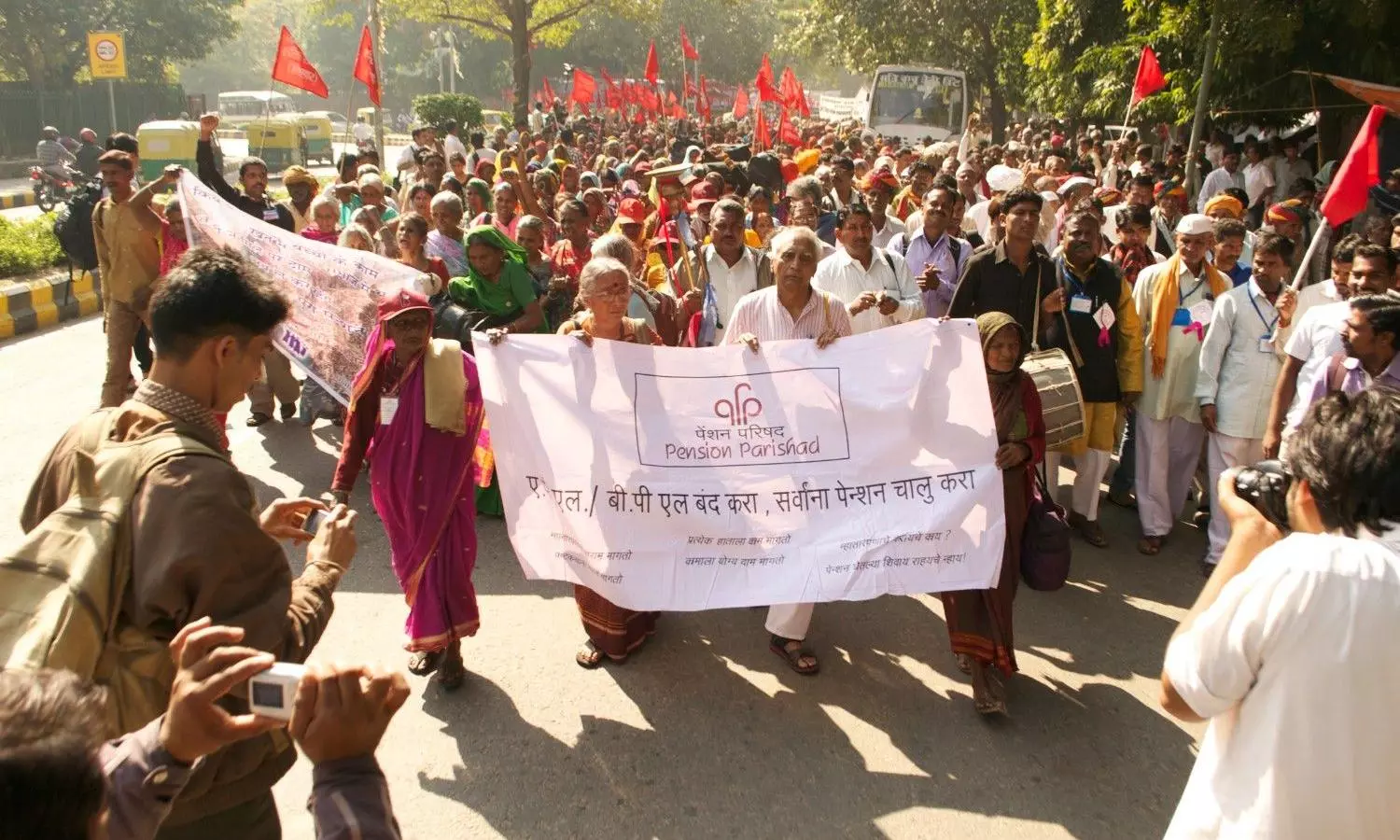
The Pension Parishad, formed on the initiative of Baba Adhav, the trade union leader from Maharashtra, and the MKSS, brought together some of the most marginalised and destitute people in the country. More than 300 elderly people sat day and night at Jantar Mantar for a month, demanding that their social security pension of Rs 200 a month be raised to a dignified level, half the minimum wage. They were silent and determined. They lacked the money for a cup of chai at the Jantar Mantar food stalls, and yet when the chaddar went around for contributions, it was filled with coins and notes of small denominations.
Poignant moments
Asked what they would do if their demand for a pension of Rs 2,000 a month were granted, one man said he would buy a good walking stick, another a pair of spectacles. An elderly widow who could barely walk said she would take an auto rickshaw to the hospital to collect her monthly medicines.
A delegation went to meet the Social Justice Minister. As they spoke of their predicaments and their destitution, the minister and everyone in the delegation had moist eyes.
The human tragedy is that today, 15 years later, the social security pension the government pays to the BPL (below poverty line) elderly remains Rs 200 a month.
Not all dharnas succeed, but no cause is ever fully lost. The elderly are an increasingly large voting population. Many state governments, which were required to match the Central contribution, have given much more, and Rajasthan has passed a right to pension law with an automatic annual increase built into it.
The great educator
The eclectic nature of Jantar Mantar is a great educator. It was not unusual to see supporters of Irom Sharmila, MGNREGA activists and protesters against atrocities on minorities all gathered at the same place, which led to a great deal of inter-protest learning. It also exposed a privileged class that was more worried about a blocked road than about degrading poverty, and yet claimed to be the victim.
Earlier, protesters were seen as critics of governance and potential contributors to a better India, and were respected for it. Today, the scenario is the opposite.
The government has always been uncomfortable with protest and people’s mobilisation in the heart of central Delhi. If Delhi is to go on calling itself the capital, it must provide space for its people somewhere in the centre, where the government can meet its voters. The arrangements made by the Delhi Police after the MKSS judgment were, at best, a compromise. The youth of today took Jantar Mantar by storm. They came out in lakhs and made it clear that police restrictions on timings and the like could not impede their freedom to gather peacefully. The recent Home Ministry order designating three remote alternative sites, which have to be hired for protest, is unacceptable.
The past three months have shown that no amount of repression, or force by the police and paramilitary, can silence the young and those who seek justice. If there is any wisdom left in the Indian ruling elite, Jantar Mantar will be made accessible as before.