Spider-Man to Gemini, how Haryanvi is having its moment in the spotlight
For decades, dismissed as ‘rough’ and ‘unsophisticated’, spoken by ‘ganwaars’, content in that same dialect is today being consumed on social media platforms like Instagram and YouTube. While Sony Music India has used the Haryanvi song ‘Barsaat’ for the promotion of the film Spider-Man: Brand New Day, at a Google Conclave this year, the company’s chatbot Gemini, too, spoke the tongue.

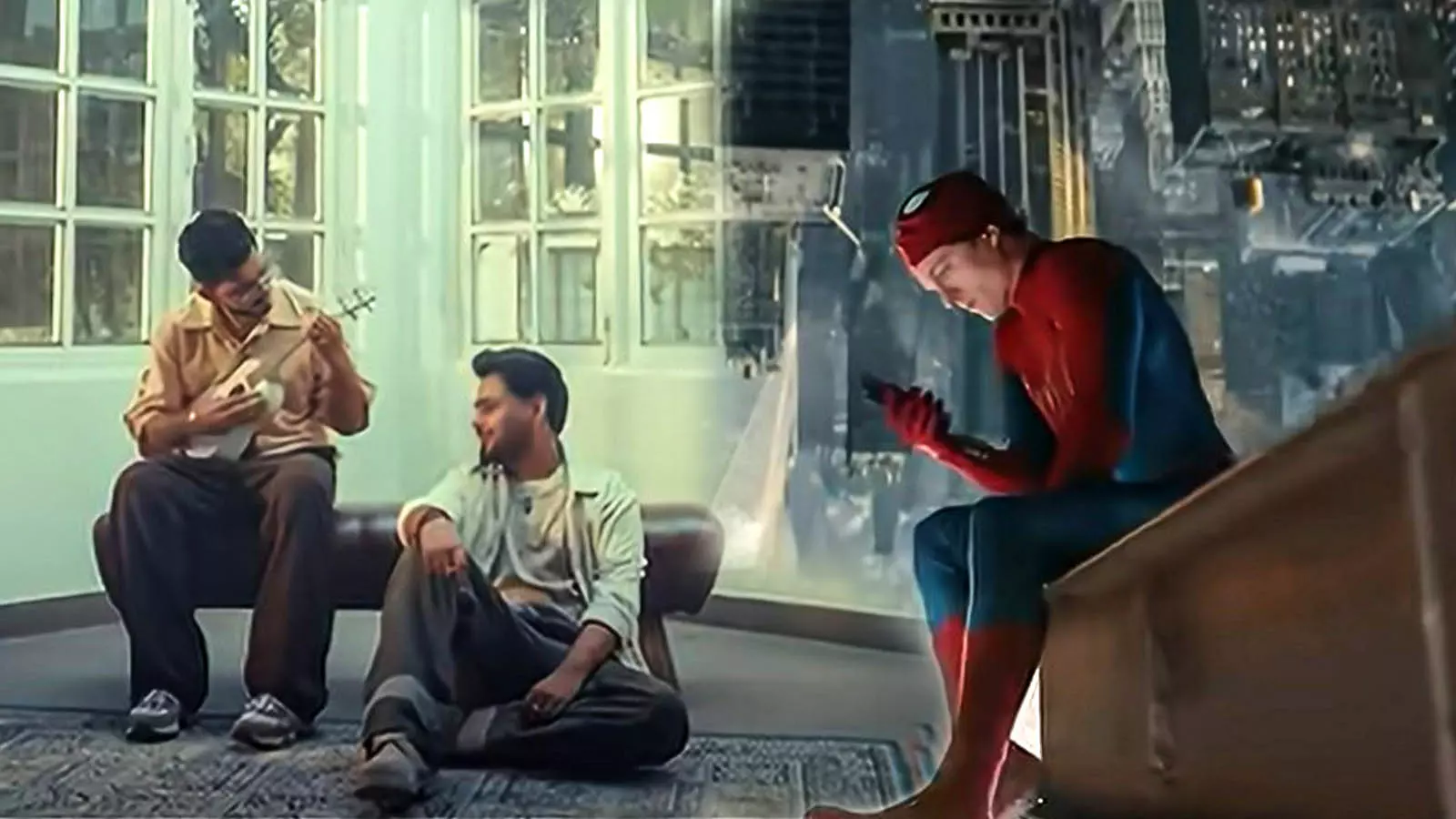
Sony Music India’s YouTube channel used the Haryanvi song 'Barsaat' by Banjaare while promoting Spider-Man: Brand New Day.
On July 28, Sony Music India’s YouTube channel dropped a new promotional song for Spider-Man: Brand New Day. The video featured the song ‘Barsaat’, which translates to rain. Not in English, the song was not even in Hindi, nor any of India's 22 scheduled languages or its 122 other major tongues. It was in Haryanvi, one of the many raw dialects spoken across the country and one that, until recently, was considered by many to be “too vernacular”.
For decades, it was the dialect the use of which could get people tagged a “ganwaar” (country bumpkin) in places like Delhi. Or worse, a “goonda” (criminal, gangster), because of its rough, edgy sound perhaps, or because of its ‘hinterland’ association. Or perhaps, because of the strongman image often associated with those who spoke the tongue — a perception that many Haryanvis The Federal spoke to admitted to not having been completely unfounded. But generations of upwardly-mobile parents in Haryana would groom their children into speaking “clean” Hindi or English, without any inflection of their native dialect, not just to sound ‘posh’, but because they felt it is what would be expected of them in their future professional lives.
Today, content in that same dialect is being consumed on social media platforms like Instagram and YouTube. JioHotstar offers cricket commentary in Haryanvi and during the recent students’ protest in Delhi for accountability and reforms in education, the Gen Z were seen dancing to Haryanvi tracks such as Masoom Sharma’s ‘Loafer’ and ‘Chambal Ke Daku’ and Vikram Sharma’s ‘Nazar Ke Teer’ and chanting slogans in the dialect.
Before Barsaat, the same singers, Sumit and Anuj, who go by the name ‘Banjaare’ (nomads), had a chartbuster called Bairan (the love and longing for a partner) hit No. 1 on Spotify's Weekly Top Songs India chart.
Both Spotify and YouTube now feature Haryanvi pop playlists and there are platforms like STAGE which focus on local storytelling, also have Haryanvi content. And at Google I/O 2026, Gemini surprised Indian viewers by speaking Haryanvi on stage, showing that voice-data and tech collectors also find the dialect worth working on.
So what changed? The people at the forefront of this shift, including commentators, influencers, linguists and writers, confirm that the shift has happened in the past five-six years. As reasons, they cite cheap data (increasing access to digital content), the Covid pandemic (the lockdown during the pandemic restricted people at home, giving them more time to both create and consume more content online), a generation that stopped apologising for its accent and began to own it and an economy that started paying for it.
‘We never knew if Haryanvi would even be understood’
Vivek Chillar has 121,000 followers on Instagram and according to his estimate, gets about 64 million views each month on his posts. His most popular reels have enjoyed 180 and 200 million views. A graduate, he creates content while holding a day job (the details of which he doesn’t want to share). He did not aim to attract a Haryanvi audience; he accidentally gained one, he claims.
"We started making it as fun, but we were overwhelmed by the response," Chillar recalls. He was inspired by Lalit Shokeen, the first creator widely credited with making Haryanvi short content genuinely popular on YouTube and began posting in late 2022.
Also read: Why Jyotiba Phule’s 171-year-old Marathi play, Trutiya Ratna, continues to hold a mirror to society
His first reel — a fun video on Haryanvi youth — crossed two million views, he recalls. "We never knew if Haryanvi would be understood by people or not," he said, "but when we crossed two million views, with nearly half the audience not from Haryana, we realised the dialect is now loved by people." Of his 1.21 lakh subscribers, only about a lakh are actually from Haryana and the rest are from other states and countries entirely, he adds.
"Haryanvi is not a language; it is closely related to Hindi, which is why many people could understand it." Because of this closeness to Hindi, it could travel to people outside the state, who could follow it without a translator; what they heard was different enough to be funny, Chillar reasons.
Both Spotify and YouTube now feature Haryanvi pop playlists and STAGE, a platform which focusses on local storytelling, also has Haryanvi content. Photo: iStock
He gives an example of Haryanvi wittiness that sits well with people on social media. “Ask someone in Haryana where a road leads, and instead of directions you will get ‘ye road kahin nahi jayega, yahi rahega" (this road is not going anywhere, it is going to stay right here. These are the funny incidents which we use in our videos and are loved by people."
‘CRPF jawans at the airport knew me’
Mumbai-based Ravin Kundu commentates on cricket in Haryanvi for JioHotstar and has 1.3 lakh followers on Instagram. He started three years ago, when Haryanvi joined Punjabi, Bhojpuri and Gujarati as regional commentary options for the IPL.
"In the very first year, the numbers were excellent," he tells The Federal, though he doesn’t share the numbers. "Our [Haryanvi] viewership lasts for longer than other languages because people stay to listen to this witty language." The viewership, he claims, is not confined to Haryana. According to Kundu, he gets messages from viewers in places as far-flung as Jammu, the North East, Maharashtra, Tamil Nadu and Goa.
"Essentially, the Hindi-understanding belt can follow Haryanvi too, at least loosely. That works in Haryanvi's favour, plus it is a thick, flavourful language on its own. People enjoy listening to it. Someone who would normally mute the TV during cricket is now watching with the sound on, just for the commentary,” says Kundu.
He adds, "What started as an experiment has now reached a point we never imagined. In 2023, when we started Haryanvi commentary, it was a pilot project for a year, but because of the love we received, now we are in the third year. Moreover, Haryanvi is the second regional dialect after Bhojpuri to now appear in international matches, too."
He used to be known for sports hosting generally in corporate events, PUBG broadcasts, and work with MTV and NDTV. Now people recognise him only for the Haryanvi commentary. "I was flying to Pune recently. The CRPF personnel at the airport checkpoint recognised me. They said, ‘bhai saab, we listen to your Haryanvi commentary’ and asked if I could recreate the scene from one of my most famous commentaries."
Also read: A lingering refrain: How the ghazal survived, evolved through the centuries
In addition to the ground gained during the pandemic, Kundu points to ace javelin-thrower Neeraj Chopra’s use of Haryanvi in his speech after winning the gold medal in the 2020 Tokyo Olympics, as a turning point for the dialect.
Haryanvi content is being consumed on social media platforms like Instagram and YouTube. JioHotstar offers cricket commentary in Haryanvi and during the students’ protest in Delhi the Gen Z were seen dancing to Haryanvi tracks. Photo: iStock
He also traces a direct line to creators like Lakshay Chaudhary, Vikanshu Tomar and Harsh Beniwal and to Haryanvi music videos, including the ones from Dhanda Nyoliwala and Banjaare, that finally started spending real money on production, the way Punjabi music did a generation earlier.
"The moment the Haryanvi industry stepped up and started providing international appeal in songs, it started receiving the respect it deserved. I can confidently say the next one or two decades belong to the Haryanvi music industry," Kundu insists.
‘Haryanvi having its moment’
Chaman Lal, former chairperson of the Centre of Indian Languages at Jawaharlal Nehru University and an author, believes part of the shift can be explained as the natural evolution of a language, or in this case, a dialect.
"A language is always in gradual motion; it keeps developing, some languages fade, some are born,” he says. "Haryanvi has not really settled into a distinct linguistic category of its own. In linguistics, it is not strictly termed a dialect at all; much of what is spoken is closer to Khadi Boli Hindi with regional colour.”
However, he acknowledges the strength of the folk tradition in Haryana, especially Ragni, a form of sung storytelling that has kept Haryana's oral culture alive for generations. Sometimes it is coarse, sometimes progressive, but it is always distinctly local.
Arjun Singh Kadian, author of Land of the Gods - The Story of Haryana, explains Haryanvi’s recent popularity as fundamentally an economics story before a culture story. Print, radio, television, each had gatekeepers who decided whose voice got amplified.
"But the internet broke that gatekeeping entirely. Cheap data, then Covid forcing everyone onto their phones, did the rest. Platforms that once felt exclusive now contain every kind of audience, and Haryana adopted the internet early,” he says.
Pointing out that anyone building an independent audience on social media now does it through localisation, Kadian adds, "At the end of the day, in a capitalist market, profit is everything and wherever the numbers show up, brands follow. Haryanvi content is showing up."
For Dr Ramesh Attri, a retired teacher and cultural expert based in Jind, "Haryanvi is still the same rude or funny dialect" that it was, whichever way one chose to view it. "But the way people treated it has changed entirely,” says Attri, crediting a generation that is "not much scared" of judgement, for its recent popularity.
As Kadian sums up, "Everything has its moment [under the spotlight] and for Haryanvi that moment is now”.