Why Tansy Troy’s new eco-adventure book for children, The Great Nicobar Journey, ends on a note of ‘hope’
Published by Talking Cub, an imprint of Speaking Tiger Books, the book centres around environmental concerns that have been raised against the Great Nicobar Island Development Project, which envisages the construction of an international container transshipment terminal, an airport for both civil and military use, a power plant and a township on the island. Couched in a gentle parable, The Great Nicobar Journey makes these issues accessible to young minds.

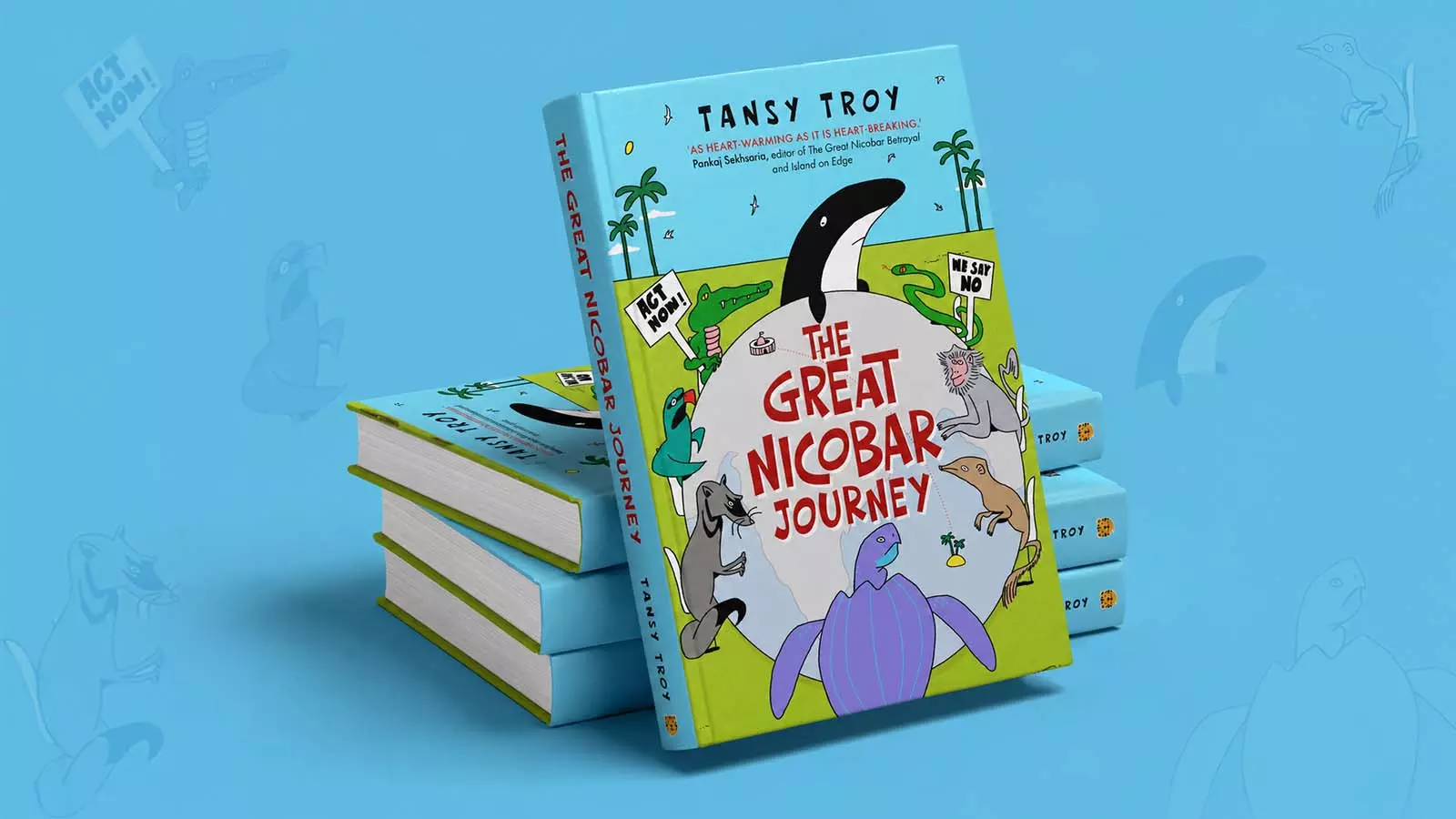
Tansy Troy’s new eco-adventure book for children, The Great Nicobar Journey: How an Endangered Island Lifted its Voice to the Skies has been published by Talking Cub, an imprint of Speaking Tiger Books.
There’s hullaballoo on Great Nicobar Island. The animals, birds, reptiles and amphibians have gotten wind that the Government of India is “planning to destroy their home”. At a great gathering of the forest dwellers — with creatures as diverse as the long-tailed macaque, forest lizard, cricket frog, civet cat, robber crab, serpent eagle and even a rare Omura’s whale in attendance — a bold decision is taken. A wise leatherback turtle opines that they have no option left but to ‘petition’, for that is what humans do when things go awry. Cat snake, who knows the ways of humans well, informs the gathering that, in times of trouble, humans “go on dem-on-sss-strations to protes-s-s-st on the doors-s-s-steps of politic-c-cians”. A consensus is reached — that a few of them will march to the Indian Parliament in Delhi to petition the government to roll back its decision. Of course, they also come up with a jolly anthem for the movement.
And thus begins an implausible adventure laced with heartbreak and hope which forms the narrative of Tansy Troy’s new eco-adventure book for children, The Great Nicobar Journey: How an Endangered Island Lifted its Voice to the Skies, published by Talking Cub, an imprint of Speaking Tiger Books.
The march to parliament
The motley crew of Nicobar beings marching to the parliament comprises Nicobar treeshrew, Nicobar parakeet, saltwater crocodile, long-tailed macaque, civet cat and cat snake. Once they reach the mainland, they encounter other beleaguered creatures — pangolins and elephants, birds and tigers — who share their stories and join them in their heroic march to Delhi.
“By now, the Great Nicobar Crew had grown so large a band of mammals, birds, reptiles, insects and amphibians that the level of outrage as stories were shared and experiences described, was amplified tenfold,” writes Troy. “Every creature had a grievance to report. If it wasn’t loss of habitat, it was lack of food, or impossible temperatures or violent encounters with humans. Some told of how difficult it was to find a mate nowadays. Others complained that their eggs or chicks were under attack by species whose populations now lacked an apex predator. Others still spoke of polluted air, rivers full of chemicals and an earth so depleted and barren that no plants could grow.”
Decoding environmental issues for the young
The author, according to the writer’s bio mentioned in the book, is an India-based educator, poet, performer and playwright, who also likes making bird and animal masks. Troy currently divides her time between Manali, where she lives in a treehouse and Bhopal, where the jungles of central India are never far.
It is clear she feels deeply about nature and the environment and the Nicobar issue in particular, which, the book mentions, she first became aware of through a media interview of preeminent environmentalist Pankaj Sekhsaria, a large part of whose advocacy is focused on the Andaman & Nicobar Islands.
Despite being written for children and couched as a gentle parable, The Great Nicobar Journey raises serious environmental concerns and makes them accessible to young minds. Troy has a lyrical and funny turn of phrase, but that takes nothing away from the graveness of the issue at the core of the narrative.
A book of ‘hope’
The southernmost and largest of the islands in the Nicobar group, Great Nicobar has been in the eye of a storm ever since the Government of India decided to set up a strategic port and ancillary facilities there. The Great Nicobar Island Development Project (GNIDP), proposed by the Niti Aayog in 2021, envisages the construction of an international container transshipment terminal, an airport for both civil and military use, a power plant and a township on the island. The island is close to the Strait of Malacca, a major shipping route and is, therefore, of immense strategic importance.
The plan, which seems to be plodding ahead in a phased manner, has environmentalists and the government at loggerheads over concerns of environmental damage, including deforestation. The effect of the project on indigenous communities like the Shompen and Nicobarese peoples has also been a matter of worry. And if that were not enough, Great Nicobar lies on top of a major seismic fault line. The epicentre of the earthquake that caused the 2004 tsunami is close by.
The Great Nicobar standoff is possibly India’s greatest environmental battle in contemporary times, where Tansy Troy’s slim little book is a mere foot soldier. Yet it bursts with optimism, not despair.
Without giving away the ending, let’s just say the book concludes on a note of almost absurd — but entirely logical — hope.