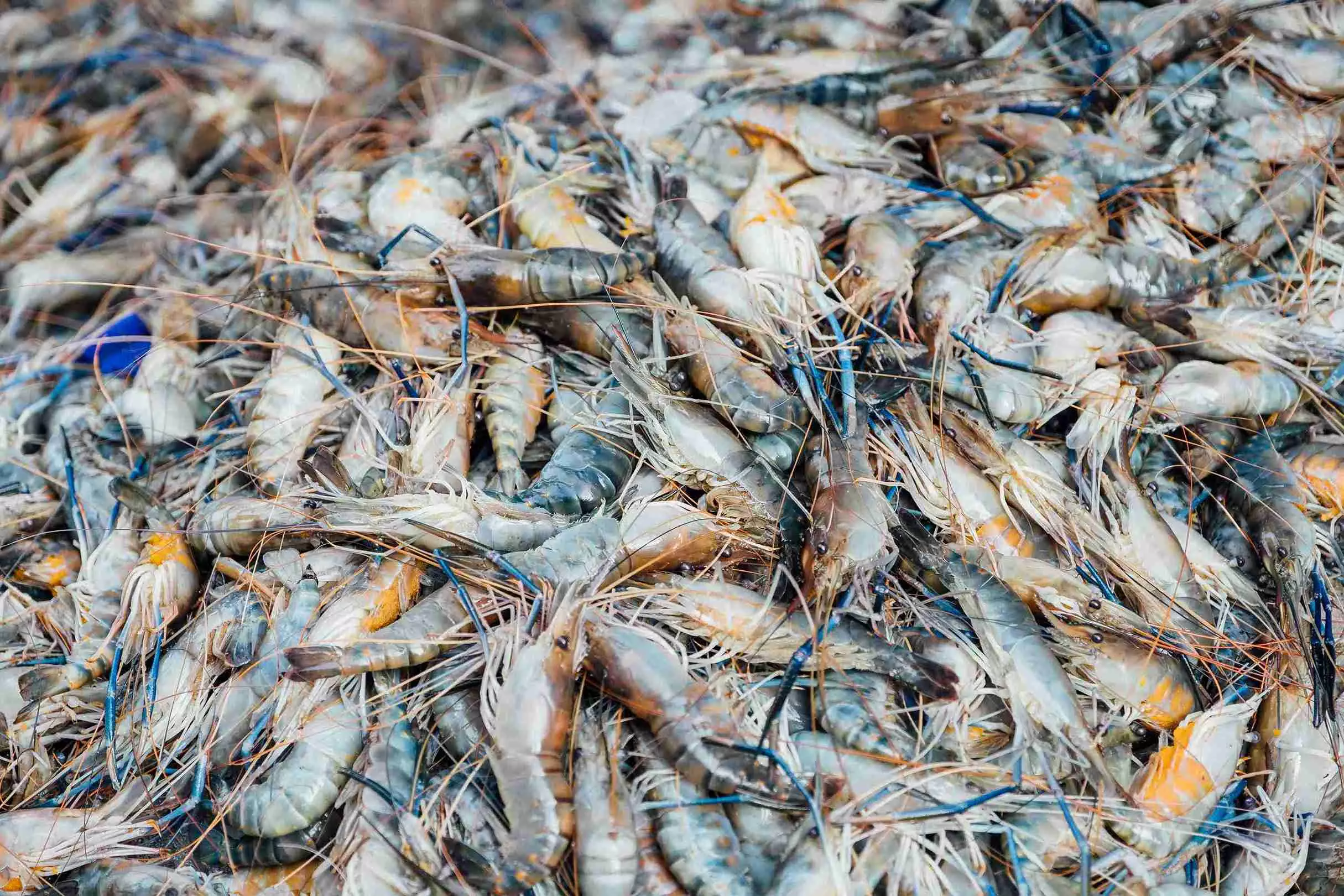
Budget relief for shrimp exports, but Andhra farmers left under strain
The budget eases cost pressures on shrimp exports to counter US tariffs, but the advantages appear skewed toward exporters, offering little support to farmers on the ground

Facing steep US tariffs, the Union government has sought to cushion India’s shrimp industry through a set of targeted measures in the Union Budget 2026. Union Finance Minister Nirmala Sitharaman positioned the package as an attempt to lower costs, boost exports and improve global competitiveness. While exporters see some immediate relief, farmers on the ground argue that the gains are uneven and largely bypass primary producers.
Also read | Budget 2026: Business as usual in a world that is not
At the core of the budget relief is a reduction in customs duties on several key inputs used in shrimp farming and processing. Basic customs duty has been slashed on items such as shrimp feed ingredients, fish hydrolysate and surimi, a protein component used in feed, from 30 per cent to 5 per cent. Exporters say this could significantly ease cost pressures at a time when Indian shrimp faces cumulative duties of up to 58 per cent in the US market.
Focus on exports
The budget also raises the duty-free import limit for specific inputs required for export-oriented shrimp processing. Import allowances for items such as food-grade chemicals and packaging materials have been increased from 1 per cent to 3 per cent of the previous year’s export FOB value. According to exporters, this move will directly reduce processing costs and help them price Indian shrimp more competitively abroad.
In another concession, fish and shrimp caught by Indian vessels within the Exclusive Economic Zone or on the high seas will attract no customs duty, and landings at foreign ports will be treated as exports. Industry bodies say this will improve logistics efficiency and expand access to overseas markets.
“These measures clearly address the export side,” says Pawan Kumar, president of the Seafood Exporters Association of India. “Our hope is that lower input costs will partly offset the tariff disadvantage we face in the US.”
US tariff pressure
The urgency behind the relief is clear from recent export data. Shrimp shipments to the US, India’s largest market, fell sharply after tariffs were imposed, with October 2025 exports down 26% year-on-year. For April-October FY26, exports to the US declined 4% in value and 34% in volume.
Yet, overall shrimp exports are projected to grow by 16% in value and 12% in volume over the same period, reaching around $4.87 billion. This growth is being driven by diversification into markets such as Vietnam, Belgium, and China, where exports have risen sharply.
“Market diversification is the only way forward,” says KN Raghavan, secretary general of the Seafood Exporters Association of India. “India has a 35 per cent share of the US shrimp market, but our exporters face cumulative duties of up to 58 per cent. Competitors like Ecuador, Vietnam and Thailand face just 10-20 per cent.”
Farmers struggle
On the farm side, however, the picture is far less optimistic. Gajuraju Venkata Subbaraju, secretary of the Shrimp Hatcheries Association, argues that the budget relief rarely trickles down to farmers. “There is a clear difference between farmers and traders. Most of these concessions help exporters and feed manufacturers, not farmers,” he says.
Also read | Budget 2026-27 works on continuity, not course correction, for agriculture
Subbaraju points to falling productivity as a major concern. “Earlier, farmers harvested up to 70 tonnes per acre. Now yields are below 20 tonnes. Prices collapsed when production was high, and now even though yields are low, input costs—especially feed—remain very high.”
Shrimp feed currently costs around ₹109 per kg, and feed manufacturers are planning a price hike of ₹4 per kg from this month. Farmers hope discussions at the Andhra Pradesh State Aquaculture Development Authority meeting in Vijayawada on February 6 will bring some clarity.
Risk and uncertainty
For many farmers, tariffs have translated into heightened risk. “With a 50 per cent duty, we are completely exposed,” says Manoj Sharma, a shrimp farmer and sector expert. “Compared to others, shrimp farmers are under far greater stress.”
Venkatapathiraju Penumatsa, a shrimp entrepreneur, warns that poor price realisation could disrupt the production cycle. “If farmers don’t get viable prices, many may skip the second crop. The US tariff was like an earthquake—sudden and unpredictable.”
There is also anxiety that imports of foreign shrimp into India could destabilise the domestic market, particularly in Andhra Pradesh, the country’s shrimp hub.
Infrastructure gaps
Exporters say the budgetary support for cold storage, processing facilities and fisheries infrastructure could help address some structural bottlenecks. Ravi Kumar Yallanki, president of the All India Hatcheries Association, notes that non-tariff barriers in Europe, such as stringent antibiotic screening, remain a challenge. China, meanwhile, prefers head-on shrimp, which requires robust cold chain infrastructure—something India lacks at scale.
Anand Kumar Uddamraju, director of the Anand Group, says US tariffs have already halved his company’s order volumes. “We are running at 50 per cent capacity and trying to push sales to Canada and Europe. But those markets take time to develop, and volumes are small.”
Uneven gains
While the budget has clearly signalled support for the shrimp export sector, stakeholders agree that its impact will be uneven. Exporters may gain from lower costs and improved competitiveness, but farmers remain vulnerable to volatile prices, rising feed costs and global trade shocks.
Also read | Budget 2026-27: Tax relief for aviation, uncertainty for UDAN
State-level measures, such as reduced power tariffs in Andhra Pradesh, have offered some relief. Yet, as industry leaders stress, long-term resilience will depend on closer integration between farmers and processors, greater value addition and sustained diversification away from a US-centric export model.
(This article was originally published in The Federal Andhra Pradesh.)