Apple belt of Kashmir-Himachal-Uttarakhand braces for cheap US imports
Growers fear imports under India-US trade deal will hurt livelihoods and fragile rural hill economies, with politics limiting a collective call for redress

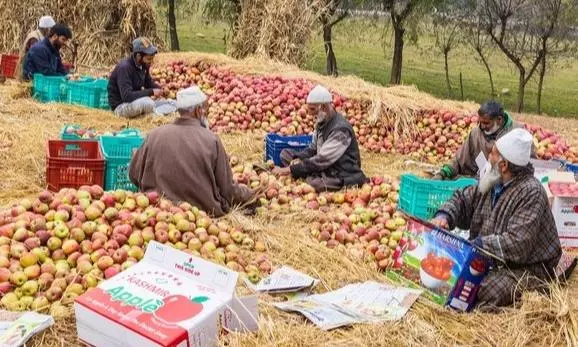
The Narendra Modi government has promised adequate protections for the country’s apple farmers under the India-US trade deal. Yet, the apple-growing community is anxious, particularly across Jammu and Kashmir, Himachal Pradesh and Uttarakhand, from where India annually produces 22-25 lakh tonnes of apple.
J&K contributes around 18 lakh tonnes, followed by Himachal Pradesh with 5 lakh tonnes and Uttarakhand, around 50,000 tonnes. Northeast states like Arunachal Pradesh and Nagaland, where apple farming has been picking up in recent years, make minor contributions to the total production.
Raising the issues with the Union government is not an easy option for the apple growers in J&K. For one thing, the state is ruled by the National Conference, which is unlikely to get ready support from the Congress government in Himachal Pradesh or the BJP government in Uttarakhand. For another, the local fruit growers, fearing stringent police action, are wary of holding demonstrations.
Supply chain infrastructure
Under the US-India interim trade deal, American apples will enter India at a minimum import price (MIP) of Rs 80 a kg, with 25 per cent import duty, making it available to the Indian customer at Rs 100.
Harish Chauhan, convenor of the Hill States Horticulture Forum (HSHF), constituting farmer organisations from J&K, Himachal Pradesh and Uttarakhand, believes it is the “death knell” for domestic farmers. In the coming months, Chauhan says, there will be a flood of foreign apples in Indian markets, causing the local produce to be sold cheaper, resulting in losses for farmers.
Also read: Washington apples are back in India; how it will affect local produce and industry
“India is already importing 6 lakh tonnes of apples from the US, which is equivalent to the quantity of apples we produce in Himachal Pradesh,” he told The Federal. Chauhan is also convenor of the Sanyukt Kisan Manch (SKM), a body of 27 farmer organisations based in Himachal Pradesh.
Apple farmers in Kashmir argue American farmers enjoy advanced technology, export subsidies and better storage infrastructure.
He disagrees with Union Commerce Minister Piyush Goyal’s assertion that there is a shortage of apple production in the country, considering an annual domestic consumption of 26-27 lakh tonees. “It is not right. We produce enough crops. The only shortcoming is in our supply chain, where the government is not helping us," he said.
Also read: Kashmir apple growers protest highway closure, say ‘produce worth over Rs 10,000 cr at risk’
"Unlike the US, we don’t have refrigerator vans for transporting fruit crops, and we don’t have enough cold storage facilities. It is due to this shortcoming that 30-40 per cent of our crop is damaged and the farmer has to suffer a loss,” he said, adding that if the supply chain gets better, the local produce could easily address domestic consumption.
Big blow to farmers
With cheap US imports, over 10 lakh apple farming families, of which 7 lakh and 2.5 lakh are from J&K and Himachal Pradesh, respectively, will take a hit, says Chauhan. “Who will buy our apples in big cities like Delhi, Mumbai, Chennai and Kolkata? People tend to prefer the looks and taste of imported apple varieties compared to the nutrition that our indigenous apples offer,” he rued.
Higher duties were all along protecting local farmers from US imports, and this has now been lowered to 25 per cent. “Our markets will be flooded with cheaper imported varieties, and our farmers won’t be able to compete in the market,” said Chauhan. It is not that the Indian apple growers don’t have the capability to compete, he said, adding that all that they need is some "government support”.
“In the US, an apple farmer is given an incentive of Rs 60 lakh while in India we have a meagre Rs 27,000 and that too intertwined in bureaucratic hustles,” said Chauhan.
In hill states like Himachal Pradesh and J&K, where industrial opportunities are skeletal at best, apples form the backbone of the economy. The sector contributes 13 per cent to Himachal Pradesh’s GDP. It is also a key contributor to J&K’s GDP and provides one of the largest private sector employment opportunities in the region.
Poor match
Apple farmers in Kashmir argue American farmers enjoy advanced technology, export subsidies and better storage infrastructure. They also enjoy subsidies for pesticides and fertilisers. The import onslaught can weaken domestic trade even at higher MIP levels, they worry.
Also read: Why import of Iranian apples is worrying growers in Kashmir
Last year, Bashir Ahmad Basheer, Chairman of the Kashmir Valley Fruit Growers & Dealers Union, conveyed the challenges faced by the state's apple sector to Union Agriculture Minister Shivraj Singh Chouhan, who was on a visit. The Minister had then said there was “no chance” of reducing tariffs on imported apples, including from the US, revealed Basheer. That, it turns out, was rather inaccurate.
Sources within the ruling National Conference government said Omar Abdullah is also looking to get on board the governments of Himachal Pradesh and Uttarakhand to jointly approach the Centre for redress.
The Kashmir Valley Fruit Growers Dealers Union, an amalgam of fruit bodies associations, pegs last year’s apple production at 25 lakh tonnes. The yield is up, but the Union is still concerned. Apple imports from the US would be a “catastrophe”, Basheer said.
“Apples are our Rs 15,000-crore industry on which the livelihoods of lakhs of families are directly or indirectly dependent. Around 80 per cent of the Kashmiri population banks on the apple industry,” he told The Federal. “We cannot match American growers when it comes to quality and quantity. They get subsidies on fertilisers and pesticides. We have to rely on spurious chemicals.”
Union writes to Modi
The Fruit Growers Union, on February 7, wrote to Prime Minister Modi, highlighting the concerns. “The reduction in custom duty on European/American apples will make imported apples cheaper and a trader will naturally prefer them over Kashmiri apples. This directly affects the pricing of apples of Kashmir, Himachal Pradesh and Uttarakhand.
"Under the circumstances explained above your goodself are requested kindly consider imposition of import duty on American/European apple to the extent of over and above 100 per cent, failing which the horticulture industry of J&K will turn the shape of sick industry,” the letter said.
Their concerns were also discussed by the Omar Abdullah government in the Union Territory. State government sources told The Federal there is much concern in those quarters. “The Centre is saying the farmers’ interests have been ensured. But we are importing fruits and dry fruits — apples, walnuts and almonds. These are typically produced from J&K. We will be doomed," one of the sources told The Federal.
State government's plan
Nasir Aslam Wani, advisor to the J&K Chief Minister, told The Federal the state government is keeping a keen eye on the developments, and will take it up with the Union government.
“It is not a small thing. Not only us, but many other states in the country will also be affected. Our state economy will be hit. J&K is dependent on the apple industry,” said Wani.
Also read: How India’s EU and US trade pacts compare with the 1991 liberalisation
He, however, reserved his comments on the J&K government’s strategy to deal with the issue, saying, “Let us see when the whole thing comes out. We will be analysing it.” From the details available now, there is cause for concern, he said.
“The prices would be too competitive. It is a double whammy for the apple growers. They cannot compete with US produce both in terms of quality and pricing,” Wani said, adding that the government needs to explore methods to save the local producers.
Political equations
Sources within the ruling National Conference government said Omar Abdullah is also looking to get on board with the governments of Himachal Pradesh and Uttarakhand to jointly approach the Centre for redress. They, however, believe it is no easy task considering Uttarakhand is ruled by the BJP.
The Congress government in Himachal Pradesh may lend its voice. However, Omar’s equation with the Congress has been souring of late, particularly after his statements against the grand old party's campaigns on EVMs and vote chori, and his refusal to part with a preferred Rajya Sabha seat.
If these political issues come into play, Omar may be unable to bring the Sukhvinder Singh Sukhu government in Himachal on board either.
Also read: India-US trade deal: Zero tariffs on gems, pharma, farm produce, says Goyal
However, the anxiety over cheap apple imports is widespread in Himachal Pradesh and Uttarakhand as well. Rising input costs, climate-related crop losses, transport disruptions and limited cold storage facilities have already squeezed margins for Indian growers. They fear that an influx of imported apples during peak season could worsen the distress in rural hill economies.
Himachal's woes
The figures obtained from the Himachal Pradesh Horticultural Department peg the state’s apple economy at Rs 3,500-4,000 crore annually. Officials say 30-35 lakh apple boxes from last year’s produce are still lying in cold storage facilities in the state and Chandigarh.
“We are waiting to see how much produce from the US will land in India in March-April. It is the time when our produce from last year reaches the country’s markets,” a Himachal Pradesh government official, speaking on condition of anonymity, told The Federal.
Senior Congress leader and AICC secretary Surendra Sharma, who is also vice president of the Himachal Pradesh Horticultural Produce Marketing and Processing Corporation (HPMC), told The Federal that the US trade deal will hurt the state’s apple economy.
“We need to see the quality and quantity of apples that will flood our markets. Will they land at higher prices? Else, we are doomed,” said Sharma.
All-party meeting
The Sukhu government in the state convened an all-party meeting on Sunday (February 8), where the BJP too was invited. The aim was to formulate a joint strategy to take up the concerns of the apple industry with the Union government. However, the BJP MLAs gave it a miss.
Also read: Gurez valley tourism surges as J&K govt steps up eco-protection measures
Confirming the development, Sharma said, “We had invited them to work together for the state’s welfare, however, they seem to be focused on their politics. We also wanted to take up the revenue deficit grant issue with them since the Centre has stopped funds for it in this Budget.”
Hundreds of families in Shimla, Kangra, Kinnaur, Kullu, Mandi, Lahaul-Spiti and Chamba are associated with apple production and as such the move will have political ramifications. Realising it, the Congress is gradually reaching out to the farmers in the belt.
Feb 12 protest
Farmer organisations including the SKM and the All India Kisan Sabha (AIKS) have called for a nationwide strike on February 12 (Thursday). The move has resonated with apple growers in Kashmir. Several growers, especially from north Kashmir’s Sopore, told The Federal that they are hopeful the organisations will raise their concerns. "We can only extend our verbal support to them. We fear if we hold protests in Kashmir, we might land up in jail," said one of the growers.
Also read: How life has altered for residents of Kashmir villages living with the threat of wildlife attack
HSHF's Chauhan concurred that Kashmir farmers are wary of protesting for fear of police action. “They (Kashmir apple growers) continue to extend their support. We are with them. They are with us. We are united,” he said.
"We will launch an agitation. It is a test for PM Modi’s 'vocal for local' assertion. I am hopeful he will stand for desi (local), not videsi (foreign),” he added.