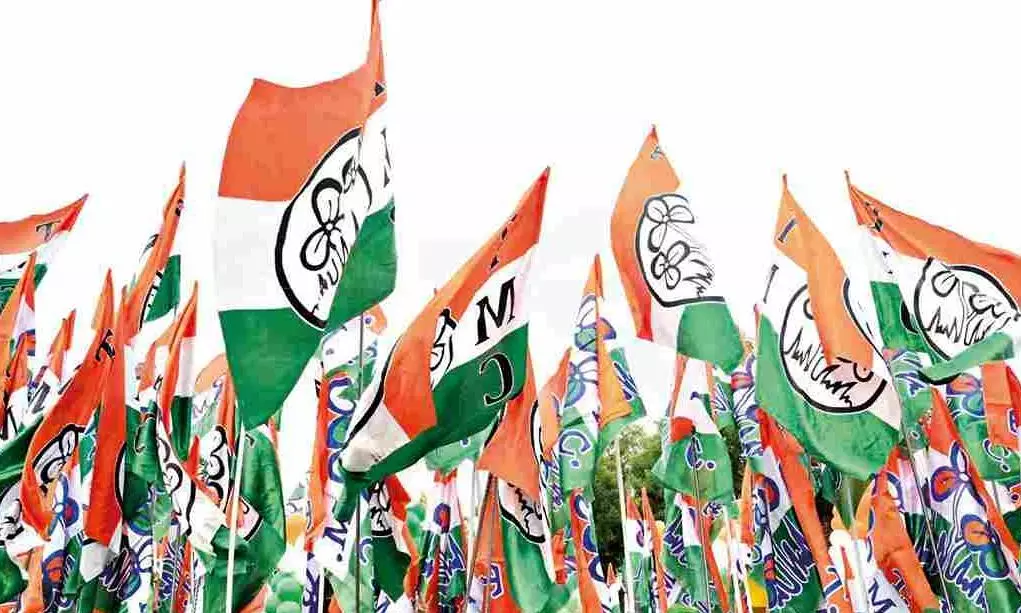
EC has frozen Trinamool name and symbol
Whose Trinamool Is It anyway? EC's toughest test since Sena
As Mamata and Arup Roy both stake claim to Trinamool Congress, the poll body decision will hinge on party rules, organisational strength and legislative numbers, not a simple majority count

“As a result of differences and dissension, a political party may be split into two or more groups, but the symbol cannot be split.”
The Supreme Court said this in Sadiq Ali v the Election Commission of India in 1971, after the Congress split and rival factions claimed the same party identity and election symbol. More than five decades later, the Election Commission of India (ECI) faces essentially the same question in West Bengal: which of two rival formations can claim to be the All India Trinamool Congress?
On September 17, the Commission temporarily froze the name 'All India Trinamool Congress' and its 'Flowers & Grass' symbol after finding that two rival groups, one led by Mamata Banerjee and the other by Arup Roy, were each claiming to represent the recognised party.
A day later, for the upcoming by-elections, it allotted the Mamata-led group the temporary name 'Mamata All India Trinamool Congress' and the 'Football Player' symbol, while the Arup Roy-led group received 'Democratic Trinamool Congress' and the 'Envelope' symbol.
These are interim arrangements. The larger dispute is being decided under Paragraph 15 of the Election Symbols (Reservation and Allotment) Order, 1968, which allows the ECI to hear rival groups of a recognised political party and decide whether one of them, or neither, should be recognised as the original party for electoral purposes.
What are the two sides arguing?
The dispute turns heavily on the Trinamool Congress constitution and the tenure of its National Working Committee.
The Arup Roy-Ritabrata Banerjee camp argues that the committee elected in February 2022 had a three-year tenure that expired in February 2025. It relies on that proposition to justify a special session held on 22 June 2026, at which a new leadership headed by Roy was elected.
The Mamata Banerjee camp contests that interpretation. It says the relevant party rules provide five-year terms and that the existing organisation consequently remained valid when the June meeting was held.
The Commission will have an important official record before it. The ECI’s own organisational-election page currently lists “All India Trinamool Congress Organisational Elections (02.02.2022 to 31.01.2027)”. The entry does not by itself decide the Paragraph 15 dispute, because the Commission must still adjudicate the rival claims, but it is directly relevant to whether the organisation elected in 2022 had ceased to exist in 2025.
The Commission will therefore have to look beyond the question of how many Members of the Legislative Assembly (MLAs) support each camp. It may need to determine which version of the party constitution governed at the relevant time, who was entitled to convene the June meeting, who could participate in it, whether the organisational elections followed party rules and how much support each side commands within the recognised party structure. The ECI also maintains the Trinamool constitution among its official political-party records.
Why two-thirds does not settle it
The rebel camp’s claimed legislative strength is important, but the frequently cited two-thirds figure belongs to a different legal framework.
Under Paragraph 4 of the Tenth Schedule to the Constitution, at least two-thirds of the members of a legislature party must agree to a merger for legislators to obtain the protection available under that provision of the anti-defection law. Paragraph 15 of the Symbols Order contains no corresponding two-thirds threshold for deciding which faction represents a political party.
Legislative strength can still be powerful evidence before the Commission, but it does not automatically determine who receives the party name and symbol.
The Supreme Court underlined this distinction in Subhash Desai v Principal Secretary, Governor of Maharashtra in 2023, arising from the Shiv Sena split. It held that the political party and the legislature party are distinct entities and that the Commission need not apply one mechanical test to every factional dispute. Depending on the evidence, it may examine organisational strength, legislative strength, the party constitution or a combination of them.
The Court also held that proceedings before the ECI and anti-defection proceedings before the Speaker can continue independently. This matters when legislators whose support is being counted face disqualification proceedings, since the apparent legislative majority may itself be under challenge.
How earlier splits were resolved, including AIADMK
The foundational precedent is the Congress split of 1969. Congress (J), eventually headed organisationally by Jagjivan Ram and associated politically with Prime Minister Indira Gandhi, and Congress (O), led by S. Nijalingappa, both claimed the Indian National Congress and its then reserved symbol, “Two Bullocks with Yoke on”.
Read our earlier copy: TMC split and fight for symbol: Who gets the twin flowers?
The ECI examined support in Parliament, State legislatures and the party organisation and recognised Congress (J). The Supreme Court upheld that decision in Sadiq Ali, accepting numerical strength as a relevant and valuable test on the facts before it. The judgement did not turn the majority into an inflexible formula for every future party dispute.
The Samajwadi Party dispute of 2017 was a case where the majority test produced a clearer answer. Akhilesh Yadav’s faction demonstrated overwhelming support among elected representatives as well as party delegates, and the Commission recognised it as the Samajwadi Party entitled to the “Bicycle” symbol.
The AIADMK dispute after J Jayalalithaa’s death offers a closer procedural parallel to Trinamool. The ECI initially froze the “Two Leaves” symbol while competing groups fought over control of the party. After O. Panneerselvam and Edappadi K. Palaniswami joined forces, the Commission concluded in November 2017 that the combined formation commanded a majority in the legislative and organisational wings and restored the symbol to it.
The Nationalist Congress Party dispute in 2024 shows what can happen when the organisational picture is itself contested. Faced with competing claims from Sharad Pawar and Ajit Pawar and difficulties in reliably determining organisational strength, the Commission gave greater weight to the legislative wing and recognised the Ajit Pawar faction as the Nationalist Congress Party entitled to the “Clock” symbol. The Sharad Pawar group subsequently received the name “Nationalist Congress Party-Sharadchandra Pawar” and the “Man Blowing Turha” symbol while its challenge continued.
Why Shiv Sena matters now
The Shiv Sena dispute is the closest contemporary precedent because the Supreme Court is examining the Commission’s decision again this week.
The ECI initially froze the Shiv Sena name and “Bow and Arrow” symbol in 2022 before recognising the Eknath Shinde faction in February 2023. During hearings on 16 and 17 September this year, the Supreme Court questioned the Commission’s reliance on legislative strength and asked whether it had considered denying the old symbol to both factions and requiring each to contest under a separate symbol. These were observations during an ongoing hearing rather than a final ruling.
The timing is particularly relevant to Trinamool because the Commission has now adopted that kind of arrangement on an interim basis. Neither group presently has “Flowers & Grass”; each has been given a separate name and symbol while the Commission determines which faction, if either, succeeds to the original party identity.
What the EC must decide
The Trinamool proceeding will therefore turn on the reliability of several kinds of evidence rather than a single numerical threshold.
If the party constitution, organisational records and legislative numbers all favour the same group, the inquiry becomes relatively straightforward. If the evidence points in different directions, the Commission will have to decide what weight each deserves.
Also Read: AIADMK rebels were disqualifiable before resigning; party’s silence keeps them safe
The ECI’s own record describing Trinamool’s 2022 organisational elections as running until 31 January 2027 could become particularly relevant to the claim that the previous organisation expired in February 2025. At the same time, the Commission must examine the legal validity and representative character of the 22 June meeting and the support each camp can establish.
For the moment, the football player and the envelope keep the two formations electorally distinct. The final decision will answer a question that has repeatedly confronted the Election Commission from the Congress split to Shiv Sena: when a political party divides into rival organisations, which one carries forward its electoral identity?