



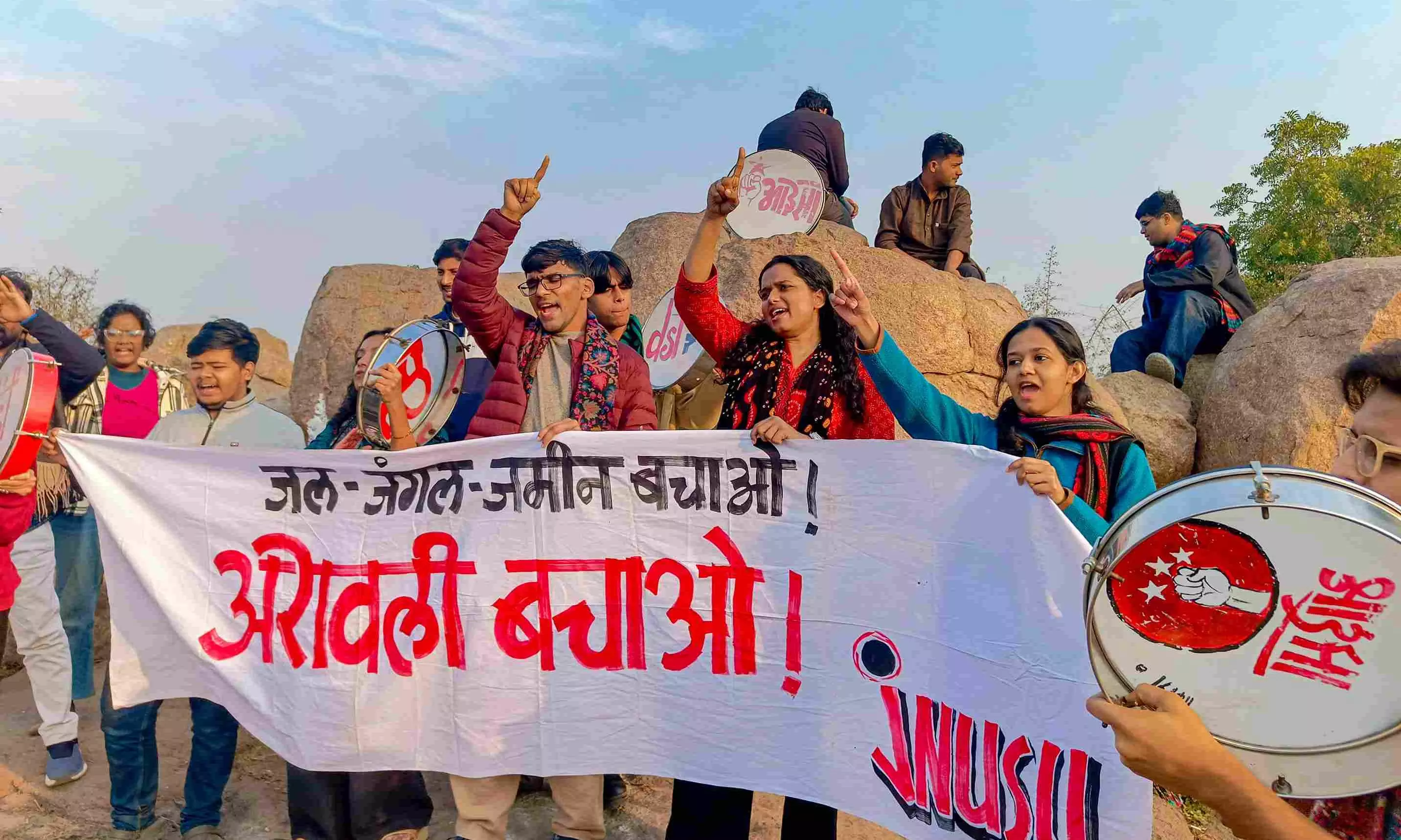
Students display banners during a protest for the protection of the Aravalli Hills at Jawaharlal Nehru University, in New Delhi, Saturday, Dec. 27, 2025. PTI photo:
SC to hear suo-motu case on Aravalli hills on Dec 29; here’s all about the issue
Even as SC bench takes suo-motu cognisance of controversial 100-metre elevation rule, The Federal explains what's at the heart of this raging controversy

Amid a row over the definition of Aravalli hills approved by it, the Supreme Court has taken suo motu cognisance of the issue and is slated to hear the matter on Monday (December 29). This development comes amid fears by environmentalists and activists of unregulated mining in this ancient mountain range, which may end up causing severe environmental degradation.
As per the cause list, a three-judge bench vacation of Chief Justice of India Surya Kant and Justices JK Maheshwari and Augustine George Masih is likely to hear the matter. The case is titled as 'In Re: Definition of Aravalli Hills and Ranges and Ancillary Issues'.
So what is the row about?
What is the issue over Aravalli hills?
At the heart of the issue, is the protection of the oldest mountain systems, an ancient range of weathered hills sprawled across four states, from the outskirts of Delhi to Gujarat.
A newly-framed, 'restrictive legal definition' of the Aravalli Hills is what is causing a controversy as critics warned that this move could expose much of the range to unchecked mining and construction activities. Recent court rulings and official clarifications seek to redefine what constitutes a “hill” eligible for protection.
Also read: Save Aravallis: Why Gujarat activists are wary despite govt assurances
This dispute carries far-reaching consequences for mining, construction, and conservation across Delhi NCR, Haryana, and Rajasthan. What hangs in the balance is not merely a matter of terminology, but the very survival of one of the world’s oldest mountain ranges.
Is the row over definition?
Yes, the core of the problem lies in the new definition of what constitutes a hill. The top court on November 20 had accepted a uniform definition of the Aravalli hills and ranges.
The apex court had accepted the recommendations of a committee of MoEF&CC (Ministry of Environment, Forest and Climate Change) on the definition of Aravalli hills and ranges to protect the world's oldest mountain system.
The committee recommended that "Aravalli Hill" will be defined as any landform in designated Aravalli districts, which is above an elevation of 100 metres or more above its local relief. Under this rule, only landforms that rise 100 metres or more above their immediate surrounding terrain qualify as protected hills. Importantly, this measurement is not from sea level, but from the lowest contour line encircling the base of each hill.
While an "Aravalli Range" will be a collection of two or more such hills within 500 metres of each other.
What the definition says
The committee, while defining Aravalli hills, said, "Any landform located in the Aravalli districts, having an elevation of 100 metres or more from the local relief, shall be termed as Aravalli Hills... The entire landform lying within the area enclosed by such lowest contour, whether actual or extended notionally, together with the Hill, its supporting slopes and associated landforms irrespective of their gradient, shall be deemed to constitute part of the Aravalli Hills."
The panel also defined Aravalli Range and said, "Two or more Aravalli Hills ..., located within the proximity of 500m from each other, measured from the outermost point on the boundary of the lowest contour line on either side forms Aravalli Range.
"The area between the two Aravalli hills is determined by first creating buffers with a width equal to the minimum distance between the lowest contour lines of both hills ... The entire area of landforms falling between the lowest contour lines of these Hills as explained, along with associated features such as Hills, Hillocks, supporting slopes, etc., shall also be included as part of Aravalli Range."
What environmentalists are saying
Environmentalists have not reacted positively to this new definition.
Also read: Congress accuses Centre of pushing ‘flawed’ Aravalli redefinition
Environmentalists and the Forest Survey of India (FSI) warn that this threshold covers over 90 per cent of the Aravalli system—specifically the lower hills and ridges that are geologically and ecologically part of the range but do not meet the 100-metre height requirement.
This also marked a sharp shift from the earlier Forest Survey of India (FSI) approach, which used state-specific minimum elevations (115 m in Rajasthan), a 3-degree slope threshold and 100-metre buffer zones. Environmentalists cautioned that the new metric could erase protection for nearly 99 per cent of Rajasthan’s FSI-identified Aravalli hills.
Dramatic peaks may be safeguarded, but gentler yet critical undulations risk being used for construction and land-use change. Experts have pointed out that mountains and hill systems are identified by the functions they perform, not by arbitrary elevation thresholds.
Activists are demanding that the government define Aravalli areas using scientific criteria, including geography, ecology, wildlife connectivity and climate resilience.
What's govt's point of view
The federal government, however, clarified that the new definition aims to strengthen regulation and ensure uniformity, stressing the need for a single, objective framework to govern mining consistently across states.
It further noted that the definition encompasses the entire hill system and that includes slopes, adjoining landforms, and intervening areas, and will safeguard hill clusters and their ecological linkages.
The environment ministry also rejected the assumption that all landforms below 100 metres would automatically be opened up for mining. Only 2 per cent of 147,000 sq km Aravalli range could potentially be mined, and only after detailed studies and official approval, said the environment minister Bhupender Yadav.
Why Aravalli Hills matter?
Despite its modest elevation, the Aravalli Range plays a vital role in safeguarding India’s environmental stability.
Firstly, extending across Gujarat, Rajasthan, Haryana, and Delhi-NCR, it serves as a natural shield, slowing dust-laden winds from the Thar Desert and preventing sand and fine particles from spreading into the Indo-Gangetic plains, thereby curbing air pollution.
Secondly, the Aravallis are crucial for groundwater recharge, as rainwater filters through fractured rocks to replenish aquifers that sustain urban centres like Jaipur and Gurugram.
According to experts, the lower, scrub-covered hills play a vital role in preventing desertification, recharging groundwater and supporting livelihoods according to experts.
Regulating climate
The forests and scrublands of the Aravallis help regulate local climates, mitigate heat stress, and anchor soils in semi‑arid zones vulnerable to desertification.
Also read: Modi govt has 'nearly signed death warrant' for Aravalli hills: Sonia Gandhi
Ecologically, the range sustains hardy dry forests, grasslands, and wildlife corridors, acting as a buffer against climate extremes. Despite their ancient and eroded form, the Aravallis draw strength from their unbroken continuity.
Disrupting or flattening these hills threatens air quality, water security, and climate resilience across northern India, say experts.
What SC says
Meanwhile, the SC delivered a 29-page judgement in the suo motu matter arising out of the long-running environmental litigation in TN Godavarman Thirumulpad case.
"We further accept the recommendations with regard to the prohibition of mining in core/inviolate areas with exception as carved out of the ... committee's report," CJI Gavai, who authored the judgement, said.
The bench also accepted the recommendations for sustainable mining and the steps to be taken for preventing illegal mining in Aravalli Hills and Ranges.
It also directed the authorities to identify permissible areas for "mining and ecologically sensitive, conservation-critical and restoration priority areas within the Aravalli landscape where mining shall be strictly prohibited or permitted only under exceptional and scientifically justified circumstances".
Calling the Aravallis a "green barrier" that prevents the eastward spread of the Thar desert and supports rich biodiversity, the court held that a clear, scientific definition was essential for ensuring environmental conservation, regulating land use, and determining permissible mining activities.