



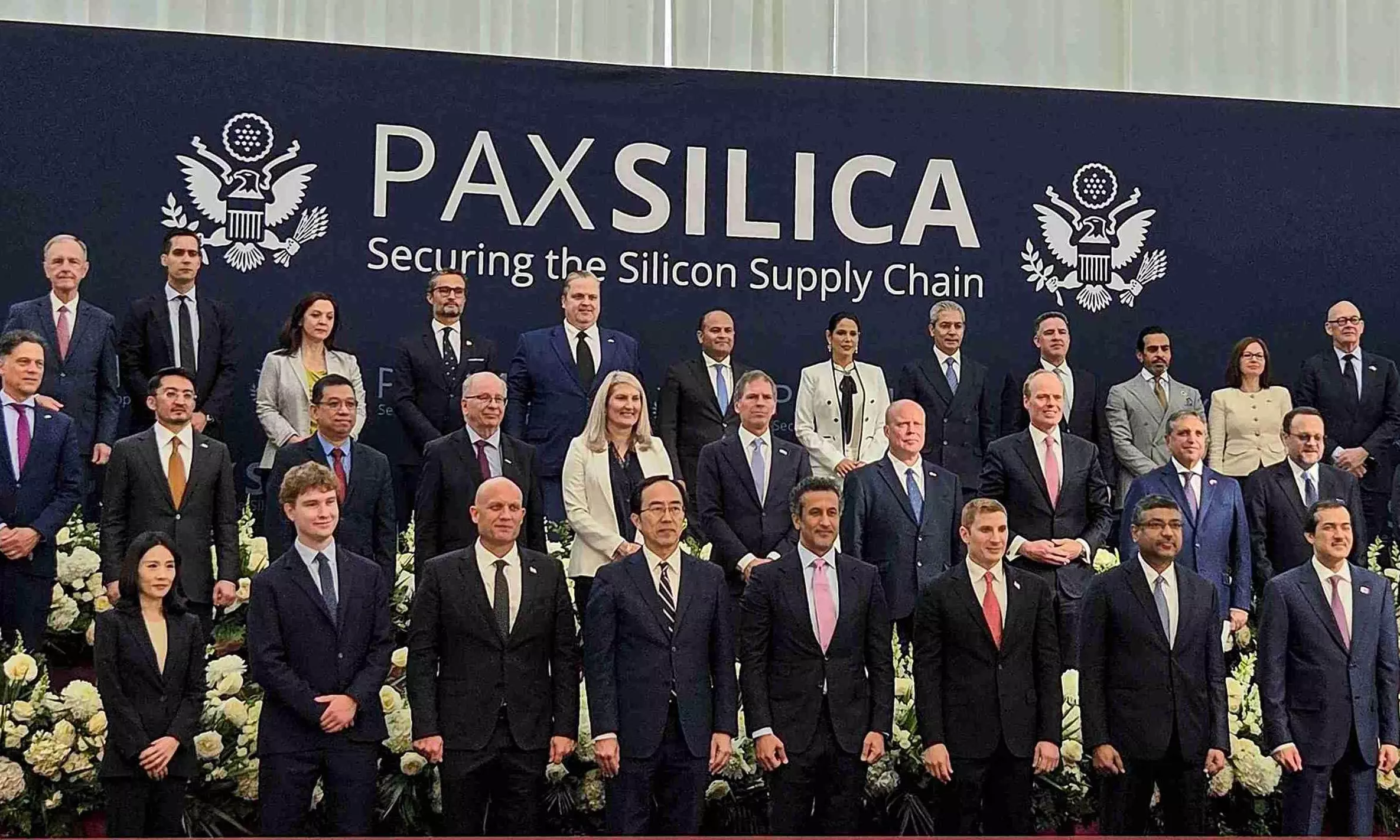
Pax Silica had expanded from a small coalition of US allies into a broader network involving countries across Europe, Asia, the Middle East and Latin America. Photo: PTI
Pax Silica explained: How India matters to the global AI supply chain pact
Beyond trade, the pact emphasises AI sovereignty; discover why India is a linchpin in securing the hardware and compute power behind the AI revolution

As the use of AI grows at a stunning speed, the term 'Pax Silica' is gaining traction. Thirty-five countries, including India, endorsed the US-led Pax Silica framework at the second Pax Silica Summit in Washington DC on Thursday (June 25).
Here is a quick breakdown of what this framework is and why it matters, with a focus on India’s critical role.
What is the Pax Silica initiative?
It's a US-led strategic framework designed to build secure, resilient, and "trusted" supply chains for the entire AI ecosystem. The name combines the Latin word pax (peace/stability) with silica (the foundation of silicon chips).
Also read: ‘Pax Silica’ minus India: Another US snub to India to gain wider market access?
It moves beyond just making chips to cover the entire "stack": from the extraction of critical minerals and energy generation to semiconductor manufacturing, data centers, and advanced computing infrastructure.
The founding members are the US, Australia, Israel, Japan, Singapore, South Korea and the UK. India was not part of the inaugural December 2025 meeting but joined the framework later in February 2026.
What is India’s role in Pax Silica, and why did it join?
India is considered a cornerstone of the Pax Silica framework. Since joining this February, India has moved from being a technology consumer to a strategic builder, positioning itself as a vital alternative hub for the global tech industry.
Engineering and talent: India brings a massive, highly skilled engineering workforce capable of designing advanced chips and developing AI models. The coalition views this talent pool as essential to meeting the global demand for millions of new AI specialists.
Manufacturing ambitions: India is scaling its semiconductor assembly, testing, and packaging (ATMP) capabilities, offering a "trusted" geography for companies looking to diversify away from concentrated supply chains in East Asia.
Strategic guarantee: A key motivation for India’s participation is securing long-term access to advanced AI technologies. During the June 2026 summit, Indian officials (led by the Ministry of Electronics and IT) successfully sought guarantees from the US that "trusted partners" like India would not face abrupt technology cutoffs, ensuring that India’s domestic digital infrastructure remains stable.
Infrastructure synergy: India is integrating its domestic semiconductor and AI missions with Pax Silica’s goals, connecting its growing network of data centres and renewable energy capacity to the global "trusted" supply chain.
Why was this framework created in the first place?
The global technology supply chain is currently highly concentrated, particularly in East Asia. Policymakers are concerned that this creates "chokepoints"—where a single regional conflict, pandemic, or geopolitical dispute could cripple the global supply of chips and technology.
Also read: Why nickel breakthrough in Chhattisgarh could boost India’s EV supply chain
Furthermore, the initiative is seen as a direct response to China’s dominance in the refining and mining of critical minerals, which are essential for everything from EVs to advanced AI hardware.
The world’s most advanced semiconductors are largely manufactured by companies such as Taiwan Semiconductor Manufacturing Company (TSMC) in Taiwan. Any geopolitical disruption in the region could affect global access to chips used in AI systems, smartphones, defence technologies and other industries.
The initiative also addresses the massive energy and infrastructure requirements of AI. Building large-scale AI models requires enormous computing capacity, data centres and reliable energy sources. The member countries are seeking to develop these resources through cooperation and investment partnerships.
What happened at the second Pax Silica summit on June 25?
The summit in Washington, DC, saw the coalition expand to 35 nations, with the EU and several Latin American nations joining. Key outcomes included:
Pax Pass: The launch of a new platform to streamline the movement of AI-related goods between trusted partners, using AI-powered risk assessment to reduce trade friction.
Foundry School: An initiative to train the next generation of engineers and entrepreneurs across member states.
Investment: The US committed $50 million in seed funding to support these logistical and workforce development efforts.
Is this just another trade deal?
Not quite. Unlike standard trade agreements that focus on tariffs or market access, Pax Silica functions more as a security and industrial policy pact.
It is based on the philosophy of "innovation sovereignty"—the idea that in the 21st century, national security is inseparable from the ability to control and contribute to the "compute" and hardware that power the global AI economy.