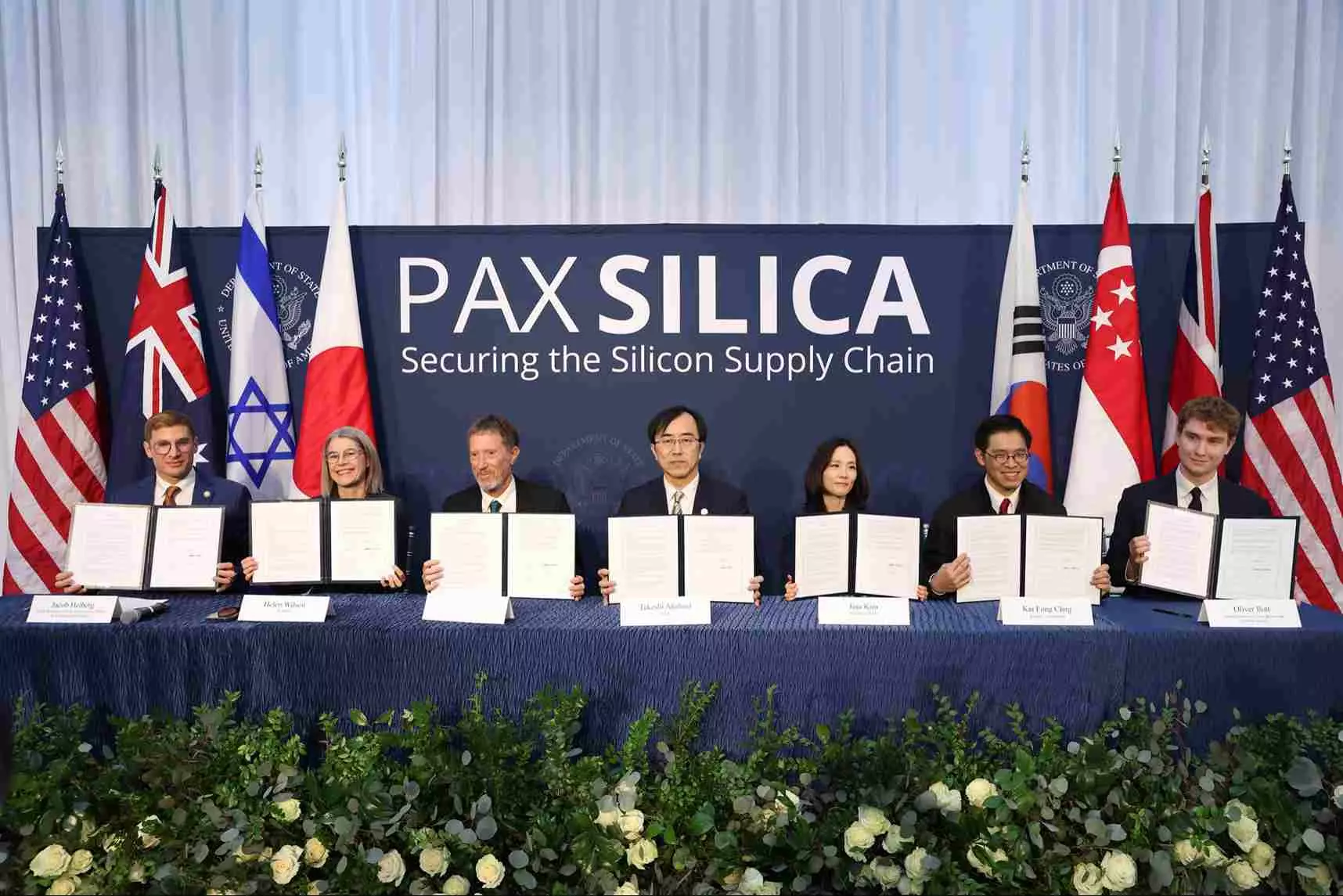
‘Pax Silica’ minus India: Another US snub to India to gain wider market access?
India’s exclusion from US-led initiative in areas of critical minerals, semiconductor and AI infrastructure follows Mexico’s high tariffs and Trump’s threat to basmati rice export

Several troubling signs have emerged in the past few days that may point to the US building up pressure on India to widen market access, particularly for its agricultural produce. The latest one is keeping India out of its global “Pax Silica Initiative”, a strategic move aimed at building “a secure, prosperous, and innovation-driven silicon supply chain – from critical minerals and energy inputs to advanced manufacturing, semiconductors, AI infrastructure, and logistics”.
Also read | US keen to prise open Indian agri market, in new twist in trade deal
This nine-country initiative, announced by the US Department of State on December 11, has Japan, South Korea, Singapore, the Netherlands, the UK, Israel, the UAE and Australia as members. Though the statement claims that “it is not about isolating others, but about coordinating with partners who want to remain competitive and prosperous,” the US and Europe have been trying to build alternate global supply chains after China disrupted the supply of rare earth minerals earlier this year.
Strategic tech alignment leaves India out
India’s exclusion goes against the US Treasury Secretary Scott Bessent’s statement of October 2025 in the context of China’s export controls on rare earth magnets. Talking to a TV channel, Bessent said the US would “be speaking with our European allies, with Australia, with Canada, with India and the Asian democracies, and we're going to have a fulsome group response to this.” He specifically mentioned that this was “China versus the world” and “not a US-China problem” and that “bureaucrats in China cannot manage the supply chain or the manufacturing process for the rest of the world.”
The Pax Silica objectives that risk isolating India globally in critical technology areas include:
(i) Projects to “jointly address” AI supply-chain opportunities and vulnerabilities across priority sectors such as critical minerals, semiconductor design, fabrication and packaging, logistics and transportation, compute capacity, and energy grids and power generation;
(ii) Joint ventures and strategic “co-investment” arrangements;
(iii) “Protect sensitive technologies and critical infrastructure” from undue access or control by countries of concern; and
(iv) “Build trusted technology ecosystems”, encompassing ICT systems, fibre-optic cables, data centres, foundational models and related applications.
Two other recent developments also point to the US pressures.
Mexico’s tariff and renewed US pressure on Indian farm exports
A day earlier, on December 10, Mexico announced up to a 50 per cent tariff on goods from India, China and other countries that would affect textiles, footwear, appliances, cars and auto parts, etc., from January 2026.
Also read | Mexico slaps steep tariffs on Asian imports; India among countries hit
The surprising part is that Mexico doesn’t figure in India’s top 20 export or import destinations. Why would Mexico put India in its high-tariff list?
The Washington Post and others quoted Oscar Ocampo of the Mexican Institute for Competitiveness to explain Mexico’s surprise move in general: “The real reason has to do with the United States, it has to do with the review of the USMCA (free trade agreement) that is coming up, with the negotiations to obtain reductions, exemptions from the tariffs that Mexico is facing at this moment to access the US market.”
The US administration has accused China of using Mexico as a backdoor into the US market, not India. Could Mexico be doing it to India to please US President Donald Trump?
Consider another development.
On December 8, Trump threatened to impose a new tariff on Indian basmati rice when a US agricultural sector delegation alleged India was “dumping” it on the US, at a White House meeting. The next day, US Trade Representative Jamieson Greer told the Senate that India was a promising market as an alternative to China for its agricultural exports, but found it hard to crack.
The US has been pushing India hard for its corn and soybeans (for making ethanol) even after India shut its agricultural and dairy markets during the trade negotiations and in public pronouncements on multiple occasions.
Impact of Pax Silica on India’s growth in critical tech areas
The industry doesn’t seem worried. Veer Sagar, chairman of the Electronic and Software Export Promotion Council (ESEPC), says the US has been behaving strangely for some time now, but the US companies are putting money into India. Recently, he pointed out, the US tech giants like Microsoft, Amazon and Google have announced heavy investments to develop AI and cloud infrastructures (data centres), and others are investing in semiconductors and critical minerals.
For now, he sees “no adverse impact”, but going forward, he is not so sure.
Vikas Gupta, additional executive director of ESEPC, sees the Pax Silica purely as a geopolitical development that wouldn’t stop big multinationals from expanding their markets in India in their own business interests as they are doing now. “Our momentum (in building up semiconductors, AI and cloud infrastructures) will continue. We have to grow, not compete at the moment,” he says matter-of-factly.
Also read | Trump signals fresh tariffs on Indian rice, alleges dumping in US
Dr Ashwini Rath, entrepreneur and tech expert, says that since Western countries are major partners in these critical future growth areas, India would like to be part of such initiatives. He adds: “We may not be contributing significantly to say, AI infrastructure, but we would like to. From the Western perspective, they must consider us from our technological prowess and significant economic and geopolitical positions.”
Another expert, who wishes to remain anonymous, sees the development in a different light: “We have nothing to offer but hollow talks.”
Nonetheless, all the above developments point to India’s need for fresh diplomatic efforts to protect its interests in trade and technology.