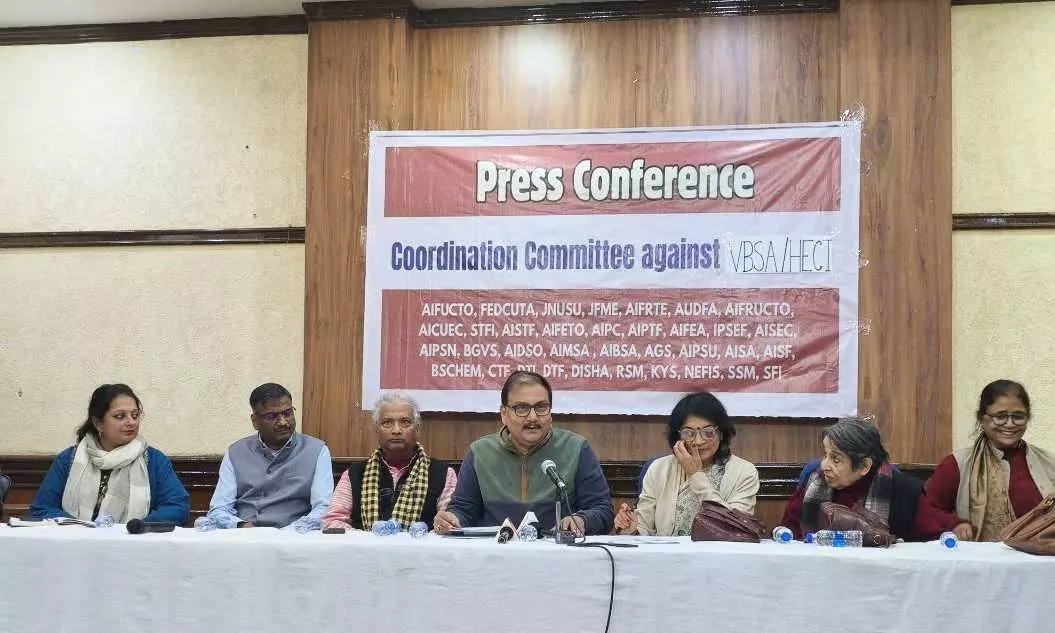
The joint press conference organised by the Coordination Committee Against VBSA/HECI on Monday (December 15). Photo: The Federal
Teachers, students, Opposition MPs flag centralisation, reduced funding in VBSA Bill
The proposed VBSA Bill repeals the UGC, AICTE, and NCTE Acts, but critics argue the removal of grant disbursal from the regulator fundamentally alters university autonomy and is an 'attack on federalism'

The Viksit Bharat Shiksha Adhishthan (VBSA) Bill, 2025 placed in Parliament and referred to a Joint Parliamentary Committee (JPC) on Monday (December 15), has triggered sharp opposition from teachers’ organisations, student unions, and Opposition MPs, who argue that it marks a deeper structural shift in the country’s higher educational regulatory structure, much more than the shelved Higher Education Commission of India (HECI) Bill of 2018.
At the centre of the controversy is the government’s proposal to repeal the University Grants Commission (UGC) Act, 1956, the AICTE (All India Council for Technical Education) Act, 1987, and the NCTE (National Council for Teacher Education) Act, 1993, and replace them with a single apex body that will oversee regulation, accreditation, and standards-setting across higher education.
What does VBSA Bill propose?
The Bill seeks to establish the Viksit Bharat Shiksha Adhishthan, an apex commission that will coordinate three councils: a Regulatory Council (Viksit Bharat Shiksha Viniyaman Parishad), an Accreditation Council (Viksit Bharat Shiksha Gunvatta Parishad), and a Standards Council (Viksit Bharat Shiksha Manak Parishad). Together, these bodies will determine academic standards, accredit institutions, enforce compliance, impose penalties, and even recommend the closure of institutions deemed non-compliant.
Also Read: HECI Bill: Teachers, students oppose, meet non-BJP MPs for support
However, unlike the earlier UGC framework, the Bill explicitly removes grant disbursal from the regulator’s mandate, placing funding decisions directly under the Ministry of Education.
Teachers’ bodies argue that this delinking of regulation and funding fundamentally alters the balance between autonomy and accountability in public universities, and is a direct attack on federalism, as education is in the Concurrent List of the Constitution, granting both the Centre and states the power to legislate.
How is this different from 2018 HECI Bill?
While the government has described the VBSA Bill as a reformulated version aligned with the National Education Policy (NEP) 2020, critics point out that it departs from the 2018 HECI Bill in crucial ways. The draft HECI Bill of 2018 itself was shelved after stiff opposition from teachers, students, and political parties.
Most significantly, the grant-giving body has disappeared altogether. Under the 2018 HECI proposal, a separate Higher Education Grants Council was envisaged. In the VBSA Bill, this function is removed from the statutory framework entirely.
Also Read: Parliamentary panel slams NTA's performance, suggests corrective measures
As Sandhya Devesan from the Democratic Teachers’ Initiative (DTI) said at a joint press conference organised by the Coordination Committee Against HECI (VBSA) on Monday (December 15), “The present model of the VBSA completely erases this fact of the grant body. The grant body has completely disappeared… which confirms that grants are going to be completely centralised and used for ideological compliance.”
Critics flag composition of proposed commission
Critics also flagged the composition of the proposed commission as being more heavily tilted towards the Centre than the 2018 draft. Earlier, of the 12 members, 10 were supposed to be central government officials, and the other two were teacher representatives.
Now, of the 12, four are going to be ex-officio members – presidents of the three Councils (Regulatory, Accreditation, and Standards) and the Higher Education Secretary. Apart from this, there will be “two eminent and distinguished academicians not below the rank of Professor from the State Higher Educational Institutions”, “five eminent experts”, and a Member Secretary who is to “function as the Chief Executive Officer and ensure general superintendence and co-ordination with respect to all administrative matters of the Commission”.
Also Read: UGC draft math curriculum obsolete and retrograde: Prof Amber Habib
“They are clearly not going to be academic figures and are obviously going to be serving the ruling dispensation. So they will be just mouthpieces of the ruling party… The two members, who are supposed to be the academic members and state representatives, could also very well come from BJP-ruled states. They can completely make invisible the existence of every other state and every other member and just choose members from their own states ruled by their own party members… Obviously, this is going to be a complete subversion of any kind of academic freedom or any kind of democratic composition that we have seen before,” said Devesan.
Explicit enforcement architecture
Another key difference, critics argue, is the explicit enforcement architecture. Chapter 7 of the Bill empowers the regulator to impose penalties running into tens of crores, suspend degree-granting powers, revoke affiliations and recommend winding up institutions, with repeated violations attracting progressively-harsher sanctions.
The most apparent difference is in the name of the Bill – seen as another example of Hindi imposition by the Central government, which has drawn sharp criticism from various opposition MPs, particularly from South India.
Is this only about regulation?
Opposition MPs argue that the Bill is not merely administrative but ideological in scope.
CPI(M) Rajya Sabha MP V Sivadasan alleged that the policy trajectory reflects a shift away from public investment towards corporatisation.
“They prepared this bill with the help of these Indian corporates… They have given huge amounts to private universities, but at the same time public universities are crying for the support of the Union government,” he said at the press conference.
RJD MP Manoj Jha, who has consistently opposed earlier iterations of the HECI proposal, said the legislation marks a shift from regulation to control.
Also Read: Why academic experts are up in arms over UGC’s new curriculum draft
“It is not only about regulation. It is about controlling the very thought process — your engagement and the freedom to read and write,” he said.
Jha also linked the Bill to a longer political trajectory.
“After 2024, for almost a year, he (Modi) used to hold on to his authoritarian instincts. That pretension is over after (election results in) Haryana, Maharashtra, and lately after Bihar. He feels he’s in the 2019 situation politically. That is why they are attempting these kinds of things, which is going to fundamentally alter the way the university system in India has functioned so far,” he said.
Teachers’ organisations have also pointed to the Bill’s mandate to promote an undefined “Bharatiya knowledge” framework, arguing that it is just another step towards saffronisation of education.
Does sending the Bill to a JPC help?
While the Coordination Committee has been demanding that the Bill be sent to the Parliamentary Standing Committee for wider consultations, given the scale of the overhaul, they will now have to do it with a Joint Parliamentary Committee (JPC).
However, Manoj Jha struck a cautionary note on whether such a referral would be sufficient.
“It is a BJP and NDA-heavy committee. Maine kayi bill dekhen hain jisme maut ki tarikh thodi aage ho jaati hai, par maut tay hoti hai (The date of death is pushed, but death is certain)… This has just been delayed for 2-3 months… People like me, if they want to join that committee, I can tell you they will not include me. I can vouch for it. I will give you proof of it. I will approach them, ‘please include me’; probably there are only one or two persons in this parliament, including me, who has not severed his links with the university. They will not include me. And for obvious reasons,” he said.
Also Read: 'Bid to push RSS agenda': Rahul slams govt over UGC regulations
Manoj Jha is also a professor at Delhi University (DU).
V Sivadasan echoed the need for a broader political struggle, linking the Bill to declining public expenditure on education.
“If you compare the investment in the education sector in India, it is much less than other countries like Bangladesh and South Africa,” he said, adding that regulatory restructuring without funding would only deepen existing crises such as faculty shortages and fee hikes.
What happens next?
Teachers’ and student bodies insist that the VBSA Bill represents not just a revival of the 2018 HECI proposal, but a more centralised and enforcement-driven framework, with funding power concentrated in the executive.
The Federation of Central Universities Teachers’ Association (FEDCUTA) has demanded “the unconditional withdrawal” of the Bill, pointing out that “‘reforming’ of higher education on the foundation of contempt for the opinions and sentiments of the educators is always destined to be a dead end”.
Also Read: New UGC rules are a disaster; education needs to go back to State List
At the press conference on Monday, the message was clear – a big movement needed to be launched to push back the Bill.
Rajeev Kunwar from the Democratic Teachers’ Front (DTF) said the fight would necessarily need to involve going to as many people as possible and mobilising the support of maximum political parties.
Manoj Jha said, “There is no whip on the streets. There is no speaker on the streets… There is no time limit on the streets. We must utilise that and be prepared… We have to be ready for a big battle… Our numbers are going down, but that mindset that nothing will change – we have to jettison it.”