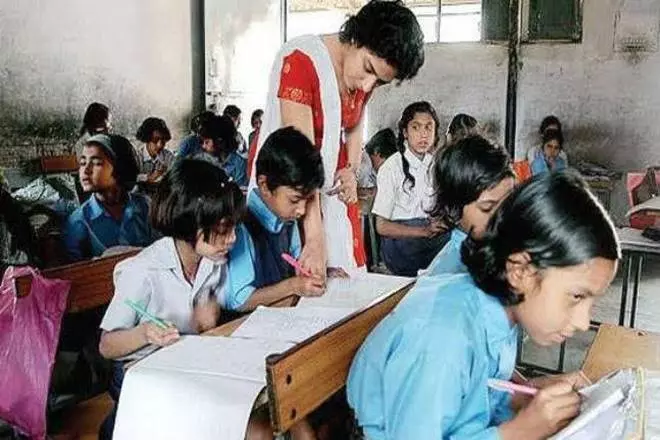
Census duty adds to teachers’ burden, disrupts learning process in Delhi govt schools
With election work, board exams, and welfare drives already stretching staff, fresh census duties pull teachers out of classrooms, raising concerns over learning gaps and systemic strain

The upcoming census has added yet another layer to the mounting non-academic workload of Delhi’s government school teachers, deepening a pattern where classrooms are routinely disrupted by administrative demands. What was already a system stretched by election duties, exam duties, and welfare drives is now set to face fresh strain, as teachers are once again being pulled out of schools to serve as the state’s on-ground workforce.
In the past two months, many teachers have been on CBSE duty for Class 10 and 12 board exams, with the second round of Class 10 exams scheduled to begin in mid-May. Alongside this, several are working as Booth Level Officers (BLOs) for election mapping ahead of the Special Intensive Revision (SIR) exercise in Delhi. With census activity now underway, the cumulative pressure is beginning to show in already resource-strained government schools.
‘Doing everything but teach’
“It seems to me that the state thinks that government school teachers are the most jobless people in the world, and they have all the time to run around doing administrative work. Almost 90 per cent of us are involved in some government work or the other. We are doing everything except what we are hired to do – teach,” said a government school teacher who is a BLO in Narela.
Also Read: AAP, BJP spar over claim that Delhi teachers were roped in for stray dog duties
The disruptions are not just frequent, but often sudden.
“Most of these assignments come at very short notice, so there’s hardly any time to plan or arrange substitutes. When one of us is pulled out, multiple classes lose continuity, and the rest of the staff has to stretch themselves or merge sections. Over time, it really disrupts the rhythm that proper teaching needs,” said a teacher in a government school in Kirari.
‘Breaking point’
In some schools, the strain has reached a breaking point.
“Today, the SHO, ACP, and 8-10 police personnel came to our school, and they said it looked like war preparations were going on. We’re completely fed up with continuous work. We have only 7-8 teachers to attend to 24 sections at the moment. How is that humanly possible?” said the principal of a government school in Model Town.
Also Read: Teachers on the brink: Deaths, threats, and unbearable SIR workload in Gujarat
He added that the latest round of census-related work has further stretched the system.
“At our school, 100 per cent teachers are attending the census training, which is being held from morning to evening for three days. Around 25 per cent teachers are involved in BLO work. Those people are doing double duty,” he said.
Range of parallel responsibilities
Beyond classrooms, the burden extends into a range of parallel responsibilities.
The month-long Delhi Khel Mahakumbh, which began on February 13, for instance, saw physical education teachers deployed extensively.
“As long as that went on, our duties were there. Apart from the administrative work in schools and the routine government work, we are also being involved in all this. It is endless,” said a PT teacher.
Threat of repercussions
There is also the threat of the repercussions that come from not doing the work as expected.
“We have to submit a report at 5 pm every day detailing how much we have achieved that day. During the month of March, I could not focus much on my responsibilities at school because we were under pressure to meet our targets. Some people who have not been able to do it have also received show-cause notices,” said a government school teacher from Ashok Vihar, who is also a BLO.
In some cases, the strain spills over into personal lives. On days she could not go out for BLO work, her husband stepped in.
“Some of us have done the errands for our spouses because we understand their predicament. It has been a challenge because all the old BLOs were removed, and new ones were appointed who don’t know the people as well, and whom people don’t know either,” he said.
Delhi HC 2019 order
This is not a new tension. Courts and policy frameworks have long grappled with whether teachers should be used for non-academic state functions. The Delhi High Court had in 2019 directed that teachers should not be engaging in such duties, recognising that their primary role lies in education.
However, last year, the Supreme Court said there were no restrictions on appointing teachers for such work.
Structural constraints
In Delhi, the issue is compounded by structural constraints. Government schools already operate within tight staffing margins, relying heavily on guest and contractual teachers to fill vacancies.
The impact extends beyond teaching hours. Administrative functions within schools – admissions, assessments, parent interactions – also suffer.
Full burden on govt school teachers
There is also a question of equity. Students in private schools remain largely insulated from such disruptions, while those in government schools, most often from economically-weaker backgrounds, face repeated interruptions in learning, risking a widening of existing educational gaps.
Also Read: EC faces Bengal teachers' 'rebellion' as Bihar-like SIR move gathers storm
“The government wants teachers to do everything because they think they are more reliable. All the burden then falls on government school teachers. We don’t mind working, but why should we do all the work? Why shouldn’t more private schools and government-aided schools be made part of this?” said a teacher.