



Does red belong to Zomato? 18th birthday ad sparks confusion
A no-logo, no-name ad relying on red background triggered a debate on social media over whether Zomato had overestimated the exclusivity of its brand colour

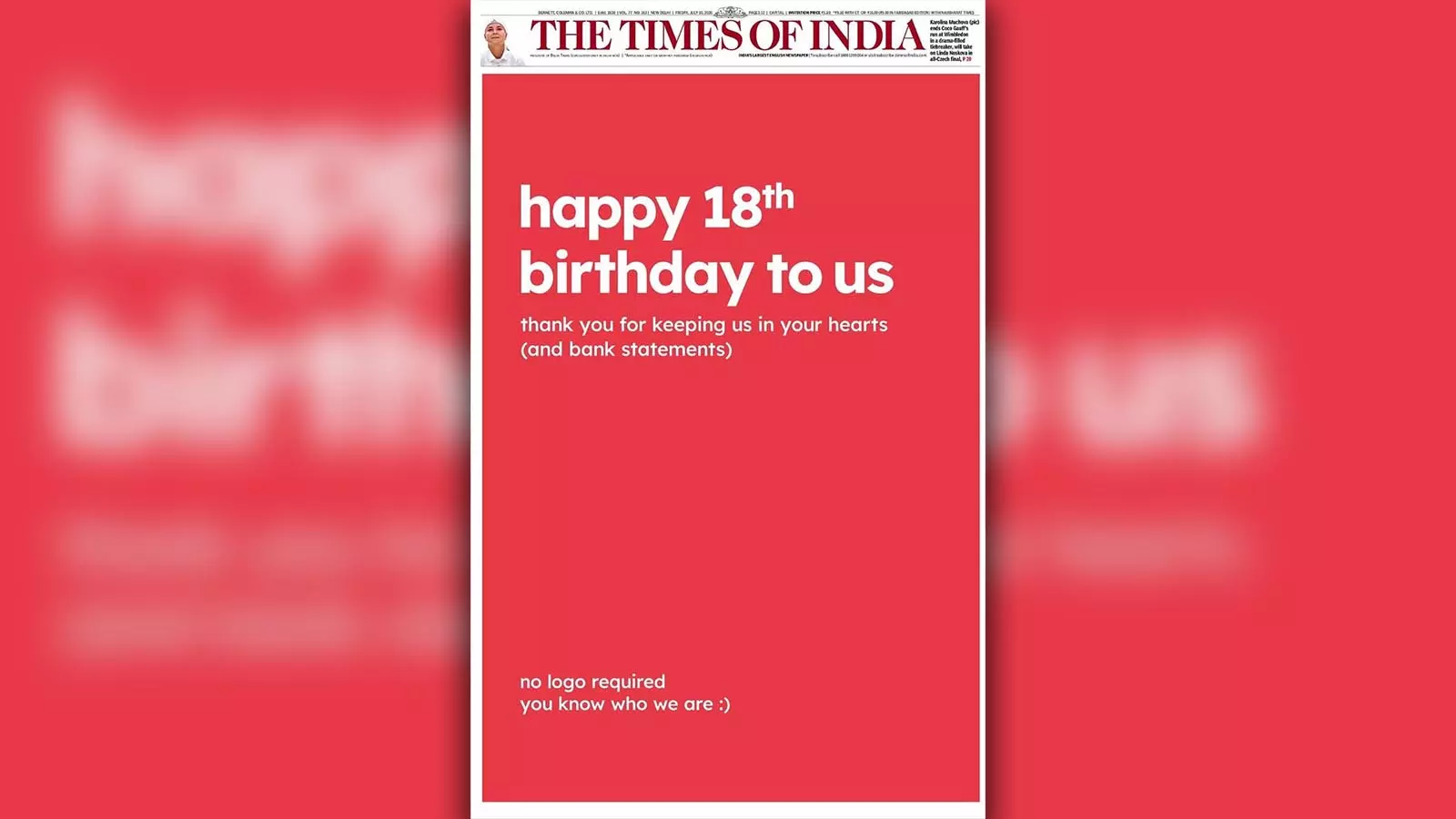
Food delivery platform Zomato marked its 18th anniversary on Friday (July 10) with a minimalist front-page newspaper advertisement that featured neither its name nor logo. It simply wished itself a happy birthday with the line: "No logo required, you know who we are."
Apparently, not many did.
The campaign relied almost entirely on a solid red background and consumer familiarity with the brand, suggesting that its visual identity alone was enough to make it instantly recognisable.
Also read: Zomato hikes platform fee to Rs 14.90 amid rising fuel costs
However, the ad quickly triggered a debate on social media over whether Zomato had overestimated the exclusivity of its brand colour.
'Red doesn't belong to Zomato'
Many users argued that red is one of the most commonly used corporate colours in India and is associated with several major brands.
X user Pankush Chhabra summed up the criticism by listing brands such as Airtel, Coca-Cola, redBus, Airbnb and The Times of India, questioning Zomato's assumption that consumers would automatically associate the colour with the food delivery platform.
Marketing discussions on LinkedIn echoed similar concerns. Brand strategist Vineet Chugh wrote that while he identified the advertisement immediately, his wife did not. According to him, she initially assumed it could belong to brands such as Airtel or Kotak Mahindra Bank, calling the campaign bold but also somewhat overconfident.
For many newspaper readers, the small line beneath the main message — and bank statements — added to the confusion. Some even mistook it for a banking advertisement because financial institutions such as Kotak Mahindra Bank, HSBC and Axis Bank also prominently use red in their branding.
Brand recall
Brand experts noted that logo-less advertising succeeds only when a company's distinctive brand assets are strong enough to complete the visual puzzle. Colour alone is rarely sufficient unless it is supported by unmistakable typography, design language, product imagery or years of cultural association.
In Zomato's case, the campaign effectively tested whether its strongest brand code was truly the colour red or the broader combination of its app interface, logo, typography and digital presence.
Also read: Zomato rebrands as 'Eternal,' signals shift towards quick commerce
The assumption is not entirely unfounded. Much like Swiggy's signature orange has become instantly associated with the food delivery platform for many consumers, Zomato appears to believe its shade of red has achieved similar recognition.
However, unlike orange, which is less crowded as a brand colour in India's consumer space, red is shared by several prominent brands, making it harder for Zomato to claim exclusive ownership in the minds of a broader audience.
While many users identified the ad instantly, others argued that the campaign demonstrated that red remains a shared brand colour rather than one exclusively owned by Zomato.
Zomato joins the conversation
After the online discussion gathered momentum, Zomato responded in its style.
"We've come a long way over the past 18 years, from getting cancelled on Twitter to getting cancelled on X. Happy birthday to us."
The post acknowledged the criticism while reinforcing the playful and self-aware personality that has become central to Zomato's social media strategy.
Not the first controversy
This is not the first time one of Zomato's advertising campaigns has sparked debate.
Earlier, the company faced criticism over a billboard carrying the initials "MC. BC." While the fine print expanded them as "Mac n' Cheese" and "Butter Chicken," many users pointed out that the initials are commonly understood as offensive Hindi expletives. The campaign drew criticism online, with several users calling it crass and insensitive.
The latest birthday advertisement may have succeeded in generating conversation, but it has also reignited an important branding debate: while Zomato enjoys strong recall among digital consumers, whether a single colour is enough to identify the brand remains open to interpretation.