



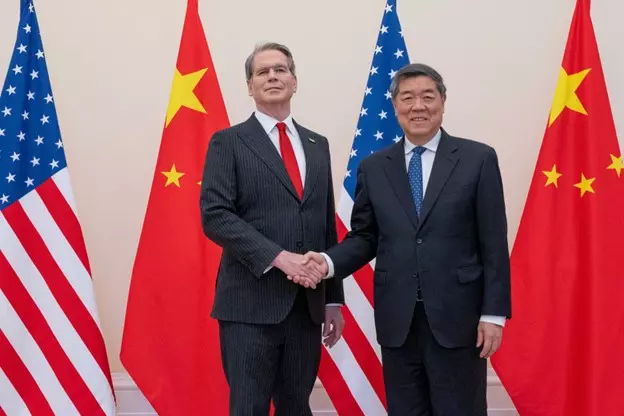
US Treasury Secretary Scott Bessent at a recent meeting with China's Vice Premier He Lifeng to discuss areas of mutual interest. Photo: X|@SecScottBessent
US considers lifting sanctions on 140 million barrels of Iranian oil to blunt price surge
Treasury Secretary Scott Bessent targets physical supply boost via Strategic Reserve releases and naval cooperation with Japan to offset Strait of Hormuz deficit

The US on Thursday (March 19) said it may lift sanctions on Iranian oil currently stranded in tankers in the Strait of Hormuz to calm the rising prices.
The move is an attempt to stabilise surging energy costs, which have seen oil prices hover above $100 per barrel for the better part of two weeks.
US Treasury Secretary Scott Bessent told Fox Business Network that in the coming days, "we may unsanction the Iranian oil that's on the water" and that is about 140 million barrels.
Additional oil supplies
The addition of sanctioned Iranian oil into global supplies would help temper oil prices down for the next 10 to 14 days, he said. This supply crunch is the outcome of intense volatility in the region, after which Iran closed the Strait of Hormuz to commercial shipping and attacked tankers.
This move mirrors a recent Treasury Department decision to permit the sale of sanctioned Russian oil, an initiative that successfully injected 130 million barrels into the global market.
Also read: Hormuz block threatens not just oil and gas, but may disrupt global internet too
Secretary Bessent further outlined a multi-pronged strategy to bolster physical supplies, including a unilateral release from the US Strategic Petroleum Reserve. This action would go beyond the 400 million barrels already committed in last week’s coordinated G7 release, he added.
Boosting physical supplies
While Bessent explicitly stated that the Treasury would "absolutely not" intervene in oil futures markets, he emphasised that the priority remains increasing the physical inventory to offset the current global deficit of 10 to 14 million barrels per day resulting from the Strait of Hormuz closure.
To further secure these supplies, President Donald Trump is scheduled to meet with Japanese Prime Minister Sanae Takaichi at the White House this Thursday.
Also read: Over 2 million tonne of Indian LPG, LNG cargo stranded in Persian Gulf
A primary topic of discussion will be the Japanese navy’s potential role in protecting shipping lanes in the Strait of Hormuz, a critical transit point for the majority of Japan's oil. Bessent expressed optimism regarding the meeting, describing Takaichi as "very pro-US" and suggesting that Japan might release additional oil from its own strategic reserves, moving beyond the amounts pledged in the recent joint G7 action.
China slammed
Furthermore, Bessent criticised China’s recent trade shifts, labelling the country an "unreliable" supplier. This follows Beijing's decision to halt exports of refined products, such as jet fuel, to its Asian neighbours.