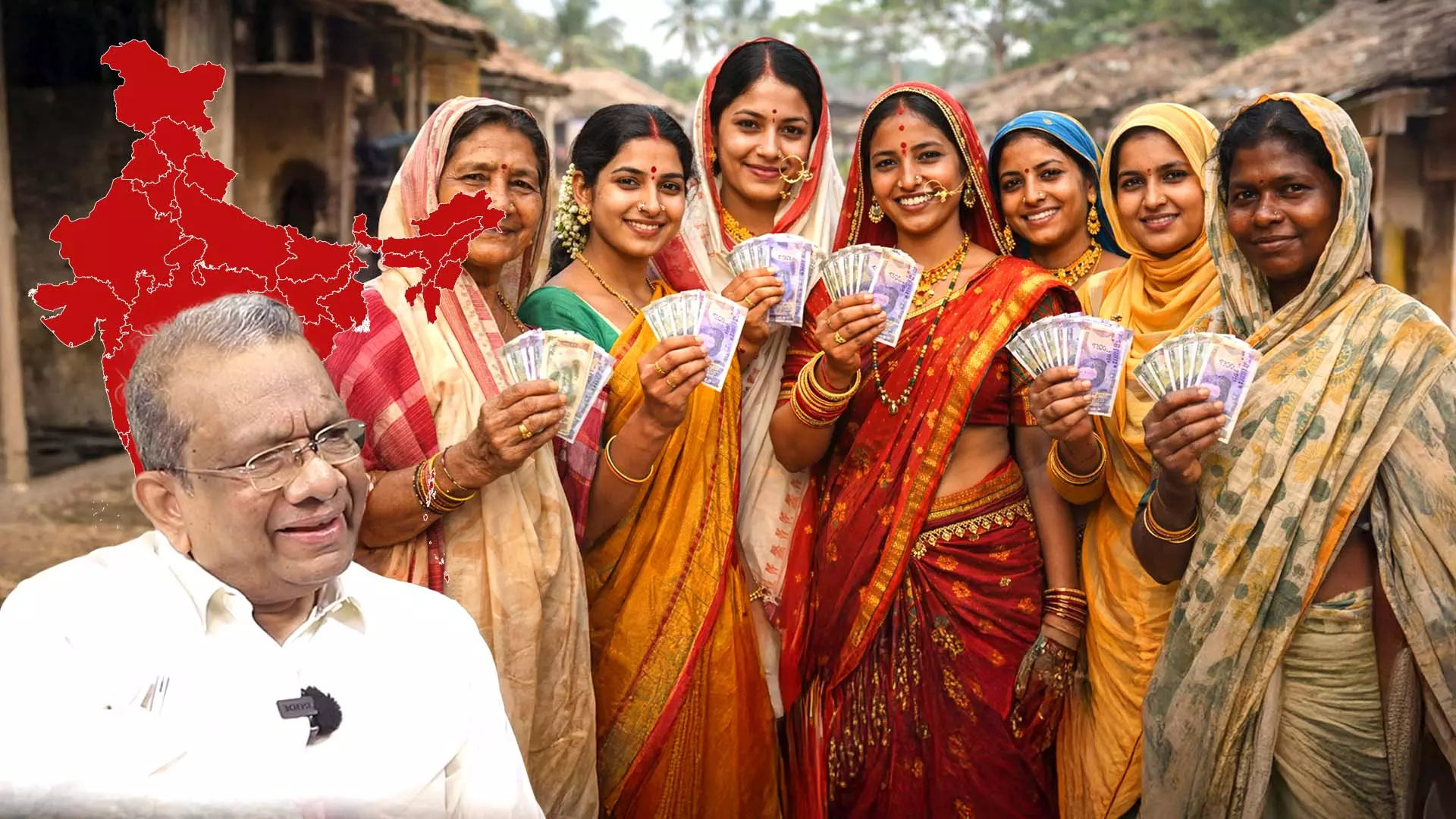
Can India impose conditions on cash transfers? | Interview with economist
Are cash transfers empowering women or quietly draining state finances? An economist breaks down the truth behind India’s biggest welfare debate

Unconditional cash transfers worth Rs 2.81 lakh crore are being portrayed as a looming fiscal disaster, but economist K Prabhakar, in an exclusive interview with The Federal, argues that this fear is misplaced and politically selective. He says the real stress on public finances comes from corporate tax cuts and loan write-offs, not welfare spending that directly improves women’s health, nutrition and labour participation.
Also read: Why Economic Survey talks about obesity, mobile addiction? AI With Sanket
Prabhakar, among other things, also spoke on whether income support schemes strengthen social protection or undermine state finances, and what the Economic Survey gets wrong.
Unconditional cash transfers have expanded rapidly across states. At what point do they turn from social protection into a fiscal risk?
The first thing we must look at is the total expenditure. Even if you take 12 to 15 states together, spending on these schemes has not crossed 0.8 per cent of GDP. Internationally, we have examples like Mexico and Brazil. Mexico began in 2007 and Brazil in 2003. These were conditional cash transfer programmes, and in both countries, poverty reduced significantly.
It is important to understand the difference between conditional and unconditional transfers. In Mexico and Brazil, the conditions included school attendance of at least 85 per cent and mandatory hospital check-ups for women three times a year. Can we realistically impose such conditions in India? It is difficult because many women covered under these schemes do not have adequate access to schools or healthcare facilities where they live.
In India, these schemes reach nearly 12 crore women. In contrast, Mexico targeted only about 27 per cent of people below the poverty line, roughly 57 to 60 lakh people. In states like Tamil Nadu, the scheme is universal. If you are a woman, you can travel for free on buses. There is no filtering.
Also read: Budget 2026: What to expect from FM Sitharaman | Experts explain
So what is the economic rationale for unconditional transfers?
The advantage is that you do not exclude people. You do not filter beneficiaries. Everyone receives it irrespective of status. I have conducted my own research, which has been published, and yes, there are leakages. Even rich women may use free bus services. In economics, we call this leakage.
In Tamil Nadu, this leakage is only 8 per cent. That means even if a wealthy woman uses free transport, the overall inefficiency is limited. The expenditure as a share of GDP is 0.8 per cent. Brazil and Mexico spend around 0.5 per cent and they have not gone bankrupt.
Most economists in the country, including Dr. Arvind Subramanian, agree that this level of spending will not push the economy into fiscal risk. The welfare benefits reaching people are far greater than the cost of not giving them this support.
But how can states afford this when many are already running revenue deficits?
Which government is running without a deficit today? The Government of India itself is running a deficit. The United States runs a deficit of nearly 6 per cent of GDP. There is no country operating on a perfectly balanced budget.
The real issue is fund flow. When states run deficits, the flow of funds from the Centre must be seamless. What is promised must be delivered. Tamil Nadu, for example, is yet to receive nearly Rs 10,000 crore meant for education.
Around 74 per cent of Tamil Nadu’s resources are generated internally. Only about 23 to 24 per cent comes from the Centre. Even within this devolution, if funds are delayed, states are forced into deficits.
Does this mean states like Tamil Nadu are less dependent on Central devolution?
Yes, not all states depend equally. Tamil Nadu does not depend entirely on Central funds. But states like Bihar are very different. Bihar depends on Central transfers for nearly 46 per cent of its budget, while only about 28.5 per cent comes through Finance Commission devolution.
Such states have no option but to rely on Central grants. Their governance systems need improvement. Fiscal sustainability ultimately comes from governance. If resources are managed carefully, outcomes improve. Tamil Nadu may not be perfect, but it manages its fiscal resources far better than many northern states.
The Economic Survey says cash transfers form a large share of women’s income. Does this create dependency?
That claim is exaggerated. According to the Monthly Consumption Expenditure Survey, rural per capita consumption is about Rs 4,000 and urban consumption is around Rs 6,000. If you are giving Rs 1,000, how can that account for 47 per cent of expenditure? It simply does not.
Field surveys show that most of this money is spent on healthcare. Women postpone medical treatment because household resources prioritise men’s health. Even minor ailments are delayed. This Rs 1,000 allows women to seek care and use free transport to hospitals.
The total cost of these schemes is Rs 2.81 lakh crore. Compare that with nearly Rs 20 lakh crore written off as corporate bad loans. This welfare spending is not even 10 per cent of that amount.
We also reduced corporate tax from 30 per cent to 22 per cent, expecting investment. But private capital expenditure has been negative. Companies are selling assets instead of investing. That is where the real fiscal drain lies.
States already spend heavily on salaries, pensions and subsidies. Does this crowd out capital expenditure?
To some extent, yes, it can affect spending on roads and infrastructure. But the solution lies in efficiency, not cutting welfare. Governments should not expand staff endlessly. Use AI to deliver services faster and cheaper.
The same Economic Survey talks about using AI. If services like certificates and approvals are digitised, expenditure can stagnate or even fall. Welfare schemes can also evolve. Over time, some light conditionality can be introduced, but monitoring must be realistic.
We have diluted schemes like MGNREGA, education and rural banking. Rural credit is shrinking due to bank mergers. In this context, unconditional transfers are one of the few ways to reach the last mile.
There is concern that cash transfers reduce women’s labour participation. Is that true?
This argument has been made by economists like Jagdish Bhagwati. But my own published research in Tamil Nadu shows female labour force participation has increased by 4 per cent.
Women’s average working hours per day have reduced by about half an hour. Free transport allows them to return home faster. This saved time goes into unpaid care work — caring for elders and children — which is not compensated otherwise.
This payment acknowledges unpaid care work. Saying Rs 1,000 makes people lazy is incorrect. Even among senior citizens receiving pensions in Tamil Nadu, employment among those above 60 has increased by 0.4 per cent over the last three years, based on Government of India data.
Basic income actually enables people to work more, not less.
So you believe cash transfers strengthen the labour market?
Yes, absolutely. They strengthen the labour market. That is why industries are willing to set up plants in places like Sriperumbudur. Workers come from nearby villages.
This money improves women’s nutrition and health. When women’s health improves, disease profiles change. Long-term healthcare costs reduce.
Should India move towards conditional or time-bound transfers like Mexico and Brazil?
India’s scale is very different. We are covering nearly 12 crore women. Monitoring attendance or health check-ups at that scale is extremely difficult. There is no robust mechanism yet.
What we can do is conduct randomised control trials. Compare beneficiaries with non-beneficiaries and study outcomes. Universal conditions are not feasible.
Mexico and Brazil succeeded because of RCT-based policy design. China has similar schemes. Over 100 countries have tried variants. But they are smaller countries with populations of 50 million or less.
In India, spending 0.8 per cent of GDP will not destabilise the economy. It becomes a risk only if it crosses 1 to 1.5 per cent of GDP at the state level. Until then, the fiscal alarmism is misplaced.
(The content above has been transcribed from video using a fine-tuned AI model. To ensure accuracy, quality, and editorial integrity, we employ a Human-In-The-Loop (HITL) process. While AI assists in creating the initial draft, our experienced editorial team carefully reviews, edits, and refines the content before publication. At The Federal, we combine the efficiency of AI with the expertise of human editors to deliver reliable and insightful journalism.)