'Two Indias' on the economy: Strong GDP, but stretched household budgets
From Rahul’s warning to CEA’s optimism, economy verdict depends on who’s speaking. But on wages, jobs, prices, households feel strain | Talking Sense with Srini

India's economy may be growing at more than 7%, but that headline figure does not reflect the financial difficulties confronting ordinary households. Weak wage growth, inadequate job opportunities, a mismatch between education and industry requirements, rising food prices and dependence on imported energy continue to weigh on the economy.
While the government points to strong economic growth and foreign exchange reserves, the Opposition has raised concerns about unemployment and the country's manufacturing base.
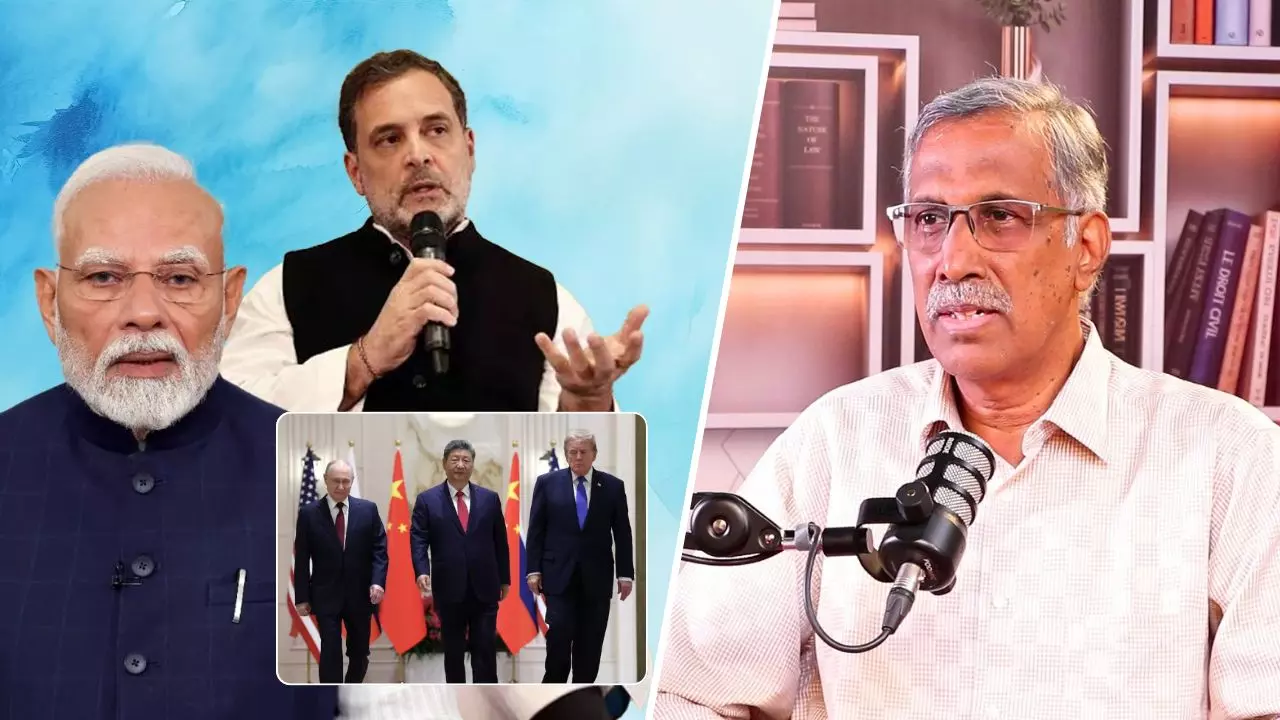
On the latest episode of Talking Sense with Srini, the flagship YouTube show of The Federal, Editor-in-Chief S Srinivasan examines the contrasting assessments of India's economy, the challenges facing households, the country's dependence on imports and the implications of changing global power equations.
Edited excerpts:
Rahul Gandhi has described India as sitting on an economic disaster, while Chief Economic Adviser V Anantha Nageswaran has suggested that the economy could be in a much stronger position next year. With retail inflation touching 6% and food inflation nearing 9%, which assessment is closer to reality?
Rahul Gandhi is essentially making two or three points. First, he is saying that there is no meaningful wage growth. That is largely true. People are getting jobs, but unemployment remains a problem. Even where people are finding employment, their wages are not adequate. Even those who are employed are experiencing a certain degree of discomfort because inflation is rising.
If you look at inflation-adjusted salary growth, it has been only about 6.5%. The unadjusted growth is much lower, at around 1% or so. The rural situation is different, and the situation for women is also quite distinct. There are several problems relating to wages, and this is particularly hurting the middle class.
That is what Rahul Gandhi is pointing out.
If companies want to expand and demonstrate good growth, why are they not hiring more people? One major reason is the shortage of skills.
He is also highlighting some of the biggest structural problems. He is saying that the education system is flawed. Ultimately, if companies want to expand and demonstrate good growth, why are they not hiring more people? One major reason is the shortage of skills. Companies are not finding the kind of skilled and employable labour they are looking for. There is a mismatch between what industries require and what is available in the job market.
Of course, Rahul Gandhi is a politician, and he is presenting these issues in a more dramatic manner so that the message reaches people. The Opposition has raised the issue, while the BJP has retaliated by accusing him of being anti-national.
The CEA is arguing that India's growth rate is good this year. He is talking about economic growth, but he also acknowledges that there is inflation pressure. He accepts that wages are not growing adequately. The difference is really about the extent of the problem.
There are two or three major crises confronting us. The first is the energy crisis, which is particularly important because of developments involving Iran. Even otherwise, India does not have sufficient domestic oil production. Whenever oil prices rise because of a war or developments in the Gulf, where much of our oil comes from, the entire economy feels the impact.
The second problem is the rise in fertiliser prices, partly because of higher energy costs. This directly affects rural communities.
Watch | Food inflation: Modi government's biggest economic challenge in 2027?
The third problem is food prices. These are also being affected by the El Niño phenomenon this year, which is not limited to India but is affecting several parts of the world.
These factors are coming together, creating considerable financial pressure. Whether the government can manage these challenges remains to be seen, but it is making an effort. The RBI, in its last policy, revised the repo rate after a three-year gap and increased it by 5.5%. There are further concerns and expectations that rates could rise again.
The middle class is certainly feeling the pinch. As an opposition leader, Rahul Gandhi is trying to amplify these concerns because that is his job.
The government, meanwhile, is trying to tell people that everything is fine. The Prime Minister also spoke at FICCI today (November 19) and said there was no such problem and that the Indian economy was doing very well.
Watch| Goldman Sachs bullish on India; could Dalal Street see a strong recovery?
The government is defending itself by pointing to India's growth rate. The Indian economy is indeed growing. It has registered growth of more than 7%, with growth of around 7.8% in the first quarter of 2026.
The expectation is that India will maintain this growth rate next year and may even do better. The World Bank and other institutions have also projected continued growth. That is the defence the government keeps presenting.
But the problem is that a 7% growth rate is not enough for India to truly shine. Given the kind of pressures and problems we face, we need much more. We need sustained growth approaching double digits, ideally around 10%, or at least 9.5%, over a considerable period.
There are several other pressures as well, particularly because of the Iran war, the global situation and the trade agreement that we have not been able to sign.
Rahul Gandhi has argued that the services sector alone cannot generate the number of jobs India needs. Are the GDP figures and the trillion-dollar export narrative hiding the ground reality?
India is currently flying almost on a single engine, which is the services sector. It should be supported by manufacturing and agriculture, but those sectors are not performing as required.
Take manufacturing, for instance. The target was to increase its contribution to around 25% of overall GDP. But that is not happening. Agriculture is also lagging. India still largely lives in its villages, and a significant proportion of the population continues to depend on agriculture. That creates another problem.
The services sector itself is changing. Gig workers, for instance, have become a very significant part of the services economy.
One component is India's service exports, particularly IT services and related activities. But that sector has also become vulnerable because of AI. At the same time, many global capability centres (GCCs) have started coming to India. These function as back-office operations for global businesses.
These opportunities are emerging, but they are not sufficient to meet the expectations people have. We often talk about India becoming a trillion-dollar economy. But that figure is also influenced by our large population, while per capita income remains very low.
The export figures can look impressive, but we must also examine the trade gap with individual countries. There are several issues associated with that.
The government, of course, takes comfort from the fact that we have substantial foreign exchange reserves. However, this brings us to the discussion about the rupee becoming stronger.
I do not think all economists would agree that a stronger rupee is necessarily desirable. If the rupee appreciates too much, it can hurt exports and become counterproductive. On the other hand, if the rupee becomes too weak, that creates another problem because financing imports becomes more expensive. These are the competing pressures the government has to manage.
Gold prices have fallen more than 23% from their January peak. The decline is being linked to expectations of higher US interest rates and a stronger dollar. How should we understand this alongside the CEA's optimism about a stronger rupee?
India imports a lot of gold. We have imported around 800 tonnes of gold so far in 2026. The value is approximately $71.98 billion, which works out to around Rs 6.71 lakh crore.
Now, the size of India's defence budget is around Rs 7.85 lakh crore. At this rate, our gold imports could soon approach the entire defence budget for the financial year and perhaps even surpass it. We need money to defend India and require substantial resources for defence, yet we are importing such large quantities of gold.
Economists have a different perspective on this. Some argue that gold imports are wasteful and ask why we should import so much of a metal. They believe that if gold imports are curbed, it could benefit the economy.
Also read | How can investors cash in on gold, silver price fall? A staggered investment strategy is key
However, administrative restrictions do not necessarily work. If imports are restricted, smuggling may increase, and people will find alternative ways to bring gold into the country. That is why certain restrictions have been imposed and subsequently had to be relaxed.
But ordinary people do not necessarily look at gold in the same way economists do. For many households, gold represents a form of reserve and personal wealth. They believe it can come in handy during a crisis.
The middle class is certainly feeling the pinch. As an opposition leader, Rahul Gandhi is trying to amplify these concerns because that is his job.
Even though banking networks have expanded and people now have several ways to save and invest money, many households, particularly women and people in rural areas, continue to regard gold as the best form of a dependable reserve. Gold also carries a strong emotional and sentimental value. It is often inherited from parents, given as a gift or associated with family traditions.
It is therefore very difficult to remove gold from the Indian psyche. That is why the debate around gold imports continues.
Coming to the current decline in gold prices, as you pointed out, the dollar is strengthening. The dollar is strengthening because markets expect another interest rate hike. That is likely to happen, and this is one of the reasons gold prices are falling. People who were previously worried because gold had crossed Rs 1 lakh per unit may now look at the decline differently. They may feel that gold has become more affordable and that they have another opportunity to purchase it.
Ultimately, these developments have created a certain degree of financial discomfort. That discomfort is important, and it is something the government needs to address.
With Donald Trump, Vladimir Putin and Xi Jinping sitting at the same table, the world's biggest powers appear to be reshaping their relationships. Where does India stand, and will this create more room for diplomatic manoeuvring or affect the country's interests?
Domestically, as I explained earlier, we are facing considerable economic pressure. Prices of several essential commodities have increased. This is creating problems for households.
As I mentioned, wages are not growing adequately, and these are all issues that are hurting people. People are also finding it difficult to go abroad because of tighter visa policies in the United States and other countries. All these developments are creating a sense of discomfort and uncertainty.
The global situation is not particularly encouraging either. For instance, after Trump lost the midterm polls, he wanted to send a message back home that he was still in control and remained politically relevant. This trilateral summit could perhaps be useful to him for that reason. Trump is a showman, and he may see such a meeting as an opportunity to demonstrate his influence.
That could be one explanation for why Xi hosted the meeting and Putin agreed to participate. In fact, the initiative for such a meeting had come from Putin. Putin had wanted such a meeting for some time because the Americans had been insisting that there should be an agreement on Ukraine. Perhaps Trump now feels that he can achieve something through this meeting.
Also read | Trump, Xi and Putin’s historic summit: Diplomatic bonhomie, but what next?
But let us remember that Trump had earlier said that if he came to power, he would resolve the Ukraine conflict within days. It has now been more than two years, and the war is still continuing. Trump is also in a relatively weak position in the middle of his second term. Whether he will be able to achieve anything remains to be seen.
For all three leaders, however, this meeting represents a significant opportunity. For Russia, the diplomatic world has largely treated it as an isolated country. It has felt diplomatically sidelined. Now, Putin is being received at an important international gathering, which is significant for Russia.
Xi Jinping is also very happy with this development. Hosting such a meeting gives China recognition as a major global power. It demonstrates that China can sit at the same table with two of the world's most influential leaders.
The bombastic claims about India being a Vishwaguru have been quietly set aside. The terminology now seems to have shifted towards Vishwamitra.
Some people are comparing this meeting with the Yalta Conference of 1945, when three major leaders — Winston Churchill, Franklin D Roosevelt and Joseph Stalin — met to discuss the post-war world order. At that time, the leaders discussed the future division of Europe and the arrangements that eventually contributed to the emergence of the Western and Eastern blocs and the subsequent Cold War.
However, the current meeting should not necessarily be seen in the same way. Analysts largely agree that the meeting between Trump, Xi Jinping and Putin is, at this stage, more about optics than any concrete agreement. We will have to see how these discussions develop and whether the three countries can build on the meeting.
As far as India is concerned, we have to watch developments very closely. India should create more alternative routes and expand trade with Europe, something it is already attempting to do. We must explore additional opportunities and increase our influence through different international forums.
For instance, we have BRICS and the Quad. The Quad includes the United States, but it also brings together other Asian countries such as Japan and Australia. These platforms can be used to strengthen India's position. We should also look more towards the Global South.
In the past, India played an important role in South-South cooperation and conferences. We used to take greater initiatives in these areas, and India can once again become an influential voice for developing countries. We should therefore consider reconfiguring our foreign policy.
The bombastic claims about India being a Vishwaguru have also, I think, been quietly set aside. We have not heard that expression as frequently for some time. The terminology now seems to have shifted towards Vishwamitra.
What's the difference?
Vishwamitra means 'friend of the world'. The idea is that India should be more friendly and cooperative rather than preachy or imposing itself on others. We will also have to see whether India can secure a better trade deal with the United States. Nobody knows how those negotiations will eventually shape up.
It is clear, however, that China has moved considerably ahead and has gained international recognition. India still has an important role to play. We are a large country and a large democracy, and we will continue to matter in global affairs.
But, as I said, we need to watch developments closely because, at this stage, the meeting is largely a photo opportunity.
When ordinary citizens hear the opposition warning of an economic disaster and the government promising a bright future, while their monthly expenses continue to rise, it only breeds cynicism.
What will it take to make people optimistic? What should the government actually do on the ground instead of relying on speeches?
The proof of the pudding is in the eating. Ultimately, if people have more money in their pockets, they will obviously be happy. The government will try various measures to manage the situation. But we have seen that during election periods, fuel prices are sometimes adjusted downwards. These kinds of things have happened in the past.
Also read | Indians borrow more via digital platforms as personal loan demand expands
I think there is also a new development today concerning EPFO regulations. The mandatory 20% rule has apparently been done away with. There is some change in the regulations, and we will have to see how that develops. Obviously, the government will try its best to soften the impact of the economic pressures people are experiencing.
But speeches are also important because the government uses them to convince people and explain the situation. For instance, the Prime Minister recently said that these are difficult times and that people should save more. He also used the Hindi expression khau, pio, mauj karo, which essentially refers to eating, drinking and enjoying life. He suggested that people should reduce such spending.
That is an approach Indians followed in the past. But that is no longer necessarily the case. Even in India, people are increasingly borrowing money to finance the purchase of consumer goods, whether it is a refrigerator, a car or other household products. We will have to see how many people actually follow the Prime Minister's advice.
All these economic clouds are gathering at a time when political pressure on the government is also building.
Watch the full video here.