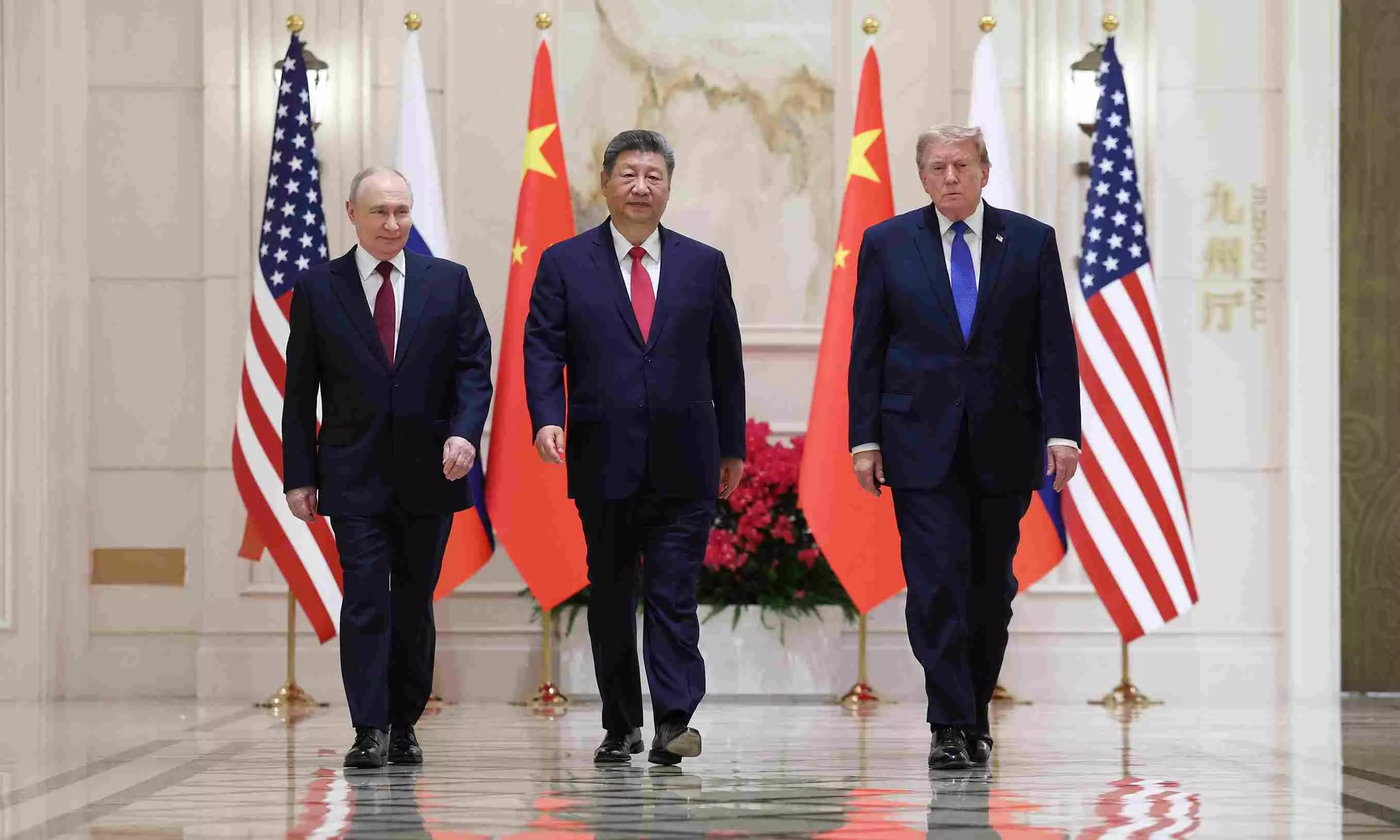
Trump, Xi and Putin’s historic summit: Diplomatic bonhomie, but what next?
The US-China-Russia summit raised hopes for progress on the wars in Ukraine and Iran, but competing interests and uncertain outcomes cloud prospects for global stability

The first-ever trilateral meeting between the leaders of the United States, China and Russia was billed as a historic moment in international diplomacy. At a time when the world is grappling with two major wars, growing economic uncertainty and an increasingly fragile international order, the coming together of Donald Trump, Xi Jinping and Vladimir Putin naturally raised expectations.
Yet, when the three leaders finally met in Shenzhen, there were few concrete outcomes to show for their more than 90-minute conversation. While they issued a joint declaration committing themselves to peace, non-proliferation, strategic stability and international security, the statement offered few specifics on how these objectives would be achieved.
Behind the diplomatic bonhomie
But as the leaders of the world's great powers met to discuss war and peace, the mood was upbeat and their camaraderie was unmistakable. Whether this bonhomie will translate into anything more substantial remains to be seen.
Also read | Trump, Xi, Putin agree on UN reforms, fuel supplies and nuclear risk talks
“The seeds sown during today's trilateral meeting will undoubtedly take root, sprout, blossom, and bear fruit,” Xi was quoted as saying by Chinese state broadcaster CCTV. He added that major powers should respect the legitimate security concerns of all nations, in an apparent reference to Taiwan. “As long as dialogue continues and the door remains open, there is hope for peace,” he said.
US President Donald Trump was equally enthusiastic. Before the meeting began, he declared: “We are really making history.” He added: “No peace was ever forged by declining opportunities for engagement.” Earlier, Trump had held separate meetings with both Xi and Putin.
For Russian President Vladimir Putin, who had first mooted the idea of a trilateral meeting, the gathering was an opportunity to return to the high table of global politics. Despite years of Western efforts to isolate Russia following its invasion of Ukraine and the International Criminal Court’s arrest warrant against him, Putin was now sitting alongside the leaders of the world’s two other major powers. His main focus, however, remained Ukraine. Speaking at a news conference after the talks, he said Trump was keen to end the Ukraine conflict and reset US-Russia ties. He regretted that Kyiv, backed by European leaders, was resisting any compromise.
But what exactly did the three leaders hope to achieve? Beyond the broad statements on peace, stability and cooperation, little has emerged about what was actually discussed behind closed doors. Perhaps that was inevitable. The meeting was unprecedented, its agenda had never been clearly spelt out, and the three leaders came with very different priorities.
Can China, Russia help end wars?
“The meeting can be seen as an exploration, an attempt to reach a grand bargain of sorts and find a way of winding down the wars in Ukraine and Iran,” says Alka Acharya, Director of the Institute of Chinese Studies. Other issues, including arms control, could also have figured in the discussions, she says.
Acharya believes Trump is now looking for an off-ramp in Iran and needs the help of both China and Russia, two countries that have maintained close ties with Tehran. China, in particular, has a strong economic interest in ending the conflict and restoring normal oil supplies. Its strategic reserves are depleting, and unless the Strait of Hormuz returns to normal, its already struggling economy will face further pressure.
“Peace in Iran and Ukraine is essential for global stability, and Trump realises that China could play a constructive role,” Acharya says. The closed-door negotiations were probably aimed at securing the help of China and Russia in ending the Iran war, she explains.
On Ukraine, however, the prospects are less encouraging. Putin has ruled out any dialogue with Europe on the question of Ukraine, while differences between Moscow and Kyiv remain unresolved.
Xi’s growing clout, Trump’s challenge
For Xi, the meeting was also a validation of China’s growing power. Having tried to bully China during his first term and in the early months of his second, Trump has realised that Beijing is not going to capitulate to American pressure. China’s ability to use rare earths as a strategic lever, particularly at a time when the US needs access to these critical minerals, has strengthened its negotiating position. The result has been a trade truce that has served both countries well.
For Trump, the stakes are different. Having promised to end wars and bring greater stability, he needs to demonstrate that his personal diplomacy can deliver results. Engaging both Xi and Putin allows him to explore whether the two countries can help resolve conflicts that Washington has struggled to manage on its own.
Quad’s relevance faces fresh questions
“India, like other global powers, is closely watching the summit. From India’s perspective, any change in the US-China relationship has an impact on India-China as well as US-India ties,” says Aparna Pande of the Washington-based Hudson Institute.
Also read | Trump arrives in China as Xi rolls out red carpet ahead of high-stakes trilateral summit
“A Yalta-like summit or a G-3 creates challenges for India in its neighbourhood and beyond.” Pande is referring to the Yalta Conference of 1945, where US President Franklin D Roosevelt, British Prime Minister Winston Churchill and Soviet Premier Joseph Stalin planned the post-war reorganisation of Europe.
“This summit follows the first Quad leaders' level summit of the second Trump administration. Symbolism aside, the fact that the Quad summit happened right before the China-US-Russia summit takes away from the Quad’s role as the minilateral grouping in the Indo-Pacific that was meant to deter China’s rise.”
It would be premature to dismiss the meeting of the big three as merely a photo opportunity, as some in the West have done. The fact that the three leaders have agreed to sit together and explore areas of common ground, despite their competing interests, is significant. But the joint declaration, for all its ambitious language, offers little indication yet of how their commitments will translate into action.
The trilateral meeting of the world’s three great powers was historic in its symbolism. Whether it can lead to a common vision for global stability or concrete action on the wars and crises confronting the world remains to be seen.