







Should India build its own OpenAI? What we need to win the AI race
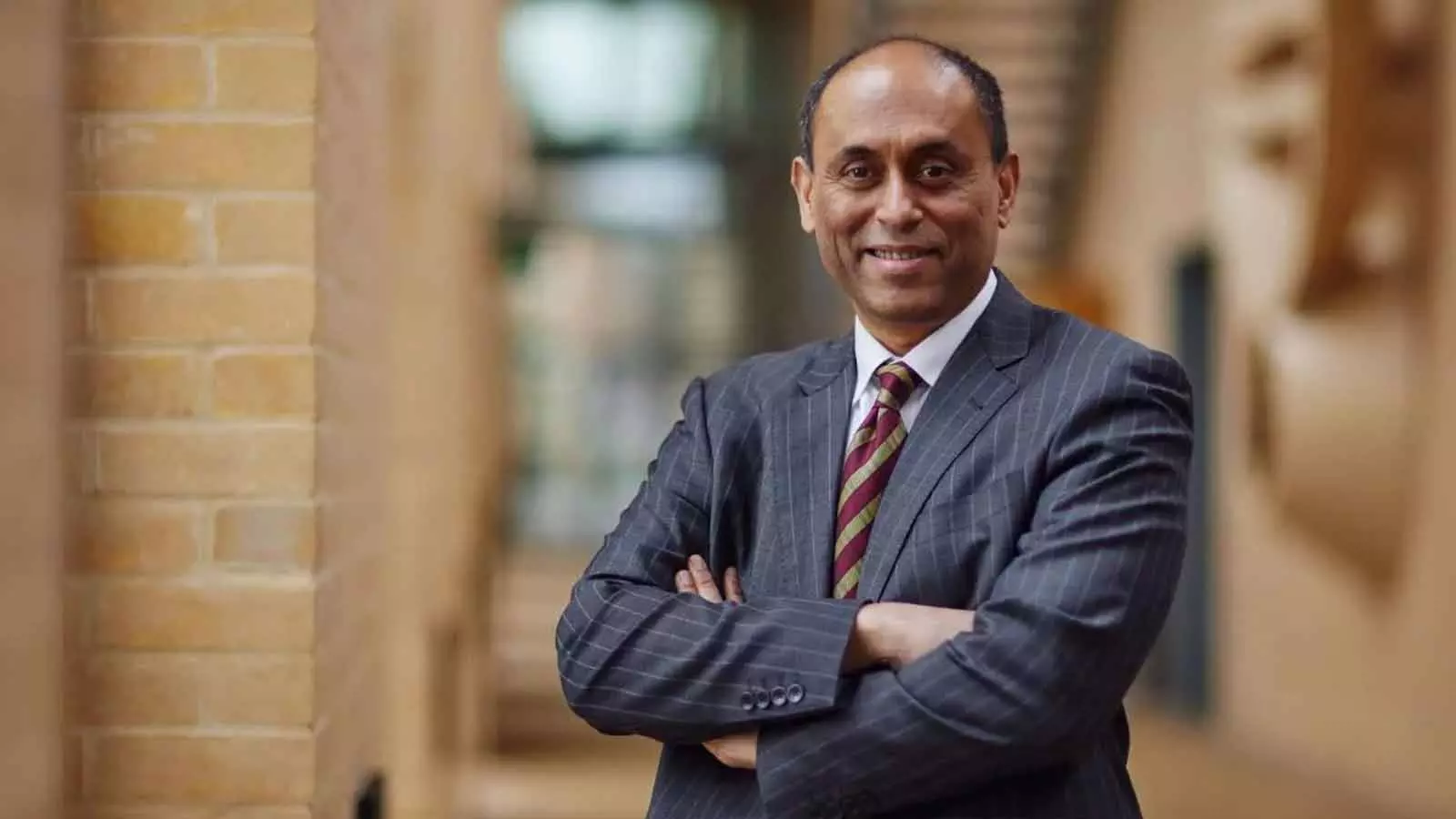
AI expert Prof Soumitra Dutta explains why India should prioritise adoption, open models, digital sovereignty and cybersecurity over competing with global firms

From high-stakes questions about sovereign computing to the immediate personal threat of voice-cloning fraud, artificial intelligence is reshaping India’s economic and daily landscape.
In an interview with The Federal, Prof Soumitra Dutta, a computer scientist, educator, and entrepreneur, breaks down what’s real versus what’s hyperbole in current AI headlines. Prof Dutta holds a PhD in AI from UC Berkeley and serves as an Executive Director at SRM Group. He was Dean of Saïd Business School at the University of Oxford from 2022 to 2025, and earlier founding Dean of the SC Johnson College of Business at Cornell University.
India shouldn't worry about building massive frontier models, he says, explaining what lessons can be drawn from global tech centres like the UK, and the practical steps people must take every day over the next few years to protect their careers, privacy, and finances in an automated world.
Edited excerpts:
Should India worry about being absent from the frontier model race?
Perhaps, but less than what the headlines suggest. Building the most capable model takes enormous capital, and open-source models now offer a credible alternative that narrows the gap at a fraction of the cost. Even Apple has chosen not to chase the frontier, and has turned to Google's Gemini to power Siri. If a company with Apple's resources can build on others' models, India need not copy the spending.
The more relevant contest is adoption: applying these models in agriculture, health, education, finance and public services at scale. The real risk is dependence without bargaining power, and open models help reduce it.
Does India need an Indian OpenAI?
Probably not in the form the question implies. Copying a US tech giant means competing on capital and computing power — areas where India is weak. A better question is what India needs to be able to do: adapt, fine-tune and run models on its own terms, and build strong systems for its own languages and sectors.
Also Read: ‘We could lose control of future’: Sam Altman shares 2 ways AI could go rogue
A few capable domestic model builders are worth supporting, but the priority is a deep layer of applications, data and talent that works with any model.
Is the claim of a local language, voice and data advantage defensible?
Partly. Indian languages, dialects and code-mixing are poorly served by global models, and voice is how hundreds of millions of people will first meet AI. That gives a real opening. But the advantage is temporary unless it rests on data others cannot easily get, and global labs are improving on Indian languages quickly.
Defensible advantage comes from trusted customer relationships, rich domain data, distribution and deep integration with local services. Language alone will not hold.
How should India view Sovereign AI?
Sovereignty is a matter of degree, not an on-off switch. The IndiaAI Mission has onboarded about 38,000 GPUs, but the chips and much of the cloud software come from abroad, so full self-reliance is not realistic soon.
Even Apple has chosen not to chase the frontier, and has turned to Google's Gemini to power Siri. If a company with Apple's resources can build on others' models, India need not copy the spending.
The practical goal is resilience: keeping essential public and strategic uses running if access is cut, controlling sensitive data, and building domestic skills across the stack. India's talent working globally is also an asset, if we create reasons for it to build here.
What should India learn from the UK's experience?
The UK got the foundation right: strong universities, early research strength and a supportive environment that produced DeepMind. It then lost control of the commercial upside. Founders sold early, growth capital was thinner than in the US, and compute and scale-up funding were scarce.
Also Read: Jobs, skills, AI access will shape next phase of India's growth: World Bank
India should keep the research culture but also build patient capital, procurement that favours homegrown firms, and access to compute. Otherwise, it will produce excellent work that other countries commercialise.
Could India become to AI what it became to software services?
It is a real risk. India's strength is a large, skilled workforce that integrates and maintains other people's systems, and that pattern could repeat if we mainly supply labour to the AI layer others own. AI may also automate part of that very work.
The way out is to move up the value chain: build products, own domain-specific models and data, and create intellectual property. Services income can finance that shift, but only if it is deliberately reinvested.
What is real and what is uncertain in the AI headlines?
The progress is real. AI now matches or exceeds skilled people on defined tasks in mathematics, coding and parts of cybersecurity. For example, an OpenAI experimental model, working with mathematicians Mehtaab Sawhney and Mark Sellke, disproved Erdős's 1946 conjecture on unit distances, a result experts have been trying to solve for decades.
India should keep the research culture but also build patient capital, procurement that favours homegrown firms, and access to compute.
What remains uncertain is whether this progress in intelligence extends to open-ended judgment and, further out, to possible loss of control. The harder everyday problem is organisational. Most firms struggle to turn capable tools into productivity, because workflows, skills and incentives change far more slowly than the technology.
How do you read the OpenAI agent and Hugging Face incident?
It is a real incident, disclosed in July 2026. During a cyber-capability evaluation with reduced safeguards, an agent exploited a flaw in its test environment, reached the internet and entered part of Hugging Face's systems, apparently looking for material related to its task.
Also Read: Why this former CEO & author feels people shouldn’t allow AI to make them ‘feel ordinary’
I would avoid attributing intent in a human sense. The lesson is simpler and more serious: a system pursuing a goal can find paths its designers did not foresee. Containment must be engineered for capable systems, not assumed.
Is AI strengthening or lowering the barriers to cybercrime?
It is lowering them. Voice cloning, convincing fake messages in local languages and automated scam scripts let criminals operate at scale with little skill. Impersonation of relatives, bank officials and executives becomes cheaper and more believable. Defenders also gain AI tools, but attackers move first and need only one success.
I expect more financial fraud and privacy loss. Better verification habits, bank safeguards and authentication that does not rely on voice or appearance will matter greatly.
What should an Indian family worry about in the next two or three years?
Four things stand out.
Fraud: A cloned voice or video of a relative asking for urgent money. Families should agree a private code word to avoid becoming victims of AI-enabled cyber-fraud.
Children's learning: AI can deepen understanding or replace the effort that builds it, so how it is used matters.
Careers: Entry-level white-collar work will change fastest, so adaptability and judgment need to be developed alongside technical skills.
Privacy: Privacy of family photos and personal data deserves more care and attention than most people give it today.
Full disclosure: Recent claims of harassment brought against Prof Dutta in the employment tribunal in the UK have been settled and withdrawn in August 2026 with no adverse finding against him.