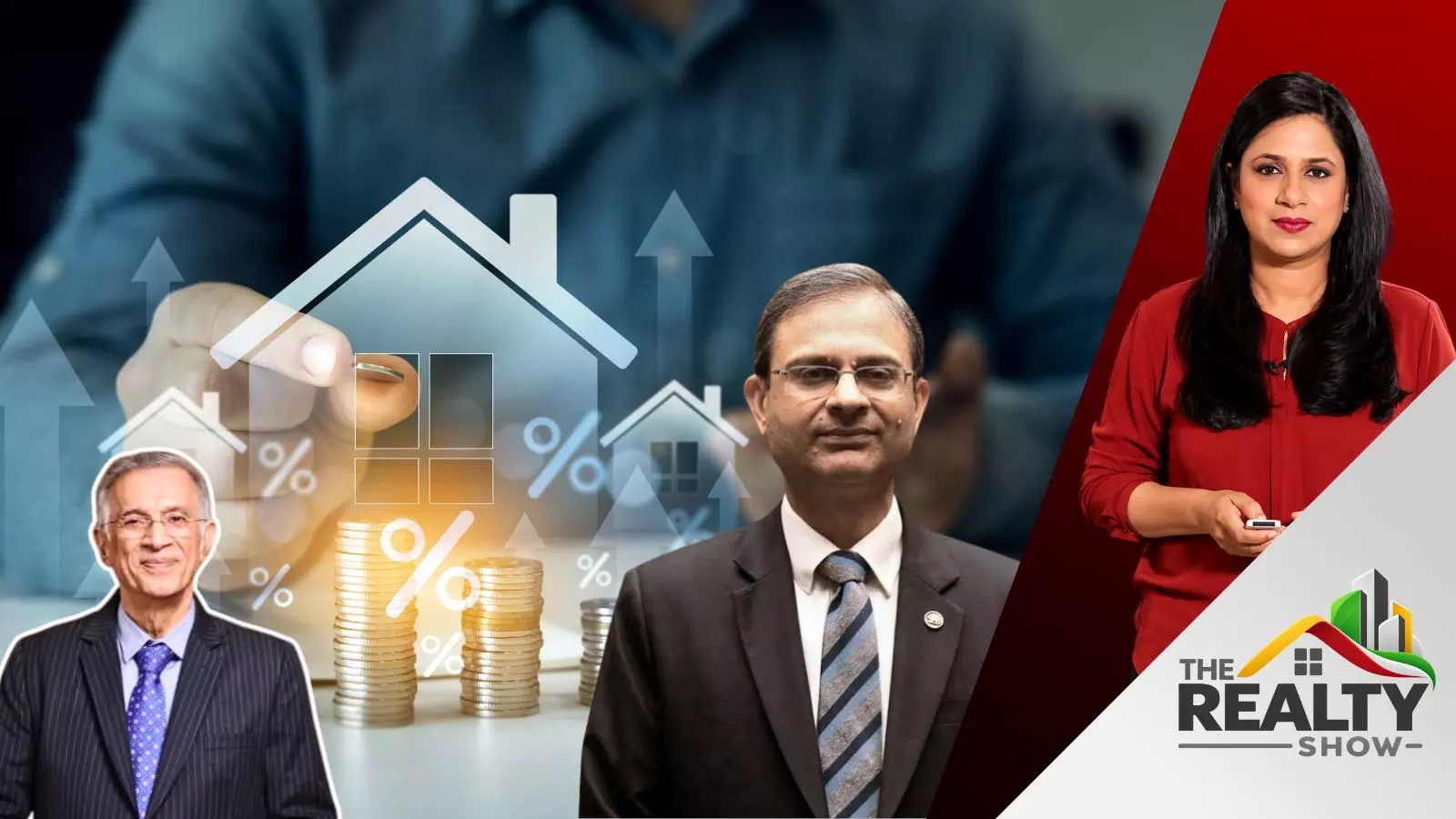
Home rates have gone up alongside interest rates, creating a dual challenge for house buyers that will definitely affect market demand, Niranjan Hiranandani, Chairman of NAREDCO highlighted.
Affordable housing is real casualty of India’s property boom: Niranjan Hiranandani
NAREDCO Chairman says RBI rate hike will squeeze lower-income buyers even as premium and mid-segment housing hold firm

A steep 20 per cent drop in affordable housing volumes and values has created a massive backlog across India's real estate market as homebuyers face the dual pressure of rising property prices and escalating interest rates. While the overall real estate sector continues to expand alongside broader economic growth, the lower-income segment is struggling to cope with compounding financial strain.
Speaking to The Federal on its YouTube programme The Realty Show, Niranjan Hiranandani, NAREDCO Chairman, explained how global monetary tightening, inflationary pressures, and urban infrastructure bottlenecks are reshaping real estate demand across primary metros and emerging secondary markets.
How does the recent RBI rate hike impact the real estate sector across the housing and commercial segments?
In anticipation of both US Fed actions and rising inflation due to ongoing conflict in the Middle East, the Reserve Bank of India (RBI) was naturally pressured to hike interest rates to control inflation and curb capital outflows.
Looking at the consequences, home rates have gone up alongside interest rates, creating a dual challenge for house buyers that will definitely affect market demand. Over the last 18 months, overall real estate has grown steadily, seeing a 10 per cent volume and value increase in the previous financial year, and over 13 per cent in the current year.
Also read: Why Bengaluru is facing a paying guest housing crisis
However, the affordable housing segment faces a massive backlog, witnessing a steep fall of almost 20 per cent in both volumes and values. While the broader national economy expands at 7.2 per cent, affordable housing buyers face severe headwinds, making this the biggest challenge for India and home loan borrowers today.
What should homebuyers looking for properties under Rs 1 crore in top cities do, given the affordability challenges?
There is a real challenge because the affordability segment is severely constrained today. Through NAREDCO, we have submitted representations to the Government and the Finance Ministry urging necessary policy changes to foster rental housing as a viable solution.
We have suggested providing tax rebates for rental housing, similar to the special tax rebates granted two years ago for industrial workers' housing. Service tenancy should receive similar fiscal benefits. Furthermore, we need structural amendments in the Rental Housing Act alongside tax concessions for the next 5 to 10 years for developers building rental properties. We are driving these proposals with the central government for inclusion in the upcoming Union Budget.
How are overall housing sales performing across different market segments, and what are the future prospects?
The premium segment continues to perform significantly better, backed by healthy demand across Tier 1, Tier 2, and Tier 3 cities nationwide. Middle-income housing is also selling well, but affordable housing remains heavily challenged.
Also read: As RBI tightens screws, what it means for your loan, home and food bill
Across the board, we are seeing a 12 per cent to 13 per cent overall growth in real estate volumes and values during the current year. Consequently, I do not foresee major difficulties in the middle or premium housing segments, though affordable housing requires targeted intervention.
With homebuyers relocating to far-flung outskirts and commuting long distances, what is the pressure on urban infrastructure, and what measures should governments implement?
In the Mumbai region, 300 km of new metro lines will be completed over the next two years, along with major infrastructure projects, including the Coastal Road, the 22-km trans-harbour bridge connecting the mainland to Mumbai city, and the new international airport in Navi Mumbai.
Other major metropolitan regions, such as Delhi-NCR, including Gurugram and Noida, as well as expanding Tier 2 cities, must similarly focus on extensive rapid transit and metro networks to ease urban commuter pressure.
What trends are emerging in Tier 2 and Tier 3 cities, and how do you view their future outlook?
There are performing Tier 2 cities and underperforming ones. A city like Pune has emerged as a major growth centre, experiencing substantial volume expansion across both residential and commercial spaces. Furthermore, Global Capability Centres (GCCs) are expanding into Tier 2 cities alongside Tier 1 hubs.
We are also seeing significant tourism activity, including religious tourism, as well as growing commercial, industrial, and manufacturing activity across various regions. Combining residential, commercial, IT, GCCs, and data centres is building strong secondary markets across Tier 2 India.
Which emerging markets across India offer strong real estate and investment potential?
Growth across Tier 2 cities largely depends on local infrastructure development, whether municipal authorities are addressing water supply, environmental management, and ground-level execution. It also hinges on how proactively state governments encourage industrial, commercial, and IT activity.
Are real estate developers actively expanding into emerging markets like Visakhapatnam, Gandhinagar, and Bhubaneswar?
NITI Aayog has projected that metropolitan towns and cities across Tier 1, Tier 2, and Tier 3 categories will undergo a sustained upsurge. However, determining which specific city reaches the next level depends entirely on continuous governance by state and local authorities. If projects face delays, lack financing, fall short on environmental standards, or result in high housing costs and long commutes, growth stalls.
Also read: PE investment in Indian real estate jumps 23% to $2.7 billion' strongest first half in 4 years
Metros like Gurugram, Mumbai, and Bengaluru continue to attract businesses despite high costs because they offer massive, readily available human resource pools. Companies locate there knowing talent can be hired easily. To attract major developers and corporates long-term, emerging cities like Bhubaneswar must build sustainable, well-supported ecosystems.
Are non-metro destinations like Kochi and Goa emerging as viable alternatives for buyers relocating from polluted metropolitan hubs?
Demand in destinations like Goa and Alibaug near Mumbai is extraordinarily high, with affluent buyers purchasing homes extensively. However, these locations function primarily as second homes for retirees or individuals able to work remotely.
Also read: Beyond the Metros: India’s next 11 real estate hotspots
They do not yet support large-scale commercial operations and therefore cannot serve as complete substitutes for major business hubs like Mumbai or Delhi NCR.
What is the growth outlook for the senior living housing segment in India?
Demand for senior living housing is expanding rapidly across all regions—north, south, east, and west. Driven by the rise of nuclear families and westernised living models where generations reside independently, senior living is becoming essential.
I expect the growth of the senior living segment to be exponential over the next five years, with strong buyer interest across upcoming projects.
What measures can be implemented to lower production costs and make housing more affordable?
Taxes currently constitute nearly 30 per cent to 40 per cent of the total cost of a house, while exorbitant land prices add another 25 per cent.
To make housing genuinely affordable, stakeholders and government authorities must carefully evaluate each of these cost drivers in the near future and introduce structural reforms to reduce overall tax and land burdens.