RBI holds rates as rupee nears psychological 100-mark; GDP forecast cut to 6.6 pc
Central bank held rates steady for third consecutive meeting, citing risks from elevated crude oil prices, rupee depreciation, and global geopolitical tensions

The Reserve Bank of India’s Monetary Policy Committee (MPC) kept its benchmark repo rate unchanged at 5.25% on Friday (June 5), choosing to hold its ground for the third consecutive meeting even as uncertainty clouds the economy.
The decision came even as the rupee hovered near 95.7 to the dollar, edging closer to the psychologically fraught 100-mark, with consumer price inflation sitting comfortably within the RBI’s 2-6% tolerance band at 3.48%, though risks of it being nudged higher by elevated crude oil prices and sustained capital outflows remain very much alive.
Growth resilient, risks remain
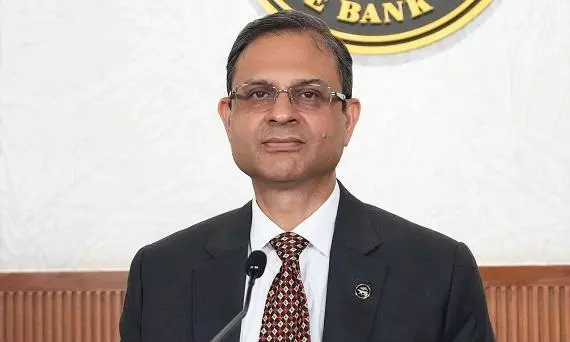
The six-member MPC, chaired by Malhotra, announced the decision retaining the policy stance at neutral. The hold was widely anticipated, with most economists and market participants expecting the central bank to stay cautious in the face of a volatile global environment shaped largely by the ongoing West Asia conflict and its ripple effects on oil prices and the currency.
Also read | India’s real economic crisis is structural, not oil shock: Surjit Bhalla
Domestic demand, Malhotra noted, remained resilient, with manufacturing and services continuing to expand, giving the MPC just enough confidence to hold without flinching.
The decision was not without its complications. Retail inflation, while benign at 3.48% in April and below the RBI's own target despite the global shock, remains vulnerable to an upward push as fuel costs filter through the supply chain.
Global risks cloud outlook
The food outlook, Malhotra warned, remains uncertain, with El Nino risks adding another layer of unpredictability to an already fraught inflation picture. The rupee has shed over 7% this calendar year, and with Brent crude hovering around $97 a barrel, the risk of imported inflation is real. Foreign portfolio investors have been net sellers, pulling a record $23 billion from Indian equities so far in 2026, piling further pressure on the currency as it inches toward territory that would mark a significant political embarrassment for the Modi government.
Even as the MPC met on Friday, the government was moving on a parallel track, announcing an exemption from capital gains tax on government bonds for foreign investors, a move aimed at drawing overseas capital back into India’s debt markets. Whether it will be enough to meaningfully reverse the outflow remains to be seen.
The global backdrop offers little comfort. The US Federal Reserve has held its benchmark rate steady at 3.5-3.75% since December, with markets pricing in no cuts for the rest of 2026 and well into 2027. For the RBI, that is a problem. Any move toward easing risks widening the rate differential between India and the US, making Indian assets less attractive to foreign investors and putting the rupee under even greater strain.
RBI cuts growth forecast
The West Asia conflict, which has kept Brent crude hovering around $97 a barrel, has only complicated the calculus further, pushing up India's import bill at precisely the moment the currency can least afford it. Adverse spillovers on economic activity from elevated energy prices, Malhotra acknowledged, remained a live threat.
Through all of this, the RBI has one eye firmly on growth, though its confidence has visibly dimmed. The central bank cut its GDP growth projection for FY27 to 6.6% from 6.9%, a downgrade that reflects the weight of global uncertainty pressing down on an otherwise resilient domestic economy. A premature rate hike risks undermining that trajectory further at a moment when private investment is still finding its footing.
The MPC, Malhotra said, saw risks to both growth and inflation from the uncertainty over the conflict, a candid admission that the committee was not operating with the luxury of a clear line of sight. The neutral stance, he confirmed, was being retained, keeping the door open in both directions.
Experts expect prolonged pause
Gaura Sengupta, Chief Economist at IDFC FIRST Bank, said, “RBI and Government of India have taken a range of measure across instruments to attract capital inflows which is essential in the current environment of tight global financial conditions. We maintain expectation of RBI staying on pause in FY27.”
Also read | Centre plans Capital Gains Tax exemption for foreign investors in government bonds: Report
G Chokkalingam, Founder and Head of Research at Equinomics Research, said, “The single largest problem for the Indian economy and monetary policy authority is the Iran war because it has led to a spike in oil prices, higher inflation, pressure on the rupee and FII outflows. A 10% deviation in the monsoon can be managed, but any further spike in oil prices cannot. Therefore, RBI will wait through June and July to assess both the initial rainfall and how the conflict is headed, and I do not see any need for RBI to revise rates in the next meeting.”
On FIIs, Chokkalingam said, “After the market hit record highs in September 2024, there were concerns about overvaluation, FIIs shifted money from secondary to primary markets, the US tariff war came and then the war pushed up oil prices. FIIs will come back once India’s external environment improves. If the conflict ends, oil prices will fall, the rupee will recover and the same FIIs will return because valuations have become appealing and India continues to offer stable, domestic-demand-driven businesses.”