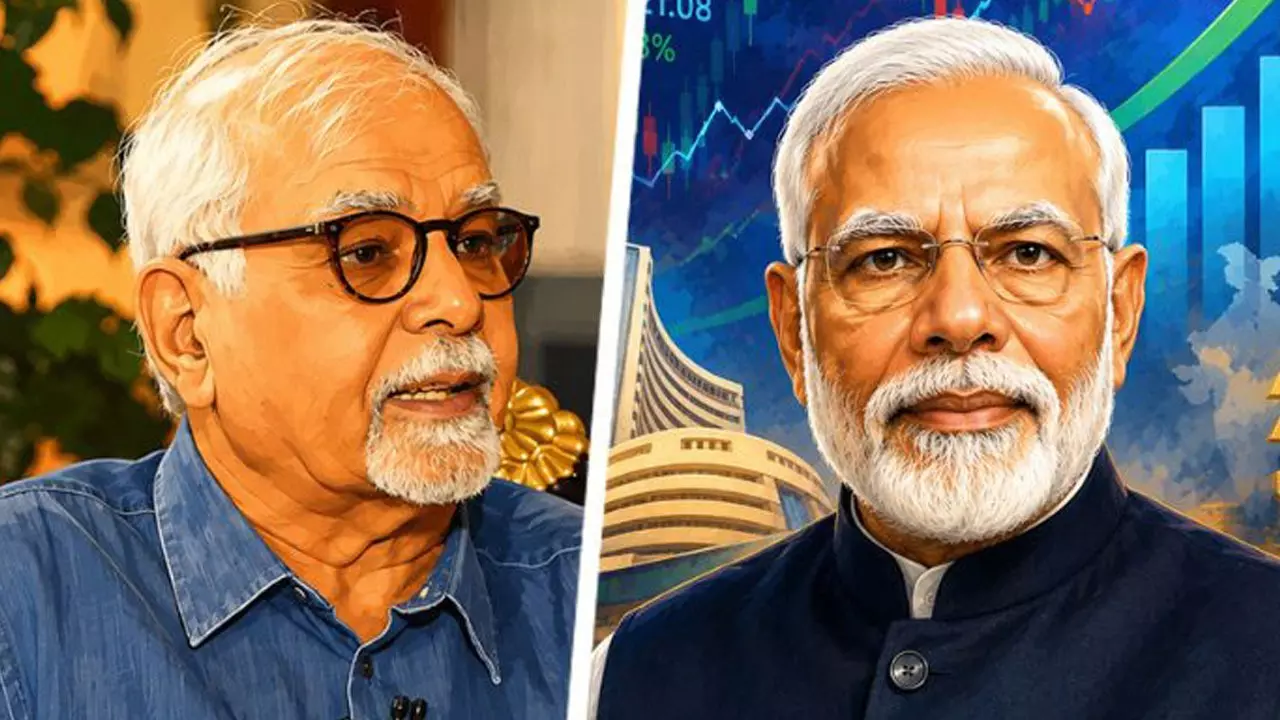
As Prime Minister Narendra Modi urges Indians to tighten spending on gold, fuel and foreign travel amid surging crude prices and renewed turmoil in West Asia, economist Surjit Bhalla argues that India’s economic challenges run far deeper than the current oil shock.
Edited excerpts:
Prime Minister Modi has asked citizens to cut back on gold, fuel, and foreign travel. He's halved his own convoy. And he just held a four-hour cabinet meeting, his first of the year, pressing ministers on Ease of Living and Ease of Doing Business. When a Prime Minister does all of this simultaneously, isn't that itself a signal that the economy is in far more trouble than the government is letting on?
No, I don’t think so. But I think what we need to examine is: what is the problem? As you rightly said, six months ago, everything seemed to be in pretty good shape.
What has happened now is that there is a West Asian crisis, oil prices, etc. Oil prices go up, oil prices go down. But I think what we need to look at, whether it is India or any other economy, is the steady state ex ante — before the February crisis started.
The issue is not the current account deficit. It is not reserves... The rupee has remained weak for years because we have not followed the right investment policies."
If the war stops, oil prices might recover. So I think it is very unwise to think of policies and evaluations on the basis of a broadly war-induced economy. That is incorrect. Scholars have been saying, “Look, let the RBI go,” or whatever policy prescription they have, and they are basing it on what is happening now.
What was the problem with the Indian economy before any of this happened? The problem with the Indian economy before any of this, basically till 2024, when we have pretty much complete data for all the economies in the world, was that foreign direct investment (FDI) in India had pretty much collapsed. It had gone down from something like 2.5 per cent of GDP to less than 1 per cent, and probably 0.2-0.3 per cent, depending on the period you take. This is net FDI. So, why has net FDI gone down, collapsed, which means foreigners are not investing?
Now, net FDI is composed of FDI coming in and FDI going out by Indian investors. So what has happened is that net FDI is down both because foreigners are not investing in India as much as they did before, and Indians are investing abroad.
So what’s the problem? Why are Indians investing abroad more than they are investing in India? You find that very rare in India. You didn’t have that happening until about 2015. This is a puzzle for all of us economists trying to analyse the economy.
Then you have the broader macro picture of the Indian economy, which is in pretty good shape. The current account deficit is not much at all. Inflation, if you exclude the last four or five months, is at record lows, whether you look at WPI or CPI.
So the current account deficit is in good shape, inflation is in great shape, and growth is reasonable, maybe 6.5-7 per cent, thereabouts. But the rupee is weak and foreigners are not investing. I think the rupee is weak because foreign investment demand has gone down.
Can you explain why foreign investment is weak? You have argued elsewhere that the treaty signed in 2013 was one factor. If you can explain that? Secondly, the bigger puzzle is that some Indian companies are sitting on huge reserves, apparently about 11 per cent of their total assets, and are still not investing. They seem to have drawn into a shell. They don’t appear to believe investment is necessary for growth. Why this fear? Exactly. Economic theory and economic experience suggest this should not be happening. So let us take FDI first, and then we’ll look at domestic investment and companies sitting on reserves.
As a matter of fact, it is likely worse than that. They are not just sitting on reserves, they are taking money out.
Rather than welcoming foreign investment, BIT did the exact opposite... Foreign investors found that this was perhaps the most onerous law passed by any country in recent times."
Until 2015, India was in very good shape, like much of the developing world. Everybody welcomes foreign investors because they bring technology, capital and global linkages. We all know why FDI is considered one of the most attractive indicators for an economy.
Now, in 2015, we passed a new Model Bilateral Investment Treaty law. What did this law say? Rather than welcoming foreign investment, it did the exact opposite. It said that if there is a dispute and you want to separate from your domestic partner, you have to wait five years and negotiate with your partner, the government and others, before you can even proceed to disengage. And then you have to go before an Indian judge.
I remember making this point to the Prime Minister himself. Indians don’t want to go before an Indian judge. We are a developing country, and our legal system is not as efficient as systems in Western economies.
I headed a high-level advisory group on investments for the Government of India in 2018-19, and nobody, including myself, noticed much decline in investment because there wasn’t much to notice at the time.
That is because FDI is governed by the laws under which investments originally came in. Investors sign 10-year or 15-year treaties. So FDI continued to flow into India until those commitments were exhausted. After that, investors either had to adopt the new Bilateral Investment Treaty or stop investing.
And that is what happened. Foreign investors found that this was perhaps the most onerous law passed by any country in recent times. Prior to 2015, India’s BIT law was broadly similar to that of most other countries. We departed from that framework. I think it is for all of us to ask why we departed.
Now, the finance minister and the government eventually recognised there was a problem. If you recall the 2025 Budget statement, the finance minister mentioned two areas under review. One was a new Bilateral Investment Treaty framework, and the second was deregulation and ease of doing business.
Relative to the Prime Minister’s own ambitions, of turning India into a developed economy, we are nowhere close."
So they recognised this was a problem well before the West Asian crisis of February 2025. After that —and this is where we can get into the deep state, if you permit me — the government announced that it wanted a new BIT law. But even now, nobody knows concretely what it will look like. The expectation is that instead of a five-year wait, it may become a three-year wait.
When you refer to the deep state, are you also pointing to institutional erosion as a factor behind investor fear? And does that concern persist even if a new BIT law comes in, since disputes would still go through Indian courts? Yes and no. There is definitely some institutional erosion happening. Domestic investors are not as confident about investing in India.
And we can point to the factors behind this erosion. For example, retrospective taxation. How many countries have done that? Then there are export bans, imposed whenever the government wants. In that sense, ease of doing business has become worse, even horrible.
There is also a psychological factor behind this. Why did we come up with the change in the 2015 BIT law? We can speculate, but I think the thinking was that India is a big country, a big market, and foreign investors are desperate to come in.
But we live in a globalised world, and foreign investors have opportunities elsewhere. So they simply did not come.
I’ll go back to 2010. It doesn’t matter which government was in power, though I think the change in the BIT framework was very unfortunate. In 2010, China decided to move up the value chain in manufacturing. At the time, all of us in India thought this was India’s “China plus one” moment.
What happened? Nothing. Vietnam became China plus one. Bangladesh became China plus one. India remained where it was. So I think there is something deeper at work here.
So this entire argument that India is a very large market, with a middle class of 300-500 million people, huge opportunities, a trained workforce, engineering talent, political stability and, to some extent, a functioning judiciary, these were all considered major positives for India. Are you saying these factors are no longer working in India’s favour?
Well, no. India still has those strengths. Maybe if we look at what is needed to get us back on track, we will be able to identify the problem more clearly.
I remember writing an article in the Indian Express almost exactly a year ago titled “India’s 1991 Moment, Again”. At the time, we were talking about a trade treaty with the US.
I still believe that if India secures a good trade treaty with the US, it could be transformative for the economy and for foreign investment sentiment.
The deep state... are vested interests that effectively dictate policy or prevent policy change. The bureaucracy is an important element of the deep state, but...the driving force is interest groups."
So the real question is: why has every other country been able to strike a trade deal with the US while India has not? Mr Trump notwithstanding, we all recognise that presidents come and go. A trade treaty is not about the moment or about egos. It is not about saying, “They can’t tell us what to do.”
Forget Mr Trump. India has been talking about a trade treaty with the US for the last 40 years. It has to happen.
Is resistance from sectors such as agriculture and consumer goods the main reason India has struggled to conclude trade pacts? And despite its strong political position after the West Bengal victory, is the government still being held back by political calculations?
Well, let me take you back to 2022. You are absolutely right, the farm sector becomes central here.
In 2022, the Prime Minister asked Montek Singh Ahluwalia to prepare a report on farm reform. He produced that report because the PM, in my view rightly, believed India needed new farm laws. But this is where the deep state comes in.
The reforms did not happen. And what was tragically amusing was that the detractors argued there had not been enough discussion. But think back to 1991. We introduced major economic reforms then. How much discussion was there in Parliament before those reforms? None.
There was discussion in the media, in the press, and among scholars like yourself and myself, all arguing that reforms were needed. And they were.
But remember, in 1991 we reformed practically every sector except agriculture. In fact, agriculture saw negative reforms. So the hope was that this would finally be corrected in 2022.
That is where the deep state comes in. These are vested interests that effectively dictate policy or prevent policy change. The bureaucracy is an important element of the deep state, but it is not the driving force. The driving force is interest groups.
Politically, Modi remains the dominant figure. He continues to win state after state. Whatever erosion happened in 2024, he seems to have recovered from it. In fact, critics would argue that the government is already exercising enormous power. And as you pointed out earlier, the global situation, whether in the Middle East or elsewhere, cannot really be used as an explanation because these problems predate the current crisis. So what exactly is holding the government back? Look, throughout my career, including when you interviewed me in 2000, people used to say my DNA was “plus-plus” because I was always very optimistic about India, about the middle class and its potential.
Today, I am less optimistic. But what gives me hope now is precisely the point you just made. The political situation is effectively settled.
So if reforms do not happen in this environment, then they will never happen. I think this is a golden opportunity. In fact, the West Asian crisis could become a godsend moment for India to push through reforms.
That is why I remain hopeful. Like you, I cannot fathom what could still be holding the government back. Your point is absolutely correct. India has probably never been better placed to undertake structural reforms. And that moment is now.
Oil and energy prices remain high, there is no immediate resolution in sight in the Gulf, and oil marketing companies say under-recoveries are still above 30 per cent. That suggests the roughly ₹3 hike so far may not be enough, and further price increases could follow. Even if inflation and the current account deficit remain broadly under control for now, how do you assess the immediate risks? How much worse could the situation get, and what kind of pressure might the economy have to absorb if OMCs continue raising prices? They have to recover, absolutely. But let me answer it this way. The immediate need is not to suddenly raise oil prices sharply. That can be done gradually. India has managed this before, and we have sufficient reserves. This is not a 1991-style crisis. We can wait it out.
But simply waiting it out without policy changes would be foolish. The policy shift the Prime Minister can announce immediately, one that would improve sentiment, attract dollar inflows and revive investment, is a return to the pre-2015 BIT framework. India should clearly signal that it welcomes foreign investors.
The government should also make it legally explicit that there will never again be retrospective taxation. Arun Jaitley had earlier said it would not be practised, even though it remained on the books. So remove it altogether. The message to foreign investors should be simple: “We want you here.”
If structural reforms do not happen now, then there is little point continuing debates about the Indian economy, because we would be missing a major turning point."
Take capital gains tax. For some foreign investors, it is effectively around 37 per cent. Why would they invest in India at those levels?
On domestic investment, once retrospective taxation is ruled out and foreign investment starts returning, confidence will improve more broadly. The government also needs to reassure domestic investors that the investment climate will improve and that fears around enforcement actions and regulatory uncertainty will ease.
The government constantly speaks about ease of doing business. So spell it out clearly. Identify ten concrete steps that will improve the investment climate and restore confidence.
So how much of this, in your view, is also linked to the rise of “champion businesses”, something several economists have pointed to?
Look, I absolutely support the idea of champion businesses. I have written about this myself for a long time. But this is how champions were created elsewhere in the world.
Governments identified firms and gave them incentives to export. That is how the chaebol system worked, and how many other countries built global champions.
But you cannot create champions in non-tradable sectors alone. I would open up non-tradable sectors much more to domestic investors. And in tradable sectors, the focus should be on strong export incentives.
So if the government wants to provide incentives, it can. These are not difficult policy choices. But the assumption cannot be that investors, foreign or domestic, will come to India regardless of conditions.
The solutions are actually quite straightforward because we have the experience of 150 countries over the last 50 years to draw from.
Today, you can even ask Claude what those countries did. You do not even need to do the research yourself anymore.
I think you are also suggesting that a lot of the narratives around India, that we are a “Viksit Bharat”, that we are on the verge of becoming a developed country, or that we are the world’s fastest-growing economy, may also have clouded perceptions. How much do you think these narratives and slogans have contributed to a sense of complacency within the government? I think there is no denying the complacency. Ask any government representative, any person on the street, or even me. The government keeps winning elections and the economy is still growing at around 6 per cent. It may not be the fastest-growing economy in the world, but it is still respectable growth.
So yes, there is a huge degree of complacency. But relative to the Prime Minister’s own ambitions, of turning India into a developed economy, we are nowhere close. That is what needs to change, and that is what the PM can address.
He can say clearly: there is no room for complacency because our ambition is to grow much faster, and these are the policies needed to achieve that. Otherwise, he should say honestly that unless we deregulate and undertake structural reforms, we are not going to get there. Not a chance.
And this has nothing to do with West Asia or oil prices. My analysis is entirely structural. Every country in the world is dealing with higher oil prices. That is not unique to India.
On oil prices, for example, the government should simply be transparent. The PM and his advisers should decide how much taxation is needed, what level of revenue the government requires, and then clearly spell out the framework.
For instance, once oil prices return to a certain range, say $60 or $70 a barrel, the government could state that if international prices fall further, taxes will rise, and if oil prices rise, taxes will fall.
If the framework is transparent, people will accept it. Investors will accept it. The media will accept it. Even the opposition should accept it.
There is no point making promises and not following through. Transparency and consistency would impose discipline on the government itself and reduce the ability of vested interests or the deep state to shape policy in their own interest.
And politically, the government is probably stronger than ever. The Prime Minister can openly say that this moment gives the government the opportunity to take bold decisions.
The rupee is at an all-time low, nearly ₹97 to the dollar. Some say let it find its own level. But with India importing over 85% of its oil, a weaker rupee means costlier fuel, higher prices, and an inflation spiral that hits every household. Should the RBI step in and defend the rupee or is intervention a battle it simply cannot win? Some serious economists, like Gita Gopinath and Arvind Subramanian, have argued that the rupee should be allowed to find its own level. They often point to 2013, when the rupee weakened sharply from the high-40s or low-50s to around 67.
With due respect, I think the comparison with 2013-14 is misplaced because structurally India is in a much better position today.
That is not to say the rupee should be fixed or never allowed to weaken. But the implicit assumption behind the “let the rupee go” argument is that all problems will somehow solve themselves.
What about the BIT framework? What about foreign investors? Are investors waiting only for the rupee to weaken further? What about retrospective taxation and the broader ease of doing business? I think this is a knee-jerk liberal solution, and the comparison with 2013 is false.
Everything I have suggested today involves structural policy changes that would alter incentives across the economy. And I am willing to bet that if those reforms are implemented, even without intervention in the currency market, the rupee would actually strengthen rather than weaken.
But if nothing changes structurally and the rupee is simply allowed to slide, that is the worst possible outcome.
We need to address the real problem. The issue is not the current account deficit. It is not reserves. India is nowhere near the situation it faced in 1991 or even 2013. The rupee has remained weak for years because we have not followed the right investment policies. Exchange rates depend on both the demand for dollars and the supply of dollars.
Investment demand creates demand for dollars, while weak foreign investment restricts the supply of dollars. If demand remains high and supply weakens, the price adjusts. It is basic economics.
So those arguing simply for a weaker rupee are, in my view, missing the larger structural problem.
One final question. In your Indian Express article, you described the BJP’s West Bengal victory as a peak political achievement. But ultimately, political success has to translate into higher growth, greater prosperity and lower poverty. From everything you have said, are we in danger of missing the larger objective? What is the point of such a sweeping mandate if it is not used to deliver deeper economic reforms? I think there is no point to such a victory otherwise. And I hope the Prime Minister recognises that. He himself had argued against freebies, and yet the BJP has also resorted to them, much like others.
The important point is that he has had the right ideas. Take the farm laws. I really want to emphasise that those reforms would have represented a generational shift in policy. But they were not allowed to happen.
So people like you and me have to ask: if those reforms did not happen then, why should they happen now? Because the political constraints that were cited earlier, the need for farm votes or other electoral considerations, can no longer really be invoked.
Political dominance cuts both ways. One, people believe in the BJP. Two, people believe less in the opposition. It is effectively a win-win political situation.
So let me put it this way, and I am willing to be proven wrong. If structural reforms do not happen now, then there is little point continuing debates about the Indian economy, because we would be missing a major turning point.
This is a potential turning point internationally, domestically and in terms of India’s global image. Everything the Prime Minister wants, everything people like you and I want, for India to become a truly bustling economy and a genuine global leader, is within reach now.
The opportunity is in the Prime Minister’s hands. If change does not happen, he will bear responsibility for that. And if he does bring about change, he deserves enormous credit.