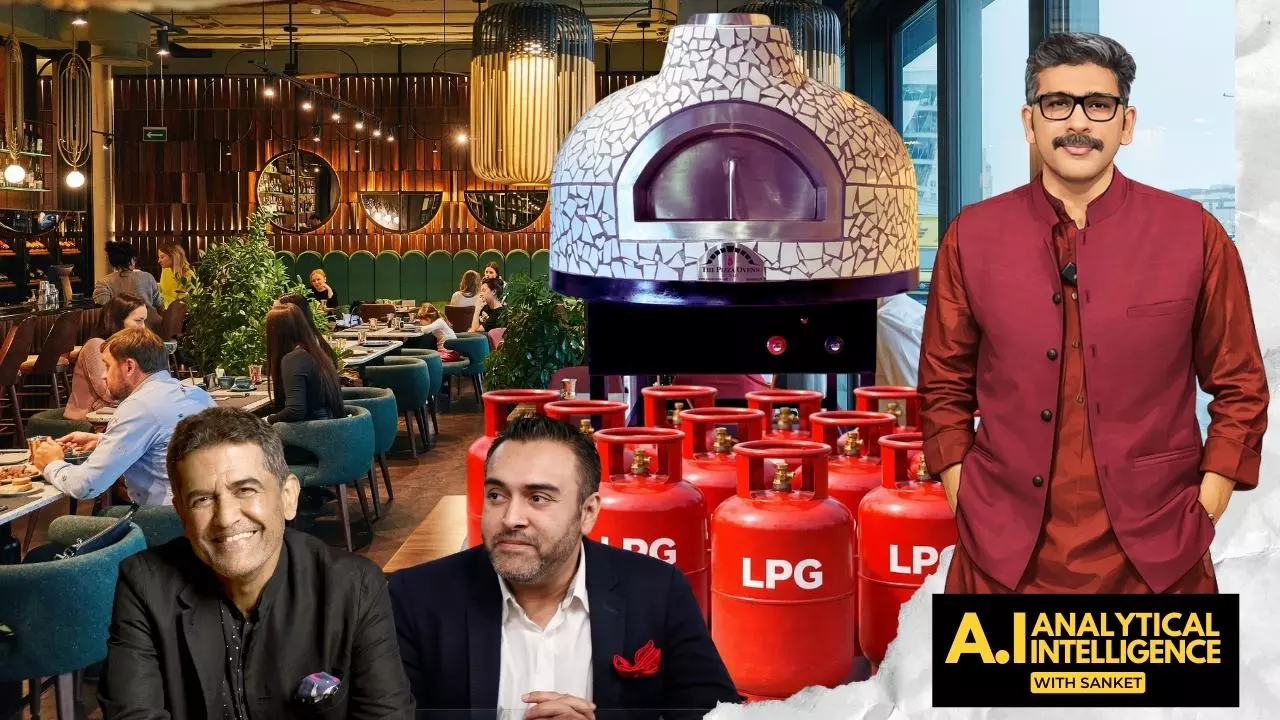
No gas, no business: How India's LPG crisis is crippling restaurants
Restaurateurs Zorawar Kalra and AD Singh caution that prolonged commercial LPG shortages could trigger mass closures, job losses, and a collapse across the food delivery ecosystem.

“If the LPG supply crisis continues for several weeks or months, it could become an existential crisis for the restaurant industry,” warned restaurateur Zorawar Kalra. The hospitality leader said many restaurants across India have already slashed menus or are on the verge of shutting down due to the shortage of commercial LPG cylinders.
In this episode of AI with Sanket, Sanket Upadhyay spoke to Zorawar Kalra, founder of multiple restaurant brands, and veteran restaurateur AD Singh, about the growing fuel supply crisis affecting hotels and restaurants across the country. Both industry leaders said the shortage is already disrupting operations and could spiral into a major economic shock if urgent measures are not taken.
Kalra compared the situation to the early days of the COVID-19 lockdown in March 2020, when uncertainty gripped the hospitality sector. “Within 15–20 days back then, the industry began fearing an existential crisis,” he said, adding that the current situation could escalate similarly if LPG supply remains restricted.
Economic scale
Kalra emphasised the scale of the hospitality industry and its economic importance to India.
According to him, the restaurant sector is the second-largest employer in the country after agriculture. It directly employs about 8 million people and supports another 8 million through ancillary industries. The sector contributes roughly 2–3 per cent to India’s GDP.
“This is a ₹6.6 lakh crore ecosystem,” Kalra said. “Every day the industry contributes roughly ₹1,800 crore to the GDP.”
Also Read: Is LPG shortage a crisis of our own making, as Opposition claims? | Capital Beat
However, the shortage of commercial LPG — widely used in restaurant kitchens — threatens that output. Kalra estimated that if LPG-based operations stop, daily losses could range between ₹1,200 crore and ₹1,300 crore.
The impact, he said, would not just be financial.
“This is wartime. We understand everyone must conserve resources. But if LPG supply becomes zero, restaurants simply cannot operate,” he said.
LPG shortage
A key concern raised during the discussion was the lack of access to commercial LPG cylinders.
This is a ₹6.6 lakh crore ecosystem. Every day industry contributes roughly ₹1,800 crore to the GDP
Kalra explained that restaurants are legally allowed to use only the 19-kg commercial LPG cylinders and cannot switch to domestic cylinders. However, in several places oil companies have either drastically reduced or completely halted commercial LPG supplies.
“Right now in some cases there is a complete clampdown,” he said.
He also pointed out that government measures to ensure fuel supply currently prioritise domestic users and piped gas networks but do not explicitly cover commercial LPG used by restaurants.
Kalra noted that only around 25 per cent of the industry uses piped natural gas or compressed natural gas networks, which are not affected by the crisis.
“The remaining 75 per cent relies on LPG,” he said. “Those restaurants are facing immediate disruption.”
India produces only about 40 per cent of its LPG domestically, Kalra said, while 60 per cent is imported. A large portion of those imports normally pass through the Strait of Hormuz, which has faced disruptions due to geopolitical tensions.
Smaller players
Industry leaders said the worst impact will be on small restaurants, roadside eateries and unorganised players.
Kalra highlighted the plight of small dhaba owners who rely on a single LPG cylinder to run their business.
“A small dhaba owner who needs one cylinder a week to feed his family has no backup,” he said.
Also Read: Telangana’s pharma giants prepare for massive hit amid West Asia crisis
He also pointed out regulatory restrictions that limit alternative cooking methods. For example, some areas restrict the use of charcoal due to pollution control measures.
“In Delhi a dhaba owner cannot even burn a tandoor because charcoal is restricted under environmental rules,” he said. “So he literally has no way to cook.”
Kalra added that the National Restaurant Association of India (NRAI), where he serves as vice president, has already issued advisories urging restaurants to conserve fuel and explore alternative cooking methods.
Coping strategies
AD Singh, whose company operates several well-known restaurants including Olive Bar & Kitchen, described the operational challenges facing even large restaurant groups.
“In Delhi many of our restaurants use piped gas, so they are safe for now,” Singh said. “But in other markets we are already shifting to induction cooking where possible.”
He said restaurant teams are revising menus and reducing dishes that require heavy gas usage.
“Chefs are analysing every item and figuring out what can be cooked using induction equipment or electric appliances,” Singh explained.
However, he acknowledged that these solutions are expensive and impractical for many smaller operators.
In Delhi a dhaba owner cannot even burn a tandoor because charcoal is restricted under environmental rules
“A lot of the sector is unorganised. They do not have the space, the money or the infrastructure to switch to other cooking systems,” he said.
Ripple effects
Both restaurateurs warned that the crisis could ripple across multiple sectors.
Restaurants are linked to a vast ecosystem that includes delivery platforms, gig workers, suppliers, and farmers.
“If restaurants shut down, the entire ecosystem gets affected,” Singh said.
Food delivery companies like Swiggy and Zomato depend heavily on restaurants for business, while thousands of gig workers rely on those platforms for income.
Vendors supplying ingredients, kitchen equipment, and logistics services would also face disruptions.
“Every person working in the industry supports four to six family members,” Singh noted. “So the economic impact multiplies very quickly.”
Kalra echoed this concern, warning that widespread restaurant closures could threaten the livelihoods of around 16 million people connected directly or indirectly to the sector.
Industry demands
Restaurant bodies have outlined several urgent measures to address the crisis. Kalra said the industry has made two primary requests to the government.
First, restaurants should be granted “essential services” status so that critical fuel supplies are ensured.
Second, oil companies should be directed to maintain the supply of commercial LPG cylinders, even if rationed.
“If production has fallen, we understand rationing,” Kalra said. “But supply cannot be reduced to zero.”
He also urged authorities to increase LPG imports and ramp up domestic production.
Kalra said one major oil company had indicated it might be able to increase production capacity by about 15 per cent, which could help stabilise supply in the short term.
Uncertain outlook
Despite the challenges, both restaurateurs expressed cautious optimism that the situation will improve.
Kalra described the hospitality sector as resilient and capable of adapting to crises.
“Our industry has one of the highest failure rates in the world,” he said. “If you are in the restaurant business, you are naturally an optimist.”
Singh agreed but warned that the longer the crisis continues, the more severe the consequences will be.
“If this goes on for months, we may see large-scale closures,” he said.
For now, restaurant operators across India are watching the situation closely, hoping fuel supplies stabilise before the crisis spreads further.
The content above has been transcribed from video using a fine-tuned AI model. To ensure accuracy, quality, and editorial integrity, we employ a Human-In-The-Loop (HITL) process. While AI assists in creating the initial draft, our experienced editorial team carefully reviews, edits, and refines the content before publication. At The Federal, we combine the efficiency of AI with the expertise of human editors to deliver reliable and insightful journalism.