



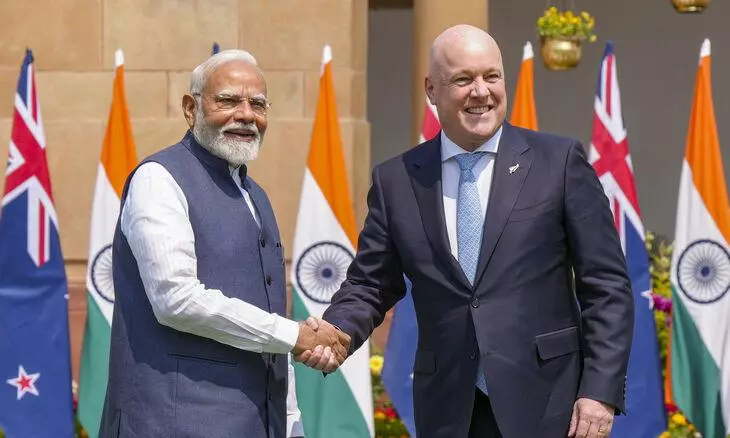
Prime Minister Narendra Modi and New Zealand Prime Minister Christopher Luxon during the latter's visit to India in March this year. Photo: PTI
India, New Zealand seal free trade pact
The India–NZ conclude FTA talks to boost trade; deal cuts tariffs on 95 pc of Kiwi exports, aims to enhance the $1.3 bn bilateral trade between the two countries

India and New Zealand on Monday announced the conclusion of free trade agreement negotiations, which is expected to boost bilateral trade in goods and investments between the two countries, and open up the Indian market of 1.4 bn consumers to New Zealand exporters.
The talks had started in May this year.
PM Luxon hails agreement
Hailing the agreement, New Zealand Prime Minister Christopher Luxon said on Monday that negotiations for a free trade agreement with India have been concluded. The free trade agreement (FTA) reduces or removes tariffs on 95 per cent of our exports to India, he added in a social media post.
Further, he said that it's forecast that New Zealand exports to India could increase from USD 1.1 billion to USD 1.3 billion per year over the coming two decades.
Also read: India in talks for free trade agreements with six key economies, says Piyush Goyal
"I've just spoken with India's Prime Minister Narendra Modi following the conclusion of the NZ-India Free Trade Agreement. The agreement builds on the strong friendship between our two countries. India is one of the fastest-growing economies in the world, and this gives Kiwi businesses access to 1.4 billion Indian consumers," Luxon said.
Bilateral trade
In FY25, the bilateral trade was about USD 1.3 billion (India's exports were USD 711.1 million and imports were USD 587.1 million).
New Zealand's average import tariff is just 2.3 per cent, compared with India's 17.8 per cent, and 58.3 per cent of New Zealand's tariff lines are already duty-free.
India's export basket to New Zealand is broad-based but concentrated in fuels, textiles, and pharmaceuticals.
Aviation turbine fuel (ATF) led shipments at USD 110.8 million, followed by clothing, fabrics, and home textiles at USD 95.8 million.
Medicines accounted for USD 57.5 million, while machinery, including turbojets, contributed USD 51.8 million.
Petroleum products were another major component, with diesel exports totalling USD 47.8 million and petrol exports totalling USD 22.7 million.
Also read: New Zealand minister under fire for Indian emails 'akin to spam' remark
Other notable exports included automobiles and parts (USD 19.3 million), paper and paperboard (USD 18.3 million), electronics (USD 16.5 million), iron and steel (USD 14.1 million), shrimps (USD 13.7 million), basmati rice (USD 11.9 million) and gold jewellery (USD 9.9 million).
NZ's exports to India
New Zealand's exports to India, by contrast, are dominated by raw materials and agricultural inputs.
Wood and wood articles (USD 78.4 million) and wood pulp (USD 39.8 million) underline linkages in paper, packaging and construction.
Steel scrap exports reached USD 71.2 million, while aluminium scrap totaled USD 42.9 million, reflecting India's dependence on recycled metal inputs.
In energy and heavy industry, coking coal exports totalled USD 48.8 million, alongside high-value turbojets valued at USD 66.2 million.
Agricultural and animal-based products also play a significant role, led by shorn wool (USD 47.3 million), milk albumin (USD 32.1 million), apples (USD 32.8 million) and kiwi fruit (USD 17 million).
Services trade
Services trade is a more significant pillar of the relationship.
In FY24, India's services exports to New Zealand stood at USD 214.1 million, while New Zealand's services exports to India totaled USD 456.5 million.
India's strengths lie in IT and software services, telecommunications support, healthcare and financial services.
New Zealand's services exports are led by education, driven by Indian students, followed by tourism, fintech solutions, and specialised aviation training, he added.
(With inputs from agencies)