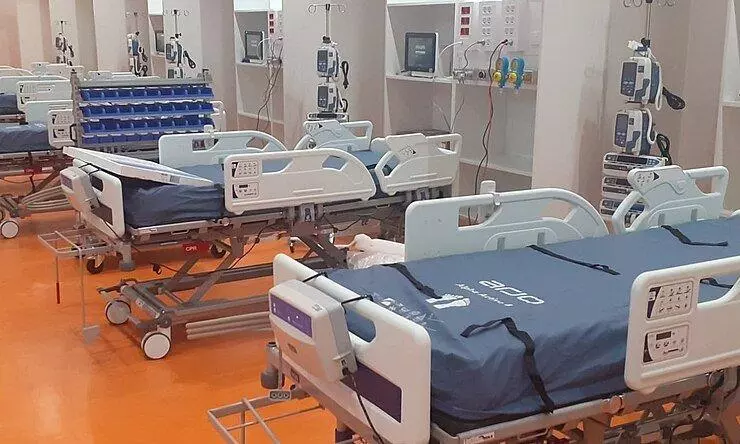
India currently has approximately 1.6 hospital beds per 1,000 people, compared with the global average of 3.3, according to CBRE’s report 'Beyond Core: A 2035 View of India’s Alternate Sectors – Part I'. Representative image: Wikimedia Commons
India needs extra 2.6 billion sq ft of healthcare real estate by 2035: CBRE
With a shortfall of nearly 2.9 million hospital beds, India’s healthcare infrastructure gap is opening up opportunities for hospital operators, developers, and investors across cities

India will need an additional 2.6 billion sq ft of healthcare real estate by 2035 to align its hospital-bed capacity with the current global benchmark, according to property consultancy CBRE South Asia Pvt Ltd. The projected infrastructure gap is creating opportunities for hospital operators, developers, and investors, with companies exploring new facilities, acquisitions, and alternative healthcare formats to expand their presence.
India currently has approximately 1.6 hospital beds per 1,000 people, compared with the global average of 3.3, according to CBRE’s report, Beyond Core: A 2035 View of India’s Alternate Sectors – Part I. Closing the gap would require nearly 2.9 million additional hospital beds, the report estimates. India’s healthcare real estate footprint stood at an estimated 2.1 billion square feet in 2025.
The scale of the requirement points to a potential expansion in healthcare infrastructure over the next decade, extending beyond conventional multispecialty hospitals to diagnostics, day-care surgery, outpatient services, and specialised medical facilities.
“Healthcare is emerging as one of India’s most consequential real estate opportunities, not simply because demand for care is increasing, but because the country needs a far deeper and more distributed physical healthcare network,” said Anshuman Magazine, chairman and chief executive officer for India, South-East Asia, the Middle East and Africa at CBRE.
PB Health plans integrated healthcare network
Against this backdrop, PB Health, backed by PB Fintech, the parent company of Policybazaar, has launched a 100-bed multispecialty hospital at Iffco Chowk in Gurugram’s DLF Phase 2. The facility is positioned as the first flagship hospital in the company’s broader plan to build an integrated healthcare network.
The company is pursuing a combination of direct ownership, acquisitions, and franchise partnerships to expand its hospital footprint. Building on its acquisitions of Neo Hospital and health-tech platform Fitterfly, PB Health is developing additional multispecialty hospitals with capacities of 200-250 beds across Delhi-NCR while planning a nationwide franchise model with partner hospitals.
The Gurugram facility offers services across neurology, cardiology, orthopaedics, paediatrics, gastroenterology, gynaecology, and urology, alongside minimally-invasive and robotic surgery. Its diagnostic infrastructure includes CT scans, MRI, X-ray, ultrasound, and laboratory testing.
Also Read: India leads digital healthcare revolution with AI and data-driven hospitals
PB Health’s model combines preventive healthcare, chronic disease management, clinical treatment, and recovery at home, supported by technology-enabled coordination among patients, hospitals, and insurers. The company aims to streamline appointments, health-record management, and follow-up care while bringing different stages of the patient journey under a connected system.
“Healthcare needs to move beyond high-cost infrastructure and episodic-treatment models,” said Alok Bansal, co-founder and executive vice-chairman of PB Fintech.
He said the company aims to combine clinical care with technology to improve transparency and make healthcare easier to navigate.
Acquisitions, specialised formats gain relevance
The expansion strategy reflects a broader shift in healthcare investment towards multiple operating formats. According to CBRE, operators are increasingly considering single-speciality hospitals, day-care surgery centres, and outpatient facilities alongside larger hospital developments.
Acquisitions can provide a route into established markets by giving operators access to existing infrastructure, licences, and patient networks. In competitive urban locations, this may offer an alternative to developing facilities entirely from scratch.
The opportunity also extends to diagnostic centres, rehabilitation clinics, eye-care facilities, in-vitro fertilisation centres, preventive health outlets, and wellness services. These formats can serve specific patient requirements without replicating the full infrastructure of a multispecialty hospital.
Also Read: Budget 2026-27: Biopharma gets big boost, public health left behind
Medical office buildings, which accommodate several healthcare providers within a single development, represent another potential real estate format. These facilities can bring diagnostics, dental care, rehabilitation, fertility services, and wellness providers together, improving patient convenience while letting multiple tenants share a location.
Built-to-suit developments could offer additional scope for property owners and healthcare operators. Purpose-built facilities can be designed around clinical, technical, and regulatory requirements, allowing operators to focus more of their resources on medical equipment, technology, and patient services.
Regional disparities shape development opportunities
The infrastructure gap is not uniform across the country. CBRE’s analysis of non-communicable disease prevalence and hospital-bed density identifies Chhattisgarh, Odisha, Madhya Pradesh, and Jharkhand as states where relatively low bed-availability compared with disease burden may indicate unmet demand for secondary and tertiary healthcare.
Karnataka, Kerala, Tamil Nadu, and Telangana have comparatively stronger healthcare infrastructure, creating scope for further expansion of specialised services and medical ecosystems.
Tier-II and tier-III cities are also expected to be important to the development opportunity, given the availability of larger land parcels and comparatively lower land costs that can support purpose-built healthcare projects.
Also Read: Why GST cut is a boost for Indian healthcare: Experts' take
“The current landscape creates scope for a diversified development pipeline, ranging from large integrated healthcare campuses and multi and single-speciality hospitals to medical office buildings, diagnostics, and day-care facilities,” said Rami Kaushal, managing director, consulting and valuation services, India, Middle East and Africa, at CBRE.
For investors and operators, the projected infrastructure requirement presents a substantial potential market, but converting it into viable projects will depend on patient demand, affordability, location, and operational efficiency. As healthcare providers expand through ownership, acquisitions, and partnerships, the next phase of development is likely to encompass a wider range of medical facilities rather than relying solely on large hospitals.