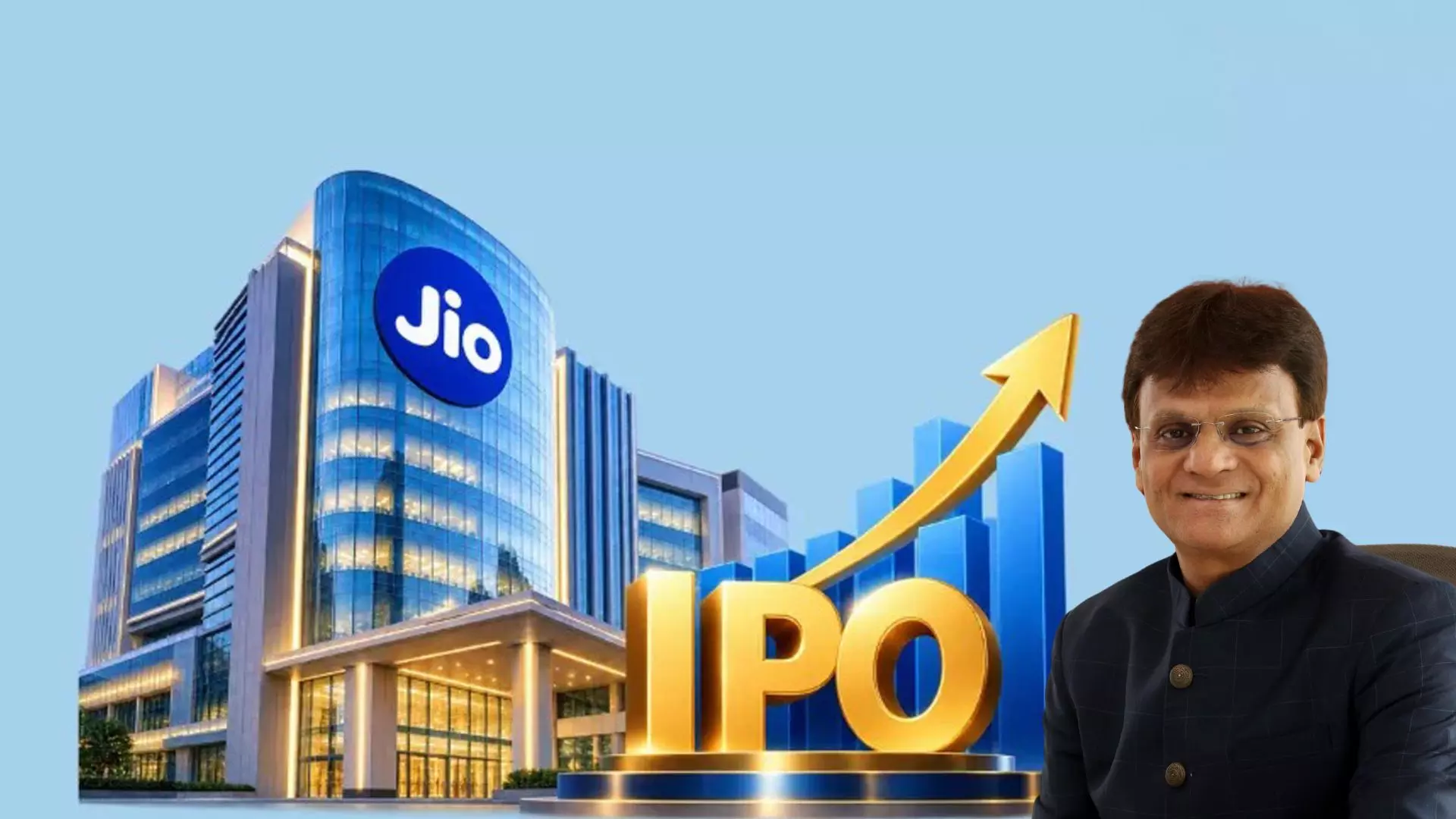
Hype around Reliance Jio IPO is completely justified: Deven Choksey
Deven Choksey of DRChoksey FinServ breaks down Rs 10 lakh crore valuation, satellite telecom rivalry, long-term upside for investors, and broader market outlook

By pricing its massive IPO at ₹10 lakh crore instead of the expected ₹12 lakh crore, Jio Platforms is leaving a 20 per cent safety cushion on the table for investors. But is the hype around India's largest telecom operator fully justified?
In an exclusive interview with The Federal, Deven Choksey, Managing Director of DRChoksey FinServ, breaks down the valuation, the competitive edge Jio holds over satellite giants like Starlink, and why the listing could unlock significant value for Reliance Industries shareholders.
If you were an investor, would you buy into the Jio Platforms IPO?
Yes, I am an investor and I will be investing in the IPO. I have been an investor in Reliance, so naturally my holding will continue in Jio Platforms through Reliance as well.
On the hype side, this is going to be the fifth largest market cap company in the country post listing. This is where the immediate attention of global investors comes in, because when a large-sized company lists, funds allocation automatically starts happening. Down the line, within six months of listing, you will see the stock entering the derivative market and the MSCI index, so allocation of money will naturally start flowing into this business. The hype is completely justified.
An upside of up to 10 per cent from the IPO marketing price remains a reasonable entry point for investors who miss out on the initial allotment.
The second most important aspect is the pricing of the IPO. It was expected that they would launch the IPO at around a ₹12 lakh crore market cap, but they are launching at a ₹10 lakh crore market cap. That means they have left a 20 per cent cushion in the hands of investors subscribing to the IPO. This protects against downside risk in the stock, which otherwise would have become imminent had they marketed at its fair price of a ₹12 lakh crore market cap.
That is another reason why activity in the grey market has picked up. When you market at ₹10 lakh crore as against ₹12 lakh crore, downside risk remains lower, driving grey market interest.
From a business perspective, the hype is equally justified. It is a tech-enabled platform where the end customer consumes data and content. In simple terms, Jio Platforms operates a variety of tech applications riding on a broadband platform serving mobility, home, and enterprise customers.
Also read | Reliance responds to Musk’s Starlink allegations: ‘We welcome competition’
Each customer segment consumes data across provided applications. For media and entertainment, they have Jio Hotstar as partner. For Large Language Models (LLMs), Gemini is a partner. Similar applications exist across agri-tech, health-tech, fin-tech, video-tech, gaming, and e-commerce.
This drives heavy data consumption among their 53 crore customers, alongside rapid growth in home and enterprise segments. The company is currently growing EBITDA at around 18 per cent CAGR, which in all likelihood could reach 20 per cent CAGR EBITDA. The hype is justified on fundamental strength as well as market dynamics.
Since you mentioned that the IPO is attractively priced, what would be the entry price for someone who wants to buy after listing, or for those who miss out on the IPO?
The first entry has to be through the IPO because it is attractively priced. If, for some reason, post-IPO the stock remains a little softer in price, that would present a further meaningful entry point to build book size.
An upside of up to 10 per cent from the IPO marketing price remains a reasonable entry point for investors who miss out on the initial allotment.
Regarding potential downside, we saw in other large listings like NSE that post-listing price corrections occurred. A 5 per cent dip from the offer price would be a justified level to accumulate the stock into a portfolio.
Given the customer base of Jio Platforms and recent statements from Reliance welcoming competition, how do you view the upcoming interplay between Jio and low-Earth orbit satellite communications providers like Starlink?
Low-Earth orbit (LEO) satellites are a crucial element in managing critical application frameworks, particularly for enterprises and national security applications on the defense side.
Whoever provides services at an affordable price will hold a strong edge. Jio holds a distinct advantage because it is present in all 24 telecom circles in India. They have built a fiber ring across all 24 circles and possess extensive last-mile wireless connectivity reaching diverse pin codes.
In remote areas where tower connectivity is unavailable, satellite connectivity will fill the gap. Jio can seamlessly connect last-mile customers through existing tower infrastructure linked to satellite connectivity.
.Over a two-year horizon, Nifty could comfortably move up from current 23,000 levels to between 35,000 and 36,000.
In contrast, competitors like Starlink will have satellite connectivity but will still need to buy, rent, or lease last-mile connectivity from existing tower operators. Jio controls the end-to-end communication ecosystem, making them a highly disruptive service provider as LEO satellite services rollout.
For an investor, which is a better bet—Jio Platforms or parent company Reliance Industries?
Reliance will continue to hold around 66-67 per cent in Jio Platforms, retaining significant valuation advantages.
If Jio Platforms at a ₹10 lakh crore market cap witnesses a 20 per cent upside to ₹12 lakh crore, that incremental holding value gets added on a sum-of-the-parts (SOTP) basis to Reliance Industries. At a ₹10 lakh crore market cap, 38 to 42 per cent of Reliance Industries' stock price—roughly ₹400 out of a ₹1,200 share price—is represented by Jio Platforms.
Watch/Read | 'Fairfax deal a positive development for IDBI Bank, its staff, customers'
Because Jio Platforms was previously unlisted, this value was not fully reflected due to holding company discounts. With the listing, holding company discounts narrow, directly reflecting in Reliance Industries' stock price. Existing Reliance shareholders will capture value that was previously unreflected, while new investors can directly buy into Jio Platforms to participate in its growth upside.
Looking at the broader markets, foreign institutional investors (FIIs) have been pulling out, though there are occasional signs of recovery. How do you view current valuation levels, market growth, and the overall market scenario?
On a trailing 12-month basis, the Nifty is valued at around 19 times earnings. Factoring in a 15 per cent earnings growth brings valuation well below 17.5 or 18 times. Historically over the last decade, whenever Nifty price-to-earnings dipped below 18 times, the market bounced back.
India's economic growth engine remains strong. The GDP is growing systematically as new investments flow into manufacturing and Production Linked Incentive (PLI) scheme sectors, boosting export-oriented businesses.
Investors should evaluate small and mid-sized businesses on a company-specific basis rather than locking them into rigid sector classifications, as many supply inputs across multiple industries like specialty chemicals.
On the corporate side, companies are adopting AI to modernise operations. In Reliance's oil-to-chemicals business, refineries and downstream supply chains use AI to integrate customer demand, production, and pricing, enhancing efficiency. Consumer companies like Hindustan Unilever are deploying AI for demand forecasting and production planning.
Domestic investors are actively buying at these attractive valuations. FII outflows have occurred primarily because global capital is reallocating directly into AI, data center, and semiconductor stocks in other markets, alongside persistent currency pressures.
Given these market conditions, what levels do you foresee for the benchmark indices over the next few months?
Short-term index forecasting for a week or two is not practical. However, taking a two-year outlook provides clarity.
India is heading toward a $5 trillion market cap on a $4.5 trillion GDP, with potential to triple over the next 10 to 12 years. Over a two-year horizon, Nifty could comfortably move up from current 23,000 levels to between 35,000 and 36,000.
With several other IPOs hitting the primary market, what does this wave of IPOs indicate about the broader market landscape?
India's SME and MSME ecosystem is scaling up. Smaller enterprises are integrating with expanding corporate giants—such as suppliers growing alongside Maruti.
Without scale, SMEs cannot survive as India opens its markets through free trade agreements. India has signed 33 FTAs and is working toward a mother agreement with the US. SMEs are accessing public capital through IPOs to expand capacity and prevent hostile takeovers.
While not every IPO will deliver stellar returns, select companies led by capable entrepreneurs present outstanding long-term prospects.
Are there specific sectors among these new listings that investors should closely monitor?
Key areas include tech-enabled operations, pharmaceuticals, engineering R&D, defense supply, railway supply, and both discretionary and non-discretionary consumption. Industrial supply chains linked to PLI schemes deserve systematic focus.
Investors should evaluate these small and mid-sized businesses on a company-specific basis rather than locking them into rigid sector classifications, as many supply inputs across multiple industries like specialty chemicals.
Having observed Reliance's evolution over decades, what key memories or insights stand out from your journey tracking Dhirubhai Ambani and Mukesh Ambani?
Having tracked capital markets since the 1980s, I have witnessed Reliance's journey firsthand.
We visited their early plants at Patalganga, Hazira, and Jamnagar when the business was purely petrochemicals and refining. Today, those operations have expanded into new growth engines like Jio Platforms, Reliance Retail, media, renewable energy storage, and enterprise AI.
Over the past 50 years, the leadership has built and prepared the enterprise for the next 100 years. Being part of that 50-year transformation as a long-term investor is a memorable journey.
Watch the full interview here.