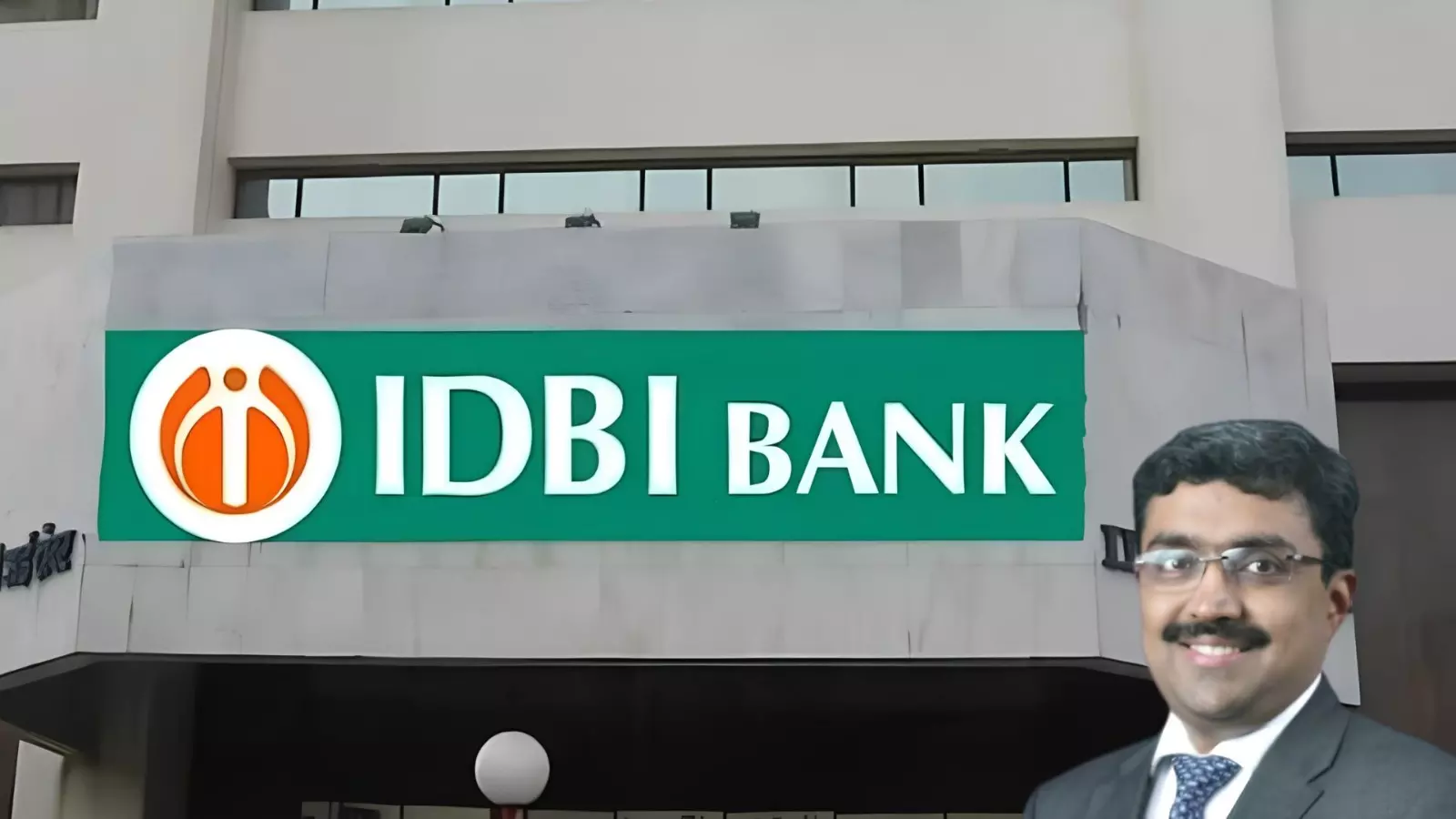
IDBI Bank stake sale: What Rs 52,878-crore Fairfax deal means | Interview
In this interview, Ajay Roti of Tax Compass discusses the sale of a stake in IDBI Bank and says it is "a very good deal and the timing is right".

The Cabinet Committee on Economic Affairs has approved the sale of a 60.72 per cent stake in IDBI Bank to Fairfax Financial Holdings for Rs 52,878 crore. This is the country’s biggest strategic disinvestment since the sale of Air India and potentially opens a new chapter in the privatisation of state-controlled banks.
In an interview with The Federal, Ajay Roti of Tax Compass discusses the deal, its implications for banking competition and investor sentiment, the regulatory hurdles involving CSB Bank, and the debate over LTCG and STT.
Edited excerpts.
What does the Fairfax deal mean for IDBI Bank and India?
The deal means a lot of things, particularly because of how long it has taken to materialise. It has been in the works for a long time, and we will come to that in a few minutes.
To understand what the deal means, we need to take a step back and look at the bank's existing ownership structure. Currently, the government and LIC together hold about 95 per cent of IDBI Bank, while the public shareholding is around 5 per cent.
What has been announced is that Fairfax will acquire a little over 60 per cent of the bank, or 60.72 per cent to be precise. The government and LIC are selling their respective stakes to the buyer. Following the transaction, the government and LIC will retain a combined 34 per cent stake, while the public will continue to hold around 5 per cent.
Fairfax will acquire the majority stake and, therefore, control the bank. The government and LIC will remain shareholders. The government has also indicated that it intends to sell its residual 15 per cent stake over time, following the approach it has adopted with other banks and companies where it holds a stake. LIC, meanwhile, is free to decide when it wants to sell its remaining holding.
Effectively, the transaction will place IDBI Bank under Fairfax's control.
This is a welcome deal and one of the largest foreign direct investment transactions in recent times. It is also significant in the banking and financial services space, where we have seen several multibillion-dollar investments in recent months.
Also read: Festive shopping: e-commerce orders jump 31 pc; 42 pc bookings from tier-3 towns
What does Fairfax's entry mean for customers and employees?
We should first understand what it means for IDBI Bank before looking at the larger picture.
IDBI was not originally established as a conventional bank. It began as a domestic financial institution focused on development credit, including the funding of infrastructure projects.
It subsequently transitioned into a bank but faced its own set of problems. It was never particularly stable for a long time and required recapitalisation. LIC eventually stepped in, and the government later decided to disinvest.
For a considerable period, IDBI Bank was not among the better-performing banks.
The transaction should improve matters for the bank, its customers and its employees. With the transition to private-sector bank ownership and management, IDBI Bank will be in a position to compete with larger private-sector banks.
Fairfax has the financial resources to support the bank, and I understand that it has also committed to investing additional capital.
Overall, this is a positive development for the bank, its employees and its customers.
From the banking sector's perspective, greater private-sector participation and competition are beneficial. Another investor with deep financial resources entering the market can help strengthen the sector.
We already have several choices in banking today. The situation is not as difficult as it was many years ago, but greater competition is always better.
From an investor-sentiment perspective, I believe this is a positive development.
Will the deal improve India's economic fundamentals?
We have been reading about foreign investors withdrawing money and concerns over taxation. At a time when foreign investment has been under discussion, how will such a large FDI transaction improve the health of the economy?
I have generally not been someone who believes that the Sensex, the Nifty or even FDI numbers necessarily reflect everything about the economy.
We may be doing very well, the stock market may be performing strongly and FDI may be increasing, but we could still have domestic economic problems.
These numbers are partly about optics and the feel-good factor. That sentiment can spread when such a large foreign investment comes into a bank, particularly after the three or four other transactions we discussed.
From a sentiment perspective, this investment will make a difference. However, I do not think it will create a huge fundamental change in the economy.
What regulatory approvals are still required?
The transaction has cleared the Cabinet approval stage, and the next step involves regulatory approvals, particularly from the RBI. You advise investors, so how do you view the next stage of the process?
Acquiring more than 5 per cent or more than 15 per cent of a bank's shareholding is not straightforward. These are two important thresholds, and not everybody can acquire such large stakes in banks.
The Reserve Bank of India must declare the prospective buyer fit and proper. That is a process in itself, and the transaction remains subject to the necessary regulatory approvals.
There is another important aspect in this case. Fairfax already holds a 40 per cent stake in CSB Bank, formerly known as Catholic Syrian Bank, which is a listed company.
There is no simple provision in the RBI's banking acquisition and banking licence regulations that explicitly prohibits an investor from holding large stakes in two banks. However, the RBI has traditionally been cautious about allowing the same entity to hold significant stakes in two banks. It does not even permit one bank to acquire more than 5 per cent in another bank.
This was always going to be a challenge if Fairfax emerged as the successful bidder for IDBI Bank. We will have to see how the RBI addresses the situation and whether it provides a transition period for Fairfax to exit CSB Bank or merge the two banks.
Will CSB Bank also have to make regulatory disclosures?
My personal reading is that the government must have factored this issue in while clearing the way for Fairfax. There may already have been informal discussions with the RBI, although the formal regulatory process is still to come.
I would expect that there has been some consideration of how the existing CSB Bank investment will be handled and what disclosures may be required.
Whether CSB Bank will have to disclose anything further will depend on what the RBI states.
Is Rs 81 per share a fair price for IDBI Bank?
I do not really have the expertise required to assess the valuation in detail, but banks are not easy to value.
Even publicly listed banks trade at different multiples and valuations. Their valuations depend on several factors, particularly asset quality, rather than simply their latest quarterly profits. Banks are not necessarily valued on the basis of earnings per share and the price-to-earnings ratio in the same way as other businesses.
That was one of the challenges in the IDBI Bank sale process.
For a while, the government had set a reserve price in the Rs 90s, if I remember correctly—around Rs 92 or Rs 93. The first round did not go through about a year or a year and a half ago.
The bank's share price has also fluctuated considerably. Its 52-week high and low have been around Rs 120 and Rs 60, respectively, representing a wide range.
The public float is only around 5 per cent, so the stock does not have a particularly large actively traded public float. A substantial proportion of the shares has been held by the government and LIC.
Given the limited public float and the share-price fluctuations, do you think Rs 81 is a good price for the government and LIC?
I would think so. We cannot simply look at the listed price over the last three months or so and use that as the sole basis for evaluating the transaction.
The government has explained that it conducted its own valuation using two different methodologies. The successful bidder also submitted its own bid.
I am sure Fairfax conducted its own valuation and concluded that Rs 81 was a fair price to offer.
Do you think the deal is happening at the right time, particularly with the government's budget targets in mind?
I think this time the Department of Investment and Public Asset Management (DIPAM) will meet its target and may even exceed it.
That is an important consideration.
This transaction has also been a long-standing burden on the government's balance sheet, although the situation is not comparable to Air India.
IDBI Bank required recapitalisation. I was looking at some of the old documents, and even in the 2020 Union Budget, the government had earmarked Rs 4,500 crore for recapitalisation. LIC also had to provide capital to the bank.
The money that went into supporting the bank was necessary.
The value could probably have eroded further if the bank had not reached this stage of the sale process.
There is another interesting aspect: IDBI Bank has moved some of its businesses, including its demat and depository businesses, out of the bank. There may be some residual value associated with those businesses, although I have not spent much time examining that aspect.
Considering all these factors, I think this is a very good deal and the timing is right.
With the government's budget targets in mind, DIPAM will certainly be looking at this transaction to help improve its performance against its target for the current financial year.
The budget-making process has already begun, with stakeholder consultations taking place. You also participate in such discussions. Moving away from the Fairfax transaction for a moment, what would you ask the government to consider, particularly after the Finance Minister's comments on LTCG and STT at the Bloomberg conference?
Tax rates are ultimately a matter of government policy. I do not think there is a single, straightforward logic that can be applied to every decision.
The demand for changes to LTCG has come up in several consecutive Union Budgets.
The Finance Minister's recent comment that the government would consider the issue, along with the stakeholder meetings taking place, has created some hope.
The way I see it, perhaps the time has come for the government to make a decision on LTCG and STT. If it does not want to change LTCG, it could at least consider doing away with STT.
The government has already rationalised the provisions relating to capital gains, although there is always room for a reduction.
However, we will know whether a tax change makes a difference only after we see the outcome.
Is your memorandum of demands for the Budget ready?
Yes, it is ready.
What are your key takeaways from the Fairfax deal? The Cabinet has approved the transaction, so what should we watch for next?
Assuming the transaction goes through, I do not see the fit-and-proper assessment or other RBI requirements becoming major obstacles. As you rightly pointed out, the regulator may already have been consulted informally and may have considered the arrangement in principle.
I therefore see the transaction as largely a done deal, although the required approvals still have to be completed.
The biggest issue will be what happens to CSB Bank and how its relationship with IDBI Bank is resolved.
The second important point is the boost to investor sentiment. This transaction will make a difference in that regard.
The fact that foreign investors are showing such strong interest in Indian banks tells us that something has gone right in the banking sector over the last few years.
I have always believed that Indian banks are in their strongest position in many years in terms of asset quality, balance sheets and their overall financial health. This applies to both public-sector and private-sector banks.
The sector has faced some challenges in recent years, including leadership and transition issues at several large private-sector banks. IndusInd Bank has had its own problems, and HDFC Bank has also faced challenges. Kotak Mahindra Bank has experienced transition issues, and Yes Bank has had its share of difficulties.
I think many of these issues are now behind us, and the banking sector is entering a better phase. The additional money coming in through FCNR deposits and other channels is also relevant to this broader picture.
Overall, I think the timing is excellent.
From the government's perspective, the transaction effectively takes IDBI Bank off its balance sheet and reduces the burden of supporting the bank.