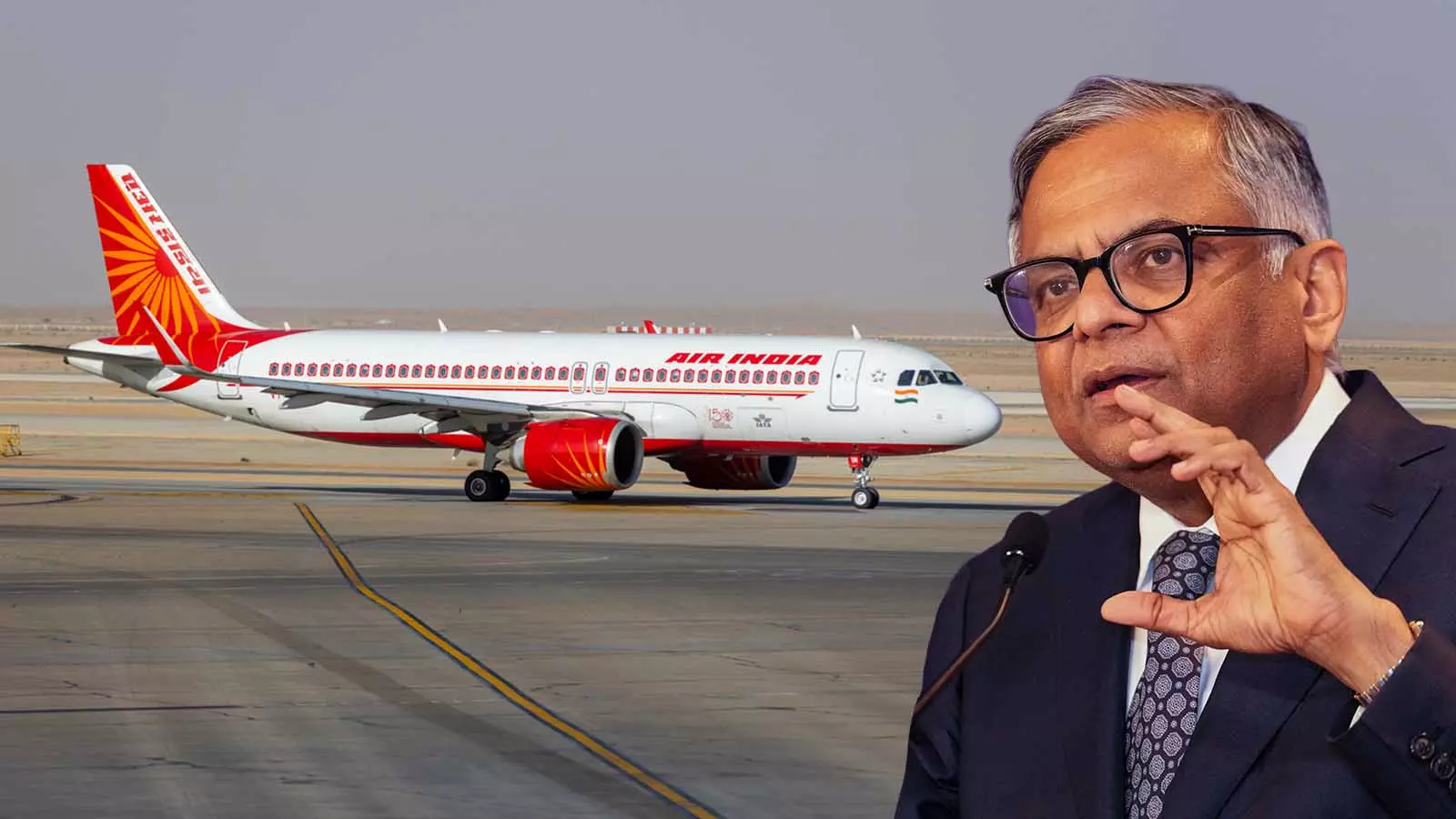
Tata Sons boardroom turbulence could threaten Air India's $1.5-b lifeline
With Chandrasekaran's future uncertain, Singapore Airlines may demand tougher governance terms before approving additional funding for Air India's revival

The unresolved crisis at Bombay House could soon spill into its most prized possession, Air India, which is already reeling from huge losses and a battered reputation.
The immediate risk to Air India is not whether Tata Sons' crisis might suspend or delay funding for the airline, but how this decision is getting entangled with a bigger question of who will control the strategy, governance, and pace of the Air India turnaround.
This matters because Air India has, so far, been leaking money and consuming capital at an unprecedented pace. In FY 2025-26, the airline suffered losses of around $2.33 billion, quite unprecedented in the Indian aviation sector. In comparison, the airline’s biggest competitor, IndiGo, posted its highest-ever loss of Rs 6,162 crore ($830 million at Rs 74.5 per dollar) during the COVID period (2021-22).
Also read | No Gulf hubs, no cheap tickets: How Iran war grounded low-cost air travel
Air India has now sought an additional $1.5 billion in fresh equity from its joint venture partners, Tata Sons and Singapore Airlines, with the former understood to have approved roughly $1.1 billion, its share based on its majority ownership. Singapore Airlines, which owns 25.1 per cent of Air India, will have to share the remaining funding.
New funding, new conditions
The new funding is apart from the infusion of $1.15 billion by both Tata Sons and Singapore Airlines during 2024-25. This is separate from the Tata Group's acquisition cost of the airline. The group acquired Air India in January 2022 for an enterprise value of Rs 18,000 crore ($2.4 billion), comprising a cash payment of Rs 2,700 crore and expected debt of Rs 15,300 crore.
Two captains, one cockpit
♦ Tata Sons in chaos just as Air India needs cash
♦ SIA's price for rescue could be more control
♦ Ageing fleet, unfinished revamp call for quick redress
According to a Reuters report, Singapore Airlines is expected to seek “stronger governance rights” before approving new funding. This could mean greater control over operations and possibly a bigger say in the board’s decisions.
The reason is simple: While Singapore Airlines has a strategic reason to support Air India, that same strategic exposure also gives it a reason to demand greater protection for its capital, given the fact that one of Singapore's opposition lawmakers has already raised concerns about the viability of the airline to keep funding the loss-making Indian airline.
Therefore, the current crisis between Tata Trusts and Tata Sons comes at an awkward moment for Air India.
Also read: Tata Sons board approves 5-year extension for Chandrasekaran; Tata Trusts calls it 'illegal'
The September 17 decision by the Tata Sons board to give the current chairman N Chandrasekaran another five-year term has led to an inconceivable dispute with Tata Trusts, which owns a 66 per cent stake in Tata Sons. Adding another twist to the confrontation, the Chandrasekaran-led board has also given the go-ahead for Tata Sons to be listed.
What changes now?
This is where the Tata Sons crisis becomes relevant.
Until now, the Tatas drove the investment in Air India to transform the airline into one of the leading international airlines, with support from a strategic minority partner. But the new dispute introduces a fresh variable: How much attention will Air India receive from Tata Sons from now on, when those leading the entity will themselves face headwinds in stabilising the holding company.
And, whether the Tata Sons Chairman, N Chandrasekharan, who is leading Air India’s transformation, will come out unscathed from the crisis.
For SIA, that creates an obvious question.
Funding talks
A fresh capital infusion can lead to several possibilities. It can shift the airline's balance of power, create governance expectations, and obviously set new conditions for future capital calls. SIA currently has only one board seat at Air India despite its 25.1 per cent holding, under the terms of the 2022 Vistara-Air India merger agreement.
However, its stake gives it important minority shareholder rights, including the right to block certain special resolutions.
The funding negotiations therefore assume importance and could redraw the relationship between Tata Sons and SIA, potentially becoming a proxy for a larger renegotiation.
Also read | Chennai’s Parandur airport scrapped: Why second airports struggle to take off in India
There is no evidence that the Tata Sons dispute by itself makes the $1.5 billion funding unavailable. Indeed, SIA has considerable financial muscle. At the end of June, it had S$10.48 billion in cash and S$3.24 billion in undrawn committed credit lines. It has also publicly said that its Air India investment is a long-term strategic commitment.
Air India needs capital not merely to absorb existing losses, but to take forward the transformation it has set out to achieve. Old aircraft must be refurbished, and newer ones must be inducted. Product standards have to be raised. Digital systems have to be integrated. International routes need to be expanded.
A bigger ask
Another complication may soon arise for Tata Sons. Some of the other entities under its umbrella might need more capital. The Tatas are investing in semiconductors, batteries, and electronics, and all of them would need more capital going forward. The question for Tata Sons, therefore, is not how much money Air India needs but how long it is prepared to commit itself and the bigger issue of how high its tolerance level for losses is.
Paradoxically, the Tata Sons crisis could ultimately strengthen SIA’s position within Air India. Tata Sons may be forced to give greater weight to the minority shareholder’s concerns. That could mean stricter performance benchmarks, greater board participation or clearer mechanisms governing future capital calls.
Also read What Air India must do to arrest its freefall post Ahmedabad plane crash
If that happens, it will change the partnership's dynamics, reducing Tata Sons’ freedom to manage Air India and view the airline purely as a long-term strategic project whose returns may take years to emerge.
While Singapore Airlines has repeatedly claimed its commitment to Air India and said its 25.1 per cent stake remains a key pillar of its multi-hub strategy, the prolonged dispute with Tata Sons could leave Air India caught between competing shareholders at precisely the stage when it needs a single, consistent transformation plan.