



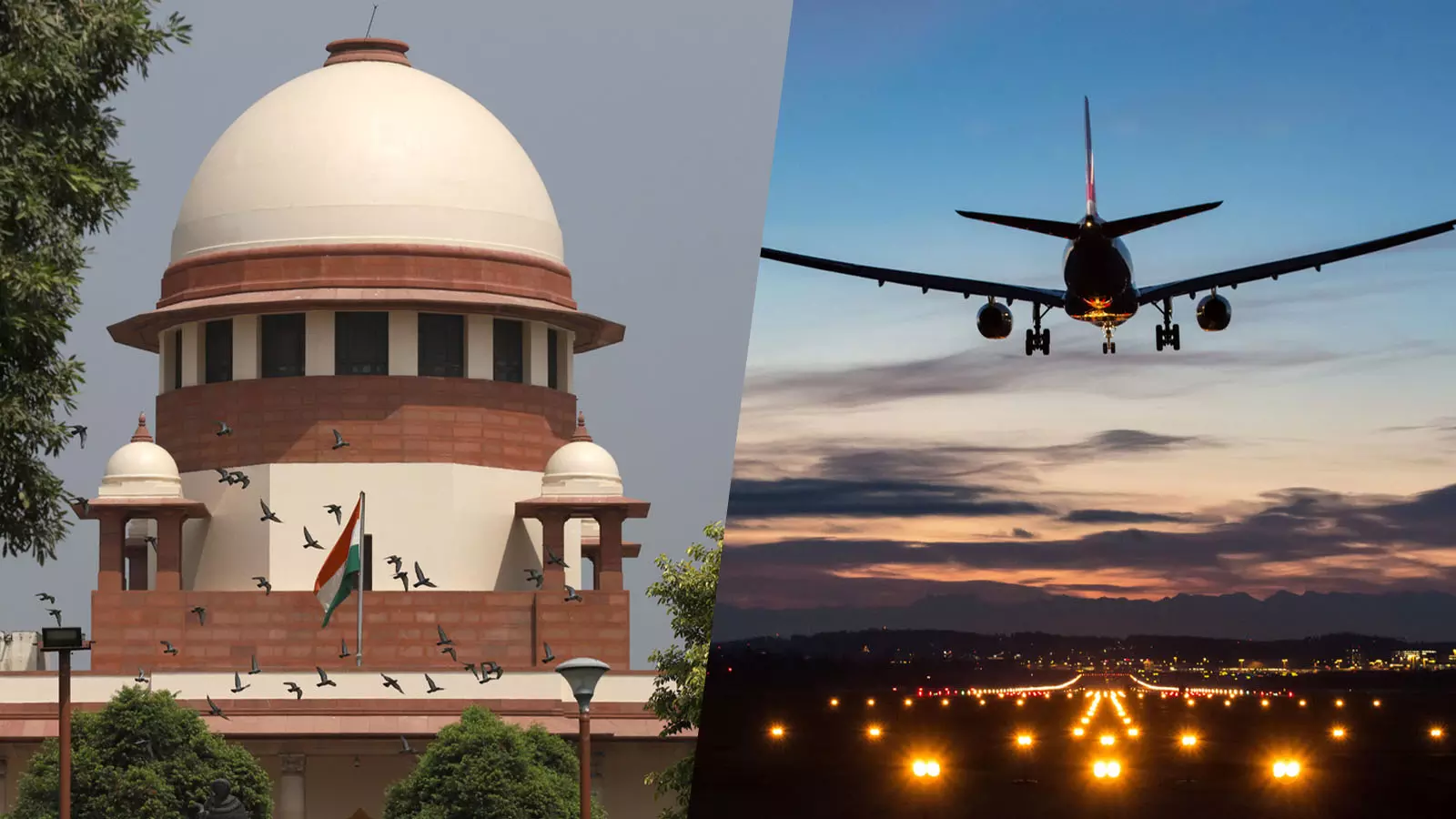
SC orders airfare rationalisation, asks Centre to 'give relief to people'
A two-judge bench was hearing a plea that sought a robust and independent regulator that ensures transparency and passenger protection across the sector

The Supreme Court on Friday (May 15) stated that there needs to be a rationalisation of airfares and requested the Centre to offer relief to passengers.
A bench comprising Justices Vikram Nath and Sandeep Mehta highlighted that, on the same day, two different airlines charged different fares for the same sector.
'Same sector, different charges'
“Try to give some relief to the people because of the discrepancy. On the same day, flights to the same sector, one airline charges Rs 8000 while the other airline charges Rs 18000 for the economy class,” the bench told Solicitor General Tushar Mehta, appearing for the Centre.
Also read: SC pulls up Centre over delay in filing airfare regulation affidavit
Justice Mehta said, “There should be some rationalisation (of airfares),” after the solicitor general said that a new enactment of 2024 has come into effect and the corresponding rules are under consultation.
He also said the government was not disputing the problem and is treating the issue as non-adversarial and considering all aspects.
The bench was considering a petition submitted by social activist S Laxminarayanan, who requested the establishment of a strong and independent regulatory body that guarantees transparency and safeguards for passengers within the civil aviation industry, as well as regulatory frameworks to manage the “unpredictable fluctuations” in airfare and additional fees levied by private airlines in India.
Senior advocate Ravindra Srivastava, representing Laxminarayanan, stated that regulations already exist under the Aircraft Act of 1937; however, the issue lies in their non-compliance.
Mehta held that the existing regulations are valid, but new regulations are currently being developed under the Bharatiya Vayuyan Adhiniyam of 2024, which came into effect in January last year.
Srivastava said till the new rules are framed, the old rules will continue and it says that if the Directorate General of Civil Aviation (DGCA) is satisfied that in a particular situation, the airlines are indulging in charging predatory or excessive fares, it will issue directions.
“They are not issuing any directions. The rules are there, the power is there but it is a case of non-exercise of powers,” he said.
The bench asked Srivastava to reply to the counter-affidavit filed by the Centre and recorded the solicitor general's submission that the consultation process for the formulation of rules under the new regime is going on.
The bench posted the matter for hearing on July 13.
On April 30, the Supreme Court reprimanded the Centre for failing to submit its affidavit regarding a petition that requested regulatory guidelines to manage the “unpredictable fluctuations” in airfare and ancillary fees charged by private airlines in India.
Also read: Govt caps ATF price hike at 25 per cent to curb airfare surge
It had asked the Centre to file an application along with an affidavit giving reasons why the affidavit has not been filed and why further time was sought for it.
On November 17, 2025, the apex court requested replies from the Centre and other parties regarding Laxminarayanan's petition, which calls for a strong and independent regulatory body to guarantee transparency and safeguard passenger rights in the civil aviation sector.
On February 23, the Centre told the apex court that the Ministry of Civil Aviation was actively considering the issues raised in the plea.
'Unpredictable fluctuations'
While hearing the matter on January 19, the top court said it would interfere with the “unpredictable fluctuations” in airfares and flagged the exorbitant rise during festivals.
The Supreme Court had termed the exorbitant rise of airfares by the airlines as "exploitation" and asked the Centre and the DGCA to file their replies on the plea.
The plea claimed that all private airlines have, without any credible justification, reduced the free check-in baggage allowance for economy class passengers from 25 kilograms to 15 kilograms, “thereby converting what was earlier part of the ticketed service into a new revenue stream”.
It said the “new policy of permitting only a single piece for check-in and the absence of any rebate, compensation or benefit to passengers who do not avail themselves of check-in baggage demonstrates the arbitrary and discriminatory nature of the measure”.
Also read: War on Iran delivers a body blow to already battered Indian airlines
The plea claimed that currently, no authority has the power to review or cap airfares or ancillary fees, allowing the airlines to exploit consumers through hidden charges and unpredictable pricing.
It said the “unregulated, opaque and exploitative conduct of airlines manifesting in arbitrary fare hikes, unilateral reduction of services, absence of on-ground grievance redressal and unjustified dynamic pricing algorithms directly infringes upon citizens' fundamental rights to equality, freedom of movement and life with dignity”.
It said the absence of regulatory safeguards results in arbitrary fare hikes, especially during festivals or weather disruptions, which disproportionately harm poor and last-minute travellers.
The plea said inaction by the State in regulating fare algorithms, cancellation policies, service continuity and grievance mechanisms constitutes a dereliction of its constitutional duty and calls for urgent judicial intervention.
What expert says
K Giriprakash, a Bengaluru-based journalist who has tracked the aviation sector for three decades, however, said that for the rationalisation of airfares, a lot of other factors related to the aviation sector need to be addressed first. Stressing that dynamic pricing is a common practice in the sector and across the globe, he remarked that having uniform pricing for a certain sector is a challenging task.
“There are many factors that contribute to differences in pricing. For example, if I choose an airline which is not known to be at its operational best, I may have to pay less because it knows that it has issues to deal with and also lowers ticket prices to lure more passengers. But if I choose an airline which is a leading player, the prices would be higher. Ground perception, quality of services, and even flight timings matter,” he told The Federal, adding, “There are also factors such as passenger load.”
Then there is the ATF (aviation turbine fuel). “ATF accounts for 40 per cent of the airlines’ operational expenses. VAT (value-added tax) also differs from city to city. There are airport handling charges, landing charges, and ground-handling charges. India is a graveyard for airlines. The root causes need to be addressed first before focusing on issues such as fare,” he said.
(With agency inputs)