







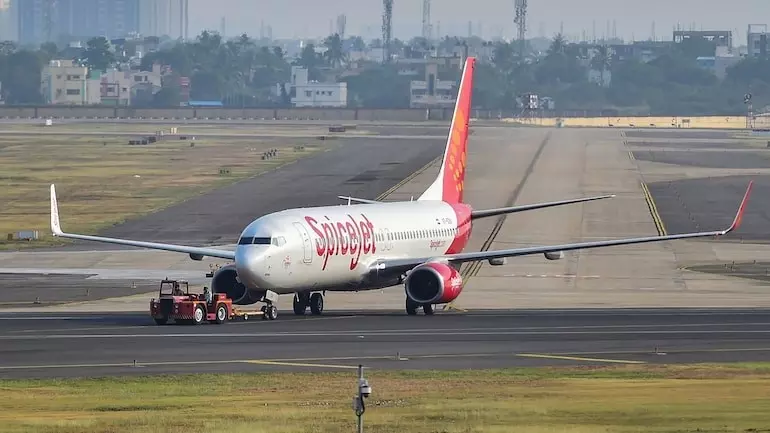
SpiceJet crisis explained: Will it go the Kingfisher, Jet, Go First way?
Beyond a fund crunch, SpiceJet faces pilot-related issues, operational incidents, delayed salaries, lease-payment defaults and management problems

Budget carrier SpiceJet is facing a severe operational and financial crisis, marked by flight cancellations, grounded aircraft, unpaid dues and regulatory action.
On Friday (November 20), the Directorate General of Civil Aviation (DGCA) issued a seven-day show-cause notice over rising cancellations, disruptions linked to delayed payments and alleged regulatory violations. Its domestic market share fell to 0.6 per cent in September from 1.2 per cent in August.
What does the notice say?
In the notice dated November 17, the DGCA flagged SpiceJet's failure to adhere to its approved schedule, passenger inconvenience caused by cancellations and delays, and inadequate passenger facilitation. It also sought an explanation for its failure to pay an earlier penalty despite repeated reminders.
Also read: SpiceJet seeks emergency funds amid salary delays, shrinking fleet
On Wednesday (November 18), SpiceJet's board approved a proposal to raise up to Rs 5,500 crore.
Are the problems similar?
The developments have revived memories of Kingfisher Airlines, Jet Airways and Go First, all of which ceased operations.
However, aviation analyst Giriprakash K told The Federal that SpiceJet's situation is not entirely comparable. "In some ways, Kingfisher and Jet Airways had issues with a lack of funds, similar to SpiceJet. But that is where the similarity stops. Each of these airlines had problems which were unique to it," he said.
SpiceJet's crisis goes beyond its fund crunch, he highlighted. Pilot-related issues, operational incidents, delayed salaries, lease-payment defaults and management problems have added to its difficulties. Several pilots have also left the airline, he added.
What happened to the earlier airlines?
Kingfisher, once positioned as a premium full-service carrier, acquired low-cost carrier Air Deccan in 2007. Rising costs, debt, loan defaults and unpaid salaries and taxes worsened its finances. The DGCA suspended its operating permit in October 2012.
Once India's largest private airline, Jet Airways struggled with debt and competition before grounding all flights in April 2019. After revival attempts failed, the Supreme Court ordered its liquidation in November 2024.
Also read: DGCA finds defects in Indian aviation ecosystem after watching key airports
Go First, formerly GoAir, suspended operations in May 2023 and filed for voluntary insolvency. It blamed US engine maker Pratt & Whitney for failing to supply replacement engines, grounding a significant part of its fleet. It owed creditors around Rs 11,000 crore and eventually faced liquidation.
Why do Indian airlines struggle to survive?
Despite growing passenger demand, several Indian airlines have struggled to maintain financial stability. Giriprakash attributes this to thin profit margins and the industry's constant need for capital.
He points to IndiGo's dominant position in the domestic market, with around 65 per cent market share, as a factor that makes it the most widely available option for passengers on many routes. However, even IndiGo is facing pressure on profitability because of rising oil prices, he adds.
High operating costs, aircraft leasing expenses and rupee fluctuations further weaken airlines. The acquisitions of Air Deccan by Kingfisher and Air Sahara by Jet Airways also highlight the challenges of integrating different business models and cost structures.
Can Rs 5,500 crore revive SpiceJet?
The proposed fundraise raises questions about whether the money will be enough to revive operations and address liabilities. Giriprakash says SpiceJet needs funds for both day-to-day operations and debt repayment. Whether Rs 5,500 crore will cover both remains uncertain. "What is surprising is that whatever funds they have raised so far have not made any difference to the airline's operations. This is quite puzzling," he said.
Also read: Air India, IndiGo, SpiceJet approach Centre, seek duty cut on ATF
He believes the airline must reassess whether further investment is sustainable or consider difficult decisions, including bringing in another partner.
What can the DGCA do?
The DGCA's response to SpiceJet's deteriorating operations raises questions about the extent of its powers and the circumstances under which it can intervene in an airline's operations.
Failure to operate an approved schedule does not automatically attract a financial penalty, Giriprakash explains. The regulator's strongest direct intervention is through capacity allocation, including reducing the number of flights an airline can operate. Penalties and action against operating licences are generally linked to specific violations, such as breaches of crew duty-time norms, rather than schedule shortfalls alone.
Also read: IndiGo hires external expert to probe flight disruptions
Giriprakash says the DGCA is trying to keep SpiceJet operational without compromising safety, noting that there are very few domestic carriers.
What lessons should India learn?
The earlier failures underline the need for regulators to act on warning signs such as unpaid salaries, fuel bills and lease payments. Giriprakash says these should trigger closer scrutiny and, where necessary, operational restrictions. Kingfisher, he notes, showed signs of distress for nearly a year before its permit was suspended.
Passenger protection is another gap. Travellers have lost advance ticket payments during previous airline failures. India needs an escrow mechanism or ticket-protection fund, alongside faster insolvency proceedings, as the Jet Airways case demonstrated, he notes.
Go First exposed difficulties faced by lessors in repossessing aircraft, while its dependence on Pratt & Whitney highlighted the risks of relying on a single engine manufacturer. The Cape Town Convention framework implemented in India in 2025 has addressed some repossession concerns, but regulators must identify financial distress early.
Giriprakash also cautions against excessive market concentration. Repeated airline failures have strengthened surviving carriers, potentially reducing the regulator's leverage over dominant players. He cites the IndiGo disruption in December 2025 as an example.
He argues that India needs clear, predefined regulatory triggers rather than case-by-case decisions when airlines show signs of financial and operational distress.