AI171 crash: The investigation is under investigation
The AAIB has told the Supreme Court not to order a parallel probe into the AI171 crash, but its own affidavit raises more questions than it answers about the investigation's rigour and completeness. First of a two-part series

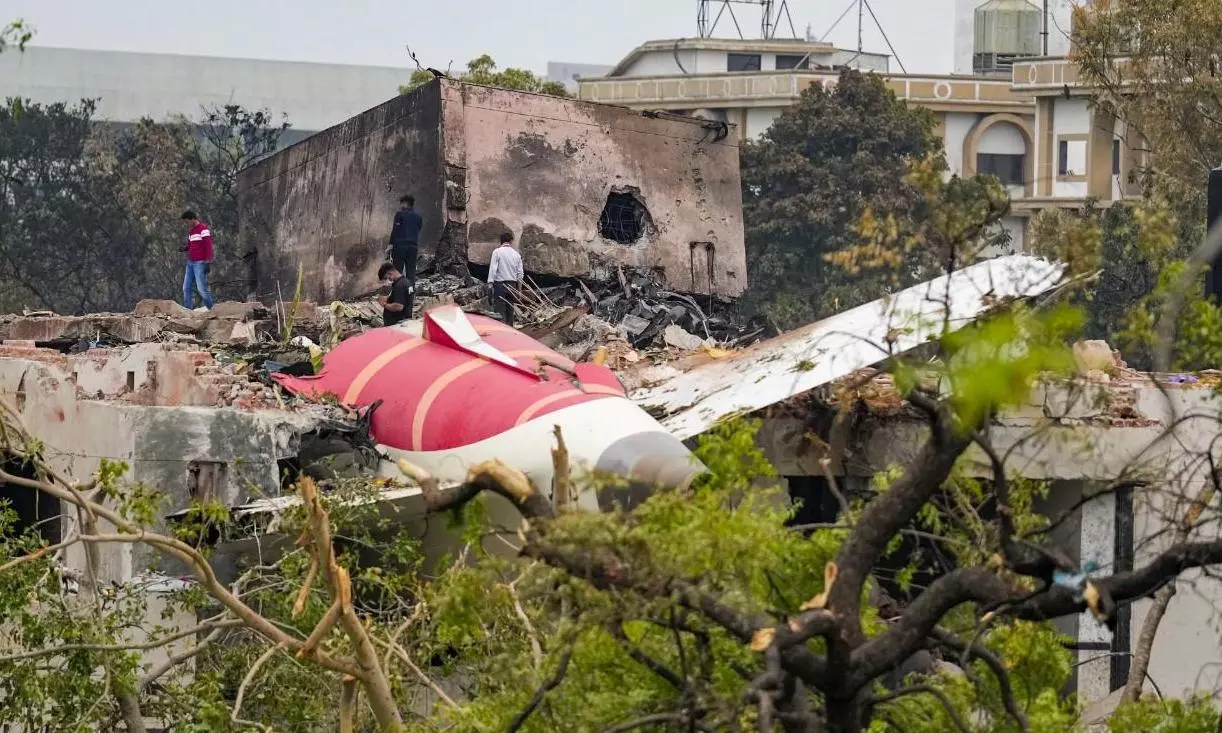
Remains of the ill-fated London-bound AI171 aircraft that crashed seconds after taking off from Ahmedabad on June 12, 2025, killing all but one person on board.
Following months of the Supreme Court awaiting an update on the state of the 2025 Air India AI171 crash investigation, the Aircraft Accident Investigation Bureau (AAIB) of India last week filed a 380-page response opposing petitions that sought a wider probe into the crash.
Of that, over 350 pages were devoted to building a legal case for its sole jurisdiction over the investigation and urging the Court to stay out of the matter, while barely 20-odd pages addressed the actual investigative work carried out so far. It also attempted to present the Court with a fait accompli by asserting that its investigation is almost finished, with the draft final report expected within six weeks.
Also read: Air India AI-171 crash final report may be released soon, says civil aviation minister
The AAIB's central argument was straightforward. The Court, it said, should not order any parallel investigation. Aircraft accident investigations are governed by ICAO (International Civil Aviation Organisation) Annex 13 and India's Aircraft (Investigation of Accidents and Incidents) Rules. The AAIB is the statutory authority designated to conduct such investigations. It alone has custody of the evidence. It has already "completed 49 of the 66 steps" prescribed under ICAO procedures. The investigation should therefore be allowed to proceed without judicial interference.
Legally, that is a respectable argument. But it also creates a corresponding obligation.
If a public authority asks the country's highest court to recognise its exclusive authority to investigate one of India's worst aviation disasters, it must also demonstrate that it is exercising that authority comprehensively, rigorously and transparently.
That is now the larger issue before the country. The question is no longer merely why AI171 crashed. It is also how India has investigated the crash.
What the affidavit chooses to prove
Read carefully, the affidavit reveals something interesting.
Faced with petitions questioning the integrity of the investigation itself, the AAIB devotes much of its effort to establishing its exclusive statutory authority, explaining the confidentiality provisions of ICAO Annex 13, defending Rule 11 of the Aircraft (Investigation of Accidents and Incidents) Rules, and asserting that it has completed 49 of ICAO's 66 recommended steps.
Those are arguments about institutional legitimacy rather than the intellectual architecture of the investigation. It is important to understand the difference because the affidavit is not merely a description of an investigation. It is asking the Supreme Court to reject calls for any parallel inquiry.
When an institution asks the Court to recognise its authority to discover the truth, it inevitably invites scrutiny not only of how much investigation has been completed, but of what kind of investigation it is conducting.
Exclusive investigative authority is not merely a legal privilege. It carries a corresponding responsibility to demonstrate that the search for the truth has been as comprehensive as the monopoly over that search.
What does '49 of 66 steps' actually tell us?
The affidavit repeatedly points to the completion of "49 of the 66 ICAO investigative steps" as evidence that the investigation is progressing appropriately.
That sounds impressive. But what exactly are those 66 steps?
They are procedural steps for managing an investigation, developed by ICAO to ensure that investigations are organised systematically: securing the wreckage, preserving evidence, interviewing witnesses, examining components, coordinating with participating States, analysing recorders, preparing reports and the like.
Those steps are indispensable. But completing them does not, by itself, answer the questions that ultimately determine whether an investigation has uncovered the truth.
How were competing explanations generated? Which hypotheses survived scrutiny? Which were eliminated? How were contradictory pieces of evidence reconciled? How were conclusions reached?
The affidavit does not attempt to answer those questions.
Also read: Fuel cut in 1 sec? AI-171’s final minutes flag mechanical failure, not pilot error
The AAIB may not be legally obliged to. But having chosen to rely upon investigative progress as one of its principal reasons why the Court should reject calls for an independent inquiry, it inevitably invites scrutiny not merely of the quantity of investigation completed but of the quality of the reasoning behind it.
Has AAIB shown us how it is thinking?
The affidavit catalogues the AAIB's investigative work. It says investigators have examined the wreckage, analysed flight recorder data, interviewed witnesses, tested engines and recovered components, conducted metallurgical examinations, analysed organisational factors, retrieved Engine Monitoring Unit data, examined operator records, manuals, audit reports and Flight Data Analysis Program records, and worked with accredited representatives from Boeing, General Electric, the US National Transportation Safety Board and other international participants.
Six specialist investigation groups, it says, are examining different aspects of the accident.
That is reassuring as far as it goes. But a scientific investigation is more than a list of completed tasks. It is a way of reasoning.
Every major accident investigation begins with competing hypotheses—mechanical failure, electrical failure, software malfunction, maintenance deficiencies, operational factors, human factors and organisational influences. Some hypotheses gain strength. Others gradually fall away.
That is how engineering investigations progressively narrow uncertainty.
The affidavit tells us what investigators have done. It does not explain, even in broad terms, what competing categories of explanation have been examined, which have been ruled out, and which remain under active investigation—while claiming the AAIB is only six weeks away from the draft of its final report.
No confidential evidence needs to be disclosed to answer those questions. Merely explaining the investigative pathway would have strengthened public confidence.
Has every technically credible avenue been examined?
The affidavit lists broad categories of evidence examined. Yet it remains notably silent on several categories of material that have figured prominently in public discussion over the past year.
It does not indicate whether investigators obtained and analysed Aircraft Communications Addressing and Reporting System (ACARS) transmissions relating to AI171.
It does not say whether Aircraft Health Monitoring (AHM) data or comparable digital aircraft health records formed part of the investigation.
It does not explain whether maintenance message traffic, off-aircraft diagnostic records or other forms of digital telemetry have been examined.
The same is true of relevant external technical material. Over the past year, especially since the publication of the preliminary report, professional pilots, engineers, independent safety organisations and investigative journalists have publicly raised technical questions about aspects of the investigation.
Also read: Exclusive: Do Air India’s Dreamliner groundings hint at deeper safety flaw?
The Federation of Indian Pilots has questioned aspects of the AAIB's preliminary report and called for simulator validation of parts of its reconstruction of events. Independent journalists have reported on maintenance records, aircraft systems and internal technical material.
Safety organisations have publicly stated that they attempted to place maintenance records and technical analyses before the investigators.
The affidavit does not indicate whether submissions originating outside official institutions were formally received, evaluated and incorporated into the investigation.
Modern accident investigations increasingly unfold alongside independent engineering analysis, journalism and whistleblower disclosures. The question is not whether every allegation deserves equal weight. The question is whether technically credible material, whatever its source, undergoes a disciplined evaluation process before being accepted or rejected.
A comprehensive investigation is defined not by where information comes from but by whether every materially relevant line of inquiry is examined with equal rigour.
The preliminary report
The AAIB argues that its preliminary report was prepared in accordance with ICAO guidance and that preliminary reports are, by their nature, limited documents intended to communicate established facts rather than final conclusions.
That is entirely consistent with Annex 13. But the public debate surrounding the preliminary report has not been about its conclusions. It has been about what it left unexplained.
The affidavit does not engage with those concerns. Instead, it relies primarily upon the proposition that the investigation is ongoing and should therefore be allowed to proceed.
That is not enough to sustain public confidence in the investigation.
A public institution, not a private laboratory
The AAIB is not merely conducting a technical investigation. It is exercising a statutory public function on behalf of the Republic of India. Scientific investigations routinely operate behind closed laboratory doors. Public investigations operate under a different constitutional expectation. They owe citizens not only technical competence but accountability.
Also read: Exclusive | Did Boeing’s machine fail in Air India 171 crash? A chilling sequence of possibilities
The issue is not premature disclosure of every conclusion. It is whether the investigation has been comprehensive, methodologically rigorous and open to every materially relevant line of inquiry before investigators arrive at conclusions that may have profound implications for victims' families, the aviation industry, manufacturers, airlines and individuals.
That obligation becomes stronger when the investigating authority asks the Supreme Court to trust it and reject calls for any parallel inquiry.
The investigation is under investigation
The AI171 disaster has resulted in something unusual. The official investigation itself has become an object of scrutiny. Professional pilots, independent engineers, victims' families, journalists, safety organisations and lawyers are all asking not only what happened on June 12, 2025, but whether India's investigation has pursued every materially plausible avenue in seeking the answer.
It is a consequence of the AAIB's own preliminary report, its public posture since then, and its latest position before the Supreme Court. It has asked the Court to place its confidence in the investigation. But confidence in a public investigation ultimately rests on more than statutory authority or procedural compliance.
It rests on the assurance that every materially plausible explanation has been rigorously tested, every important contradiction confronted, and every conclusion has followed from the evidence rather than preceded it.
That is the standard by which the final report will ultimately be judged.
The second and concluding part examines whether ICAO Annex 13's centralised model of accident investigation suits today's world of distributed information.