



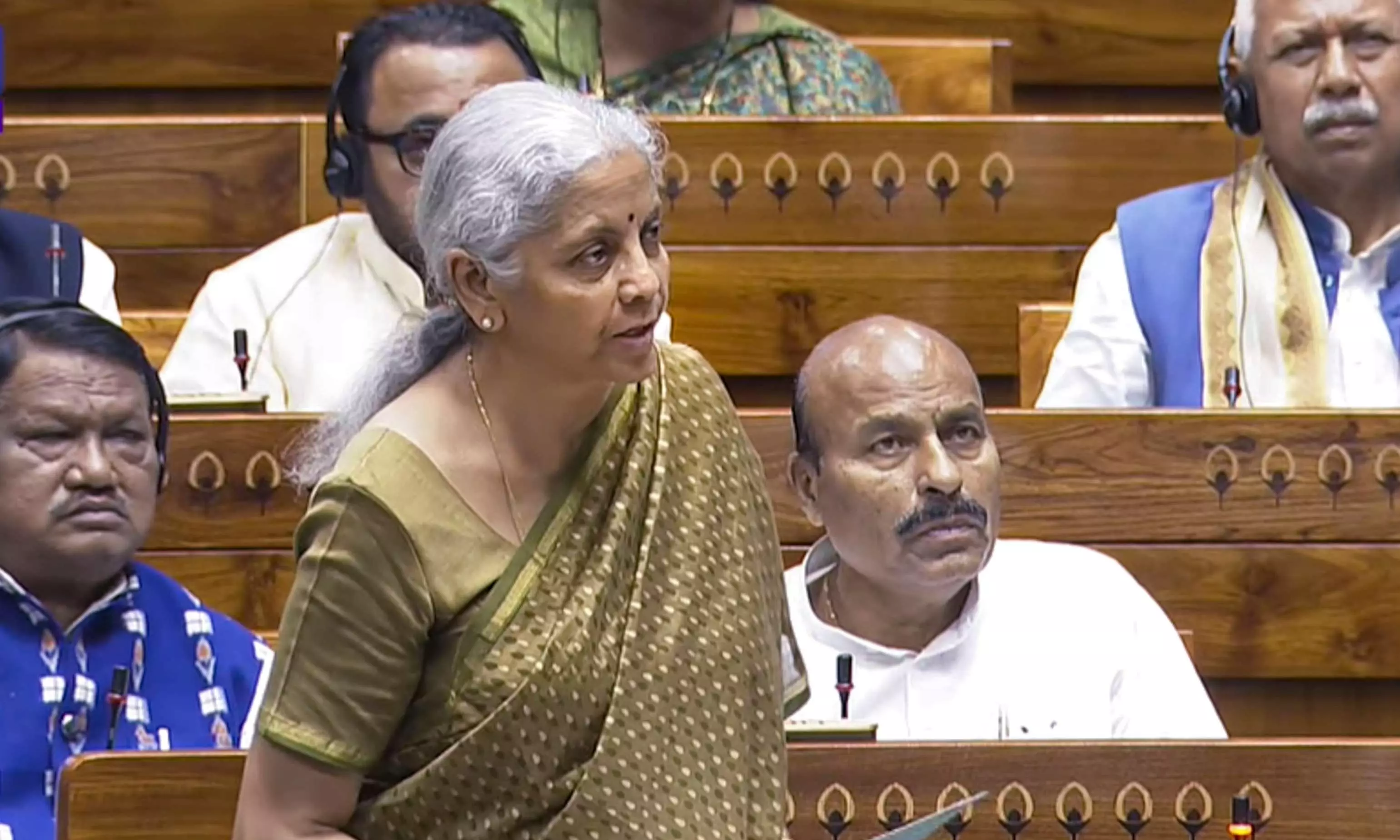
While ruling out a blanket waiver, FM Nirmala Sitharaman outlined the range of existing support measures the government has put in place to strengthen the economic conditions of farmers across the country. Photo: PTI
No proposal for complete loan waiver for farmers: FM Nirmala Sitharaman
Finance minister Nirmala Sitharaman rules out a complete farm loan waiver while also clarifying that disability pension tax relief for soldiers remains intact

Finance Minister Nirmala Sitharaman on March 23 told the Lok Sabha that there is no proposal for a complete loan waiver for farmers which is under consideration with the central government, putting to rest speculation about a possible debt relief package for the agricultural sector.
What govt is doing for farmers
While ruling out a blanket waiver, Sitharaman outlined the range of existing support measures the government has put in place to strengthen the economic conditions of farmers across the country.
According to the Finance Minister, chief among these is the Kisan Credit Card scheme, under which crop loans of up to Rs 3 lakh are provided at subsidised interest rates under the Modified Interest Subvention Scheme, with additional incentives built in for farmers who repay on time.
Also Read | PM Modi on West Asia conflict: Highlights of his Lok Sabha speech
She noted the government has also raised the ceiling on collateral-free short-term agricultural loans, including loans for allied activities, from Rs 1.60 lakh to Rs 2 lakh, making it easier for small and marginal farmers to access credit without pledging assets.
Beyond credit, the government has also been channelling support through crop insurance schemes and direct cash transfers to landholding farmers under the Pradhan Mantri Kisan Samman Nidhi, or PM-KISAN.
The Reserve Bank of India's Priority Sector Lending guidelines further ensure that agriculture continues to receive an adequate flow of credit from the banking system, she said.
Disability pensions
Replying to a separate question, Sitharaman addressed growing concern among serving and retired armed forces personnel over whether the tax exemption on disability pensions had been quietly withdrawn under the new tax framework.
She explained that the exemption, which has been in place since the Income-Tax Act of 1922, technically lapsed when the new Income-tax Act 2025 came into force, as the older savings provisions that had carried it forward ceased to operate.
Also Read: Govt imposes Rs 20 crore penalty on firms for CSR non-compliance in three years
"With the enactment of the Income-tax Act, 2025, the earlier enactments pertaining to the Income-tax Act, 1922, and related savings provisions ceased to operate. Therefore, in the absence of an express provision in the new Act, the exemption would have lapsed," she said.
However, she was categorical that there has been no actual discontinuation of the benefit. "On the contrary, the Finance Bill, 2026, proposes to explicitly provide for a specific exemption in respect of disability pensions under the Income-tax Act, 2025," she added.
The exemption applies to personnel invalided out of service on account of a disability attributable to, or aggravated by, military service.
Invalided out of service
As of January 31, 2026, around 89,598 armed forces personnel receiving disability pensions had been invalided out of service, while the total number of retired personnel with a disability stood at 1,47,263.
Sitharaman said no grandfathering clause was needed since the new provisions were intended to continue the existing legal position, not to introduce a new levy or withdraw an exemption.
On the medical process, she said fitness assessments are carried out annually, with personnel found to have medical conditions placed under Low Medical Classification and reviewed periodically.
Those deemed permanently unfit for military duties may be invalided out through an Invaliding Medical Board, which assesses the degree of impairment. She said that the medical board's role is limited to defining the condition and recommending employability restrictions, while entitlement decisions rest with the respective service headquarters.
(With agency inputs)