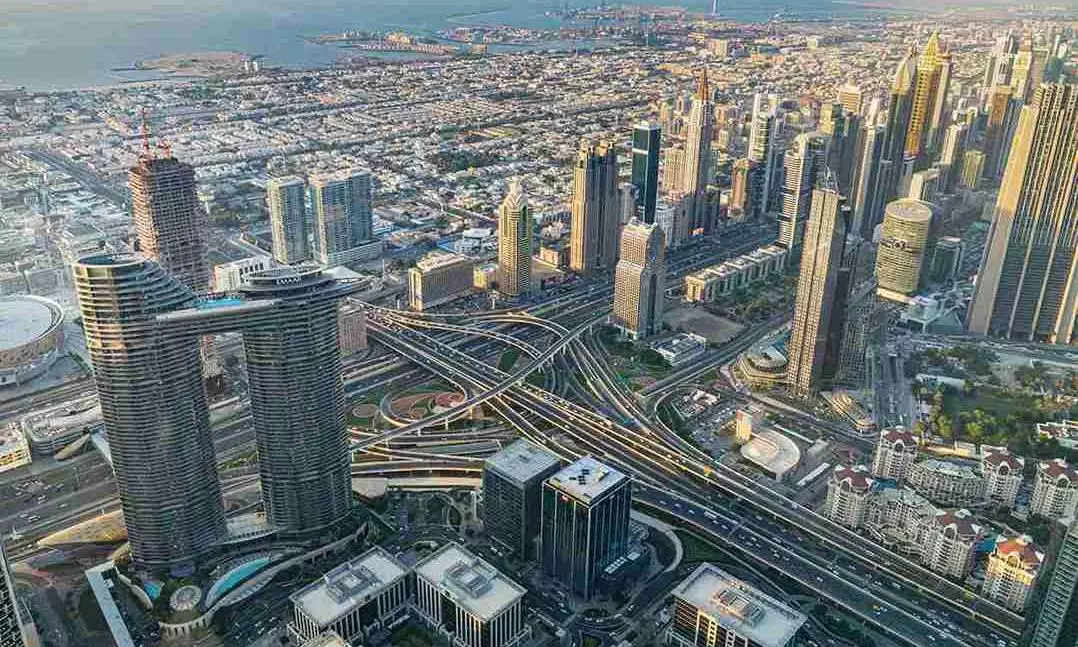
Dubai South housing boom offers Indian buyers an opportunity but supply-surge test looms
Residential sales surpass 2025 full-year levels in 8 months, but a surge in apartment supply and shifting buyer preferences could test the market’s resilience

Dubai South’s residential property market is gaining momentum, offering a fresh investment proposition for Indian buyers seeking overseas real estate exposure. But a growing pipeline of new homes, changing purchase patterns, and uncertainty over future rental yields suggest that the next phase of growth may depend less on transaction volumes and more on the market’s ability to absorb supply.
The district recorded 12,428 residential transactions between January and August 2026, 27 per cent more than the 9,788 registered during all of 2025, according to Anarock Research & Advisory’s Dubai South Residential Micro-Market Report (September 2026). Sales value reached 15.9 billion dirhams (Rs 41,200 crore), equivalent to 81 per cent of last year’s total of 19.6 billion dirhams (Rs 50,788 crore).
The report estimates that residential sales could reach 23.9 billion dirhams (Rs 61,927.42 crore) in 2026 if the January-August pace continues. That is a run-rate projection, not a forecast or confirmed full-year outcome.
Also read: Dubai flat, Greece villa: Financial returns drive Indians’ purchase of foreign property
For the Indian investors who are familiar with the appeal of property-led wealth creation at home, Dubai South presents a different set of considerations: Exposure to an international property market, a long-term infrastructure development story and rental-income potential, balanced against currency movements, ownership costs, and the risks of buying into a market with substantial future supply.
Smaller homes reshape demand
The most striking change is the shift towards smaller apartments. Studios accounted for 45 per cent of residential transactions in the first eight months of 2026, up from 20 per cent in 2025. One-bedroom homes contributed another 31 per cent, taking their combined share to about 76 per cent.
Apartments represented 94.5 per cent of residential sales volume, compared with 31 per cent in 2020. The figures point to a market increasingly driven by lower-ticket properties rather than larger family homes.
“Dubai South has already surpassed its full-year 2025 residential sales volume in just eight months,” said Ayush Puri, CEO (Residential), Middle East, and CEO, Anarock Channel Partner. Studios and one-bedroom homes now account for around three-quarters of transactions, he said, adding that smaller-ticket apartments are becoming the main driver of activity and broadening the area’s residential appeal.
Also read: India's realty investment hits Rs 57,917 crore, but affordable housing lags
For Indian buyers, this shift could lower the initial capital required to enter the Dubai property market. Yet affordability alone does not establish investment value. A lower purchase price may make a property easier to acquire, but returns will depend on achievable rents, occupancy, service charges and the availability of competing apartments.
Prices rise as purchase values fall
Dubai South’s price indicators reveal another important distinction. The average residential price reached 1,656 dirhams (Rs 42,910) per square foot in January-August 2026, up from 650 dirhams (Rs 16,843) in 2020. Meanwhile, average ticket size declined to 1.28 million dirhams (Rs 3.32 crore) from a peak of 2.57 million dirhams (Rs 6.66 crore) in 2023.
Anarock attributes the divergence largely to the growing share of smaller homes. The figures therefore do not, by themselves, indicate a broad-based decline in property prices.
For investors accustomed to evaluating Indian residential markets through capital appreciation and ticket sizes, the distinction matters. Average purchase values can fall even when prices per square foot rise, simply because buyers are choosing smaller properties. Comparisons between projects need to account for unit size, location, completion status and comparable resale transactions.
Infrastructure offers a long-term catalyst
Dubai South’s investment case is closely linked to infrastructure development, particularly the planned expansion of Al Maktoum International Airport. The report describes the district as a 145-sq-km master-planned development designed to accommodate about one million residents and 500,000 jobs at full build-out.
Also read: Real estate deals slump 69 pc: What it means for homebuyers and investors
The airport’s stated ultimate design capacity is 260 million passengers and 12 million tonnes of cargo annually. These are planned capacity figures, not current operating levels, and the report cautions that infrastructure programmes can face delays and changes in phasing.
The rental market has also expanded. Average annual rent increased to 82,063 dirhams (Rs 21.26 lakh) in January-August 2026 from 34,534 dirhams (Rs 9 lakh) in 2020, while rental transaction volumes rose to about four times their 2020 level. Anarock reported an indicative apartment gross rental yield of 4.3 per cent in 2025, before service charges, vacancies and transaction costs.
For Indian investors, these numbers offer a starting point rather than a guaranteed return. Net yields could be materially lower after property-management fees, maintenance, financing and other expenses. Currency movements between the rupee and dirham also affect the final return when measured in Indian rupees.
Supply is the market’s biggest test
The more immediate concern is the scale of new housing expected to reach the market. Anarock identifies 38,116 residential units scheduled for handover between 2027 and 2029, with deliveries peaking at 16,094 units in 2028. Apartments account for approximately 85 per cent of the under-construction pipeline.
Such a concentrated delivery cycle could intensify competition among landlords, pressure rents and make resales more difficult if demand fails to keep pace. The report also warns that rental yields could compress in 2026 and 2027 if property values rise faster than rents.
Also read: Jaipur emerges as a leading Tier-II commercial real estate hub, says JLL
Off-plan properties accounted for 94 per cent of residential transaction volume in January-August 2026, up from 73 per cent in 2020, according to Puri. He described Dubai South as still being in its launch-and-absorption phase, with the ready and secondary market yet to mature.
That creates a further consideration for Indian buyers: An off-plan purchase involves exposure to the developer’s delivery schedule, construction progress and the future market at handover. A strong launch market does not guarantee an equally liquid resale market several years later.
Selectivity will matter more than momentum
Dubai South’s growth is supported by rising transactions, stronger rents and an ambitious infrastructure programme. But the delivery pipeline will test whether those factors translate into sustained demand.
For Indian investors, the case rests on more than headline appreciation. Entry price, rental demand, net yield, delivery risk and exit liquidity will be critical to the outcome. The report offers evidence of a rapidly expanding market, but not proof that every segment or project will deliver attractive returns.
The next phase of Dubai South’s property story will be determined by whether population and employment growth can absorb the incoming homes — and whether the market can sustain demand once the initial wave of launches gives way to completed properties and resales.