Exclusive: Centre plans new law to counter AI deepfake menace, says MeitY Secretary
After mandating labels for AI-generated content, the government is closely monitoring the situation and may introduce a new law against deepfakes

The Union government is keeping its options open to enact new legislation to counter deepfakes, which have become more dangerous due to rapid advances in AI-based technologies.
Also read | Will AI summit deliver outcomes benefiting Global South? Why critics are sceptical
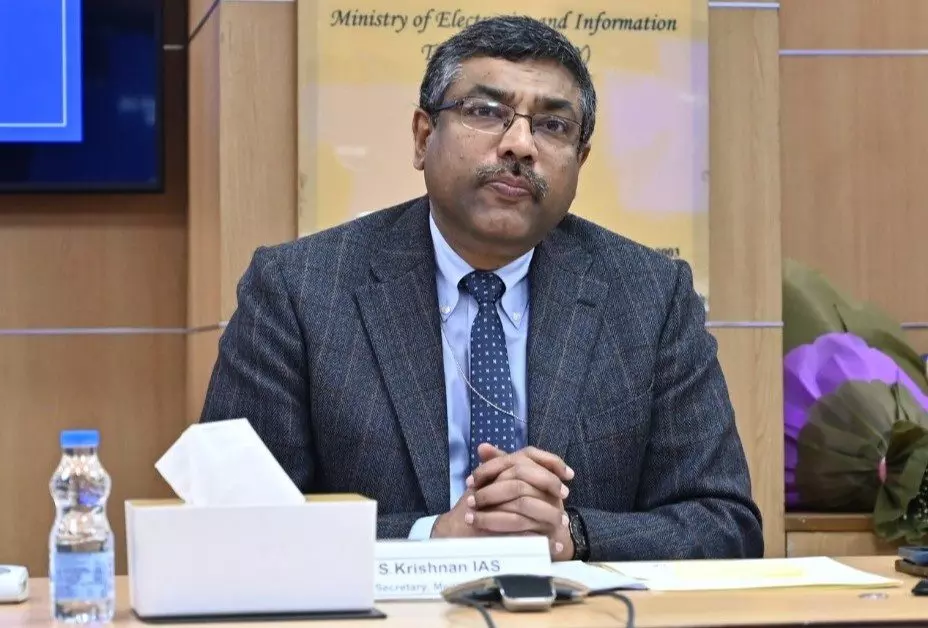
New rules have been introduced mandating the declaration of “synthetically generated” content, and the government is willing to bring in a new law to tackle the menace, according to S Krishnan, Secretary in the Ministry of Electronics and Information Technology (MeitY).
Crackdown on AI deepfakes
Speaking exclusively to The Federal, Krishnan stressed that new AI-based tools are enabling the creation of deepfakes that are difficult to detect, while the time needed to generate such content is also shrinking. The government is aware of the risks posed by AI-generated content, he said, which is why new rules mandating clear labelling will come into force from February 20.
The Ministry of Electronics and Information Technology (MeitY) notified new rules on February 10, emphasising the clear declaration of "synthetically generated information" (SGI) or AI-generated fakes. Social media platforms have also been asked to remove within three hours “synthetic” content that does not have clear labelling through proper declaration right at the beginning. If social media platforms allow deepfakes without proper labelling, they will lose their “safe harbour” benefit and will be liable for prosecution under Section 79 of the IT Act. MeitY is the nodal agency in the central government responsible for regulating digital content.
India’s data centre push
Krishnan said that India accounts for nearly 20% of all digital data generated worldwide. However, data centres in India have the capacity to store only around 4% of the data generated globally. Unless new data centres come up quickly to boost infrastructure, data generated in India may have to be stored in data centres located in other countries.
Chennai is in an advantageous position to attract data centre investments, Krishnan said, explaining that locations with undersea data cable connectivity are better suited. Undersea data cables from various locations such as Singapore terminate at Chennai and this makes locations around the Tamil Nadu capital preferred for data centres. Mumbai is another preferred location with a similar advantage.
“Our personal data protection laws are sound and they make it clear that an individual's data cannot be used without consent,” Krishnan said. His remarks put in perspective the recurring apprehensions over misuse of personal data collected in the country. Data can be used to develop sound policies for the benefit of people and decisions based on data will be more effective, he added.
AI boost for economy
Krishnan also spoke about the buzz generated by the AI Impact Summit and how the Union government is gearing up to make positive strides with the advent of new artificial intelligence technologies.
Also read | Will Bill Gates attend AI Impact Summit? Foundation says yes, reports say no
The Union government believes the rapid advancement of AI can translate into higher investment and job creation, along with improved delivery of public services. This, it is felt, will help achieve the ambitious goal of building India into a developed nation by 2047. Electronics and IT Minister Ashwini Vaishnaw has expressed hope that India will attract $200 billion in the AI sector in the next few years, while the Adani Group on Tuesday announced an investment of $100 billion over the next decade to build renewable-powered hyperscale AI data centres.