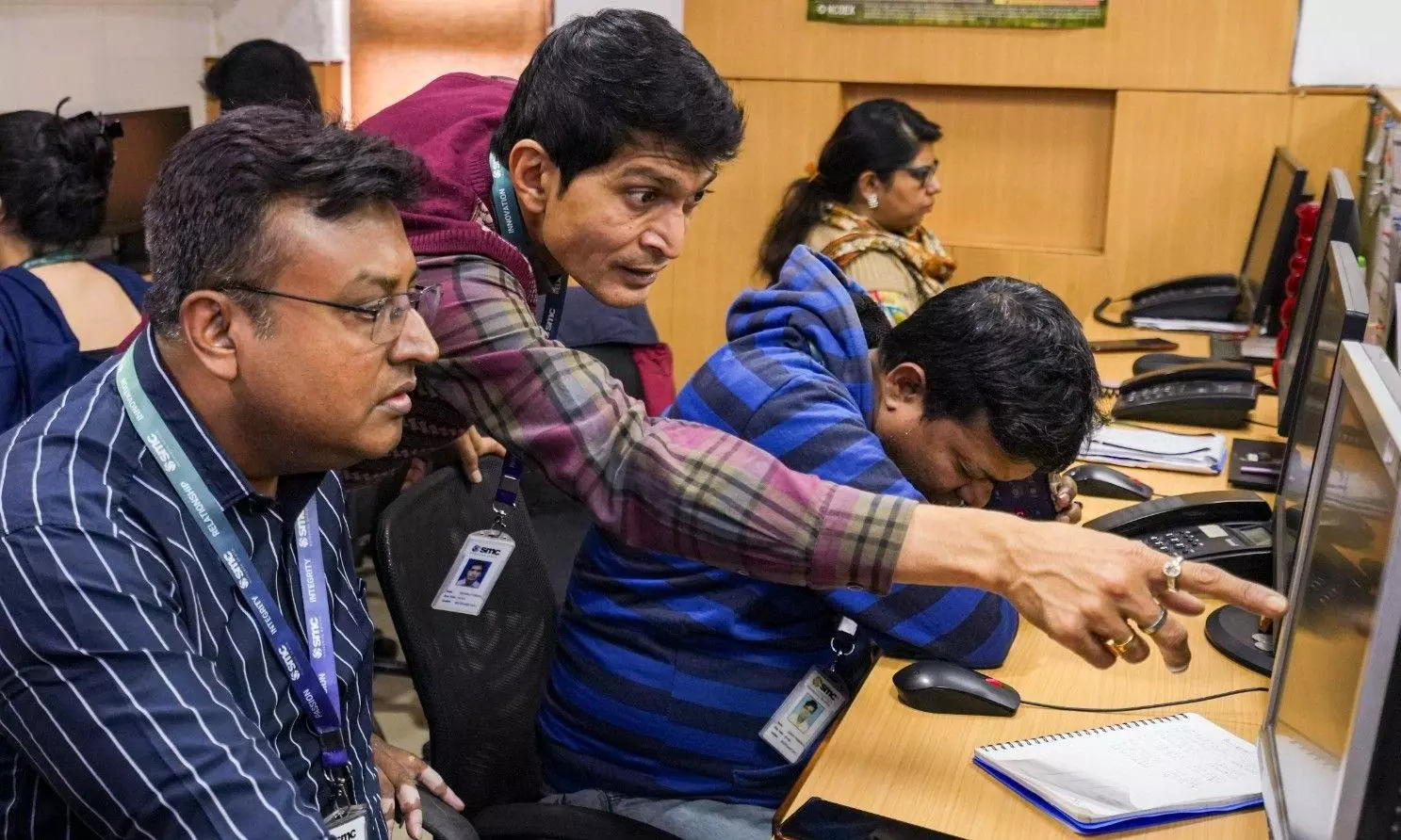
Sweet start, sour finish: Why markets bled on Budget Sunday
Historic Sunday Budget leaves investors disappointed as STT hike and no LTCG relief trigger sharp sell-off; Sensex plunges 2,000 points before partial recovery

The day began with President Droupadi Murmu offering dahi cheeni (curd and sugar) to Finance Minister Nirmala Sitharaman — a traditional good-luck ritual ahead of the Union Budget. But while the sweet start may have worked wonders for some sectors, the markets found the taste rather sour.
Making history, this year’s Budget was presented on a Sunday — the first such instance in recent memory. Since the Budget session was on, trading too was allowed for the full day.
Also Read : Budget 2026-27 LIVE
Even before the Finance Minister began her speech, most Indian investors were already seeing red in their portfolios — thanks to global jitters largely driven by US President Donald Trump.
Metals were melting across the board, and the tremors were visible in ETFs. Silver ETFs hit the lower circuit, while gold ETFs slipped nearly 7%. There were virtually no buyers for silver ETFs. The metal, which had risen nearly 50 per cent in January, was left unattended on February 1. Hindustan Copper, Hindustan Zinc, and National Aluminium Company (NALCO) all tanked around 10 per cent.
STT and LTCG
Investors had pinned hopes on some relief in the Long-Term Capital Gains (LTCG) tax — but none arrived. To make matters worse, the Finance Minister announced a hike in the Securities Transaction Tax (STT) on futures and options. The STT on futures was raised to 0.05% from 0.02%, while the STT on options premiums and exercises went up to 0.15% from 0.1% and 0.125%, respectively.
Also Read : Budget 2026-27: Here are 10 key takeaways
Though the increase may seem modest, with markets already under pressure from continuous FII outflows through the past year, the reaction was swift and sharp. The Budget also introduced changes in buyback taxation. Under the new regime, buybacks will now be taxed as capital gains for all shareholders. Additionally, promoters will face a higher effective tax of 22% for corporate entities and 30% for non-corporate entities to discourage tax arbitrage.
The market’s immediate verdict was unforgiving — the Sensex crashed over 2,000 points on Sunday as investors expressed disappointment over the lack of major tax relief. The biggest drags were the Capital Markets (hit by the STT hike), Defence, and PSU Banking sectors. However, the Sensex managed to claw back roughly 1,500 points before the closing bell.
Retail investors and physical gold buyers, meanwhile, had also hoped for some respite in gold duties — but that too remained unchanged. Among Indian indices, only Nifty IT stood tall — rising 575 points, led by Wipro (up 3.28%) and TCS (up 2.54%). Every other index was bleeding red.
As investors nurse their wounds, the market now looks to the coming weeks — hoping for a much-needed miracle.