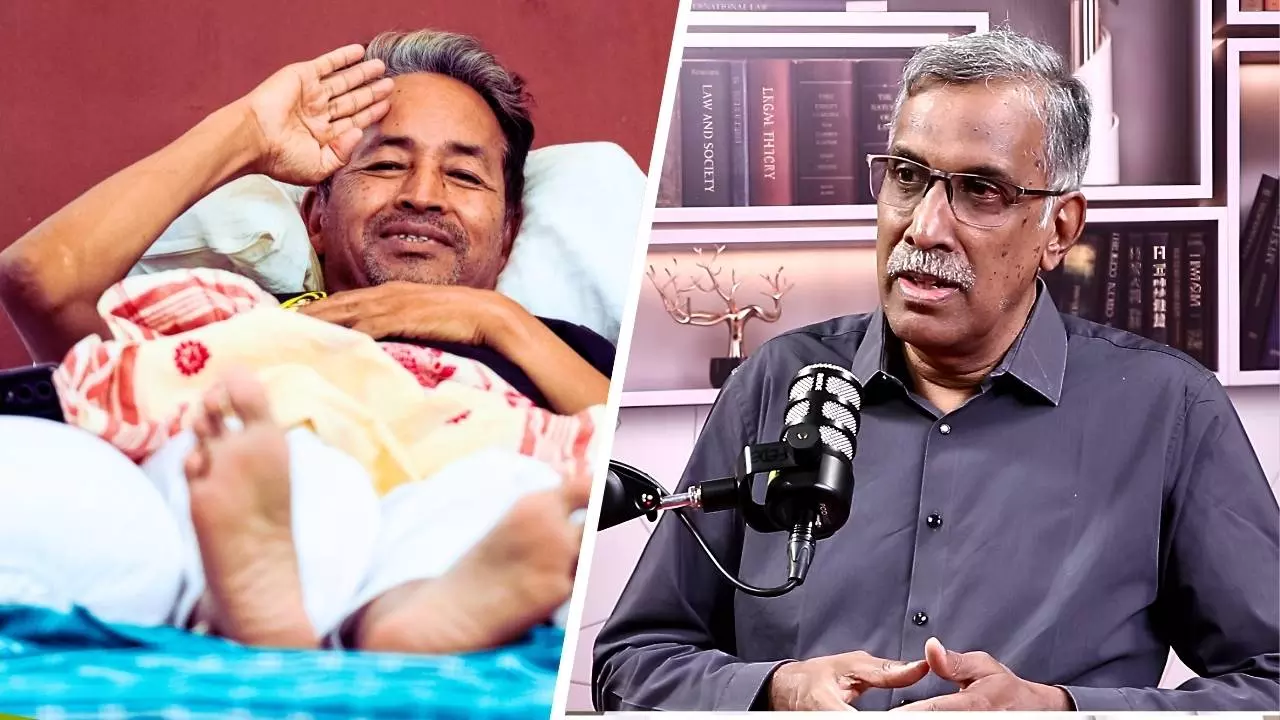
Why Wangchuk's strike may not become an Anna Hazare-like movement
With mainstream media largely silent and Opposition parties non-committal, The Federal's Editor-in-Chief says Wangchuk/CJP strike faces a tougher road than the movement that gave birth to AAP

As expected, activist Sonam Wangchuk was shifted to a government hospital by the Delhi Police on Saturday morning after his health deteriorated on the 21st day of his indefinite hunger strike at Jantar Mantar.
Hours before Wangchuk was whisked away from the site and larger limelight, The Federal's Editor-in-Chief S Srinivasan reflected on the efficacy of hunger strikes as a form of protest in the current political climate. Srinivasan was talking on our flagship show, Talking Sense with Srini.
"Hunger strike as an agitation is a tactic which is very familiar to Indian conditions," Srinivasan said. "Mahatma Gandhi is one of the primary proponents of this form of satyagraha, and it's very popular here in India. What does a hunger strike do? It exerts moral pressure on the regime. There has been no reaction from the government, and none from the BJP either. So the very premise on which a hunger strike rests — that it will provoke a response from those in power — hasn't materialised so far.''
Also Read: Delimitation Bill: Why Stalin and Akhilesh hold the key to BJP’s gameplan
"This, in a sense, is the limitation of a hunger strike. The person leading it pushes it to its extremities, and when no response comes, it becomes very difficult to sustain.''
'2026 is not 2011. Game has changed'
Srinivasan also drew parallels with the 2011-12 Anna Hazare movement, which shook the nation.
Anna Hazare's landmark anti-corruption movement — the one demanding the Lokpal Bill and known for his hunger strike at Jantar Mantar and later at Ramlila Maidan — took place in 2011. It began with a hunger strike in April 2011 and saw a bigger wave in August 2011, becoming one of the most significant civil society movements in India in recent decades and eventually giving rise to the Aam Aadmi Party in 2012.
S Srinivasan said things are totally different now. He pointed to the media's role in sustaining such movements, contrasting the present moment with the past. "The entire Anna Hazare movement, or other movements in the past, really got momentum because a lot of support came from the media. Today, the media is very quiet. If you look at the mainstream newspapers and channels, they are hardly taking any note of this. So it's a very tough, difficult task in the hands of CJP to actually make this work."
Srinivasan noted that sustained public movements typically require prolonged groundwork, which he said has been missing in this case. "This whole rise of the CJP has been surprising. These things don't happen in a few weeks. It requires a longer duration, a longer mobilisation period — that hasn't happened here," he said.
Can we compare CJP's trajectory to the Aam Aadmi Party? "It's still a fledgling party, and highly untested."
Hunger strikes passe? Not exactly
Asked whether the potency of hunger strikes as a protest tool has been declining over time, Srinivasan pushed back on the generalisation. "I wouldn't say the power of the hunger strike as such has been declining. In this particular case, it's because of the circumstances — even a hunger strike, or any form of strike, requires certain conditions to be met first. Those conditions have not been met here," he said.
He also pushed back on the perception that Opposition parties, especially Congress and Rahul Gandhi, had entirely distanced themselves from the protest. "It is not true that Opposition leaders have stayed away completely," Srinivasan said. "Leaders from the Samajwadi Party and the Trinamool Congress have visited the protest site. A Congress spokesperson also visited recently. But frankly, I think the Congress is still trying to understand what exactly this movement represents.''
So will CJP and Wangchuk be reflected in the upcoming Parliament session? "Normally, political parties tend to emphasise their own campaigns rather than someone else's movement. Parliament session is already crowded with competing priorities, leaving limited space for any single movement to dominate the agenda. It has numerous issues; there is the Ram Mandir issue, the situation arising from the Asia conflict, inflation, delimitation, the Women's Reservation Bill, developments in West Bengal, governance issues, and several other national concerns."
You can watch the entire Talking Sense show here