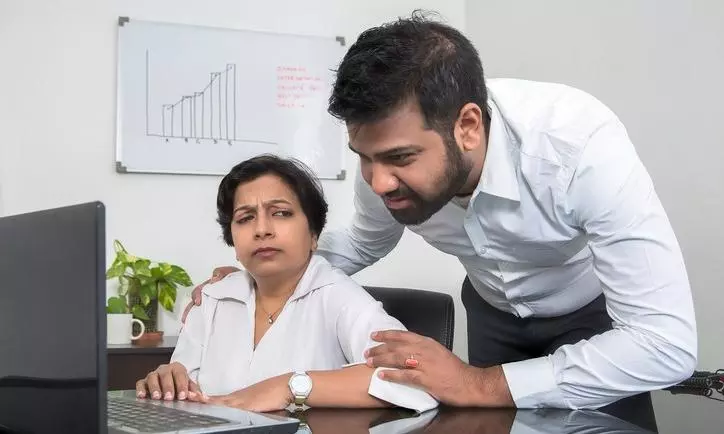
POSH complaints rise in NIFTY 50 firms; what about the 94 pc the law forgot?
POSH does not make a distinction between formal and informal sectors; women in the most vulnerable informal sector are left to handle the harassment themselves

A recent encouraging newspaper report said POSH reporting had gone up in FY26 in the NIFTY 50 companies by 4.6 per cent. This is good news if it is the result of greater awareness and trust among female employees who feel encouraged to come forward to report bad behaviour, and not so good if this is an indication of a spurt in cases of sexual harassment. These details are not available.
It should be remembered that the Companies (Accounts) Second Amendment Rules now require boards of companies to disclose complaints received, cases disposed of, and cases pending with penalties for non-compliance.
Also read: TCS Nashik case: NCW directs company to set up internal committees in all its 127 units
Perhaps the presence of a SHe-Box portal (from 2024) put in place by the Ministry of Women & Child Development to provide easy access to redressal mechanisms has also helped. Given the fact that there has been an increase in India both in Female Labour Force Participation Rate (FLFPR) from 23.3 per cent in 2017-18 to around 40 per cent in 2025, as also in the Female Worker Population Ratio (FWPR) from 22 per cent to nearly 39 per cent in the same period, safety mechanisms must be in place.
Safety and protection of women at workplace
Having brought women to the workplace, it was critical, and one is not being sexist here, to ensure their safety and protection. The background of the Sexual Harassment of Women at Workplace (Prevention, Prohibition and Redressal) Act, 2013 was precisely this.
A 1999 judgment in the Apparel Export Promotion Council v AK Chopra clarified that physical contact is not necessary to establish sexual harassment; an attempt or intent was sufficient. Nothing changed on the ground, though.
Known popularly as the POSH Act, the trigger was the tragic rape of a worker employed in the Rajasthan Women’s Development programme whose crime was trying to stop a child marriage. Women’s groups stepped in after the local courts dismissed charges; the Supreme Court, in a landmark 1997 judgment in Vishaka v State of Rajasthan (Vishaka being a collective group of social activists and women's rights organisations) recognised workplace sexual harassment as a violation of fundamental rights of a citizen and framed binding guidelines.
Definition of sexual harassment
Sexual harassment was defined too. It included physical contact and advances; (b) a demand or request for sexual favours; (c) sexually-coloured remarks; (d) showing pornography; (e) any other unwelcome physical, verbal or non-verbal conduct of a sexual nature. A 1999 judgment in the Apparel Export Promotion Council v AK Chopra clarified that physical contact is not necessary to establish sexual harassment; an attempt or intent was sufficient. Nothing changed on the ground, though.
Also read: In dating app era, why Indian professionals continue to fall for the charm of a workplace romance
Then came the horrific December 2012 Delhi gang rape case, which prompted the government to set up a committee under Justice JS Verma to recommend amendments to the law to provide for quicker trial and enhanced penalty.
Finally, after the public outcry following the December 2012 incident, the Parliament legislated. Thus, after the passage of 15 years from the date of the verdict delivered in Vishaka’s case, the Sexual Harassment of Women at Workplace (Prevention, Prohibition and Redressal) Act, 2013 was legislated.
POSH as it stands today is applicable only to women. In a significant order, the Supreme Court refused the request made to direct that “sexual harassment” be defined in gender-neutral terms.
The Act lays down a comprehensive mechanism for constitution of an Internal Complaints Committee (ICC), the manner of conducting an inquiry into a complaint received, duties of an employer, penalties for non-compliance of the provisions of the Act, etc.
Timelines have been prescribed from filing of complaint to completion of inquiry and action thereafter. It is critical that ICCs are trained to handle complaints, as the observations of the Supreme Court in Aureliano Fernandes vs State Of Goa as late as in 2024 have shown this has not happened.
Ignoring informal sector's female workforce
But what is forgotten is that more than 94 per cent of India’s female workforce is in the informal sector. POSH does not make a distinction between formal and informal sectors, and obviously the women in the most vulnerable informal sector have been left to handle themselves. The only remedy for them is to approach the police. And needless to say, that may not be the best option.
Even in the formal sector, a survey by the Udaiti Foundation had revealed that 59 per cent of companies have not even formed a legally compliant internal committee, the very backbone of the POSH process.
The success of POSH in the formal sector ultimately depends on the ethos of the company and management, which look at ensuring a safe workplace as something fundamental and not merely a formality to comply with legal requirements.
Empathy is critical; perhaps having women in senior positions does help, which, as available data shows, is abysmally low in India. There is a constant apprehension in the minds of management that a POSH complaint will show them in a poor light. There is a tendency to dissuade any formal complaint. The influence and pressure that senior management can put on an employee is subtle and can make filing a formal complaint difficult.
Men excluded from POSH
POSH as it stands today is applicable only to women. In a significant order, the Supreme Court (Binu Tamta & Another. Versus High Court Of Delhi & Others) refused the request made to direct that “sexual harassment” be defined in gender-neutral terms; the Court also refused to direct that references to “aggrieved woman” be supplanted with “aggrieved persons” to reflect the gender-neutral protection of the Regulations. This is unfortunate.
Employment for women, apart from greater utilisation of nearly 48 per cent of the population which they constitute, ensures financial independence, promotes gender equality, ensures confidence and self-esteem building, and in short gives long-term benefits to society, and obviously will be central to our country’s vision of a Viksit Bharat.
POSH should be accompanied by an education system that puts a premium on gender equality and on building good old family values. Tragically, both are lacking, and cases of female harassment and worse are on the increase. This reflects poorly on the country. The law, after all, can only do so much.