Kharge ‘purification’ row: Why Rahul Gandhi is upping the ante on Dalit politics
The Congress leader's attack on BJP over the Haldwani incident comes ahead of polls in Uttarakhand, UP and Punjab, where Dalit voters could prove crucial

Nearly three weeks after members of Hindutva outfit, Shri Ram Sena, performed a ‘purification ritual’ at the Ramlila Maidan in Uttarakhand’s Haldwani following a rally addressed by Congress president Mallikarjun Kharge, Lok Sabha’s Leader of Opposition Rahul Gandhi has upped the ante against the BJP on the issue.
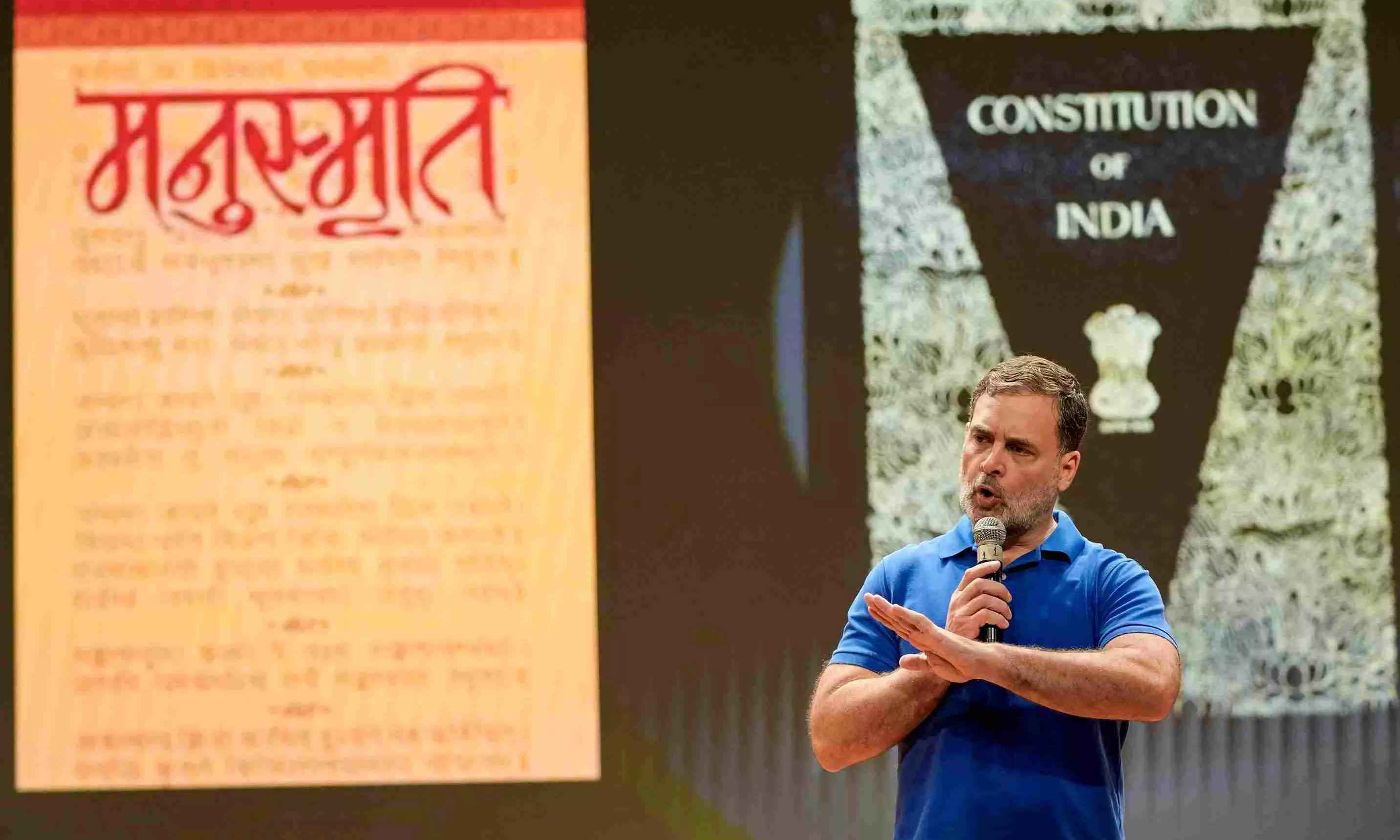
Addressing a press conference at the Congress headquarters in Delhi on Saturday (August 29), Rahul said the shuddhikaran (purification) incident that happened in Haldwani on August 10 was “akin to practicing untouchability, which is illegal under the SC/ST Act and against the Constitution”. Demanding “justice for the Congress president”, who is a Dalit, Rahul urged Prime Minister Narendra Modi to ensure “an FIR is registered against those responsible for this illegal act”.
Rahul attacks BJP’s Dalit politics
While asserting that the deplorable incident in Haldwani “is a symbol of the ideology and mindset of the BJP and the RSS”, the Congress leader quoted statements made by Uttarakhand BJP chief and Rajya Sabha MP Mahendra Bhatt, who a few days earlier, justified the ‘purification ritual’, claiming that “slogans raised by Kharge from the platform of Lord Ram, the Ramlila Maidan, had polluted the area”.
Also read | How Kharge's Manusmriti citation turned into a 20-min Rajya Sabha storm
While Congress leaders like the party’s Uttarakhand in-charge Kumari Selja and Uttarakhand Assembly’s Leader of Opposition Yashpal Arya, both veteran Dalit politicians, had immediately latched on to Bhatt’s remark and called it “evidence of the BJP’s collusion in the incident”, Rahul on Saturday demanded that the BJP must act against Bhatt if it disavowed views of the Rajya Sabha MP. Arya also said that while former BJP national president JP Nadda claimed in the Rajya Sabha on August 13, the day Kharge raised the issue in the House, that “the BJP doesn’t subscribe to such activities or views”, Bhatt’s comment had “exposed the BJP’s double-speak”.
The Lok Sabha’s Leader of Opposition also sought to use the Haldwani episode as “only one example” of similar humiliation of “crores of Dalits on a daily basis” by members of the Sangh Parivar, who, according to Rahul, subscribe to the “ideology of the Manusmriti and not of India’s Constitution”.
Congress sharpens Dalit outreach
Rahul’s intervention on the matter may seem belated, coming as it does 19 days after the incident, but its political undertones may not be lost on anyone. For the BJP, which may have hoped that the furore over the incident would die down in due course, Bhatt’s comments have reignited a row that the Congress believes could severely dent the saffron party’s poll prospects among Dalit voters, who constitute a sizeable part of the electorate in Uttarakhand, Uttar Pradesh and Punjab – all states that go to polls early next year.
By upping the ante against the BJP, dubbing the Haldwani incident as a symbol of what Dalits face across the country every other day and asserting that if Kharge, one of the country’s seniormost Dalit politicians and Congress chief, could be subjected to such discrimination what would be the lot of ordinary Dalits, Rahul has set his party’s poll narrative for Dalit outreach. The pitch aligns well with the planks of Dalit empowerment and ‘saving Babasaheb Ambedkar’s Constitution from the BJP’s assaults’ that have increasingly featured in Rahul’s political discourse over the past few years.
In poll-bound Uttarakhand, Uttar Pradesh and Punjab, the Dalits constitute an estimated 19 per cent, 22 per cent and 32 per cent of the total population, respectively. In the 2024 Lok Sabha polls, the Congress’s strident Dalit outreach through its ‘save Constitution’ pitch had helped the party wean a large chunk of Dalits, who had, over the past decades, moved away from the Congress decisively towards the BJP, particularly in Uttar Pradesh.
Dalit vote shapes poll strategy
In Punjab, it was on Rahul’s insistence that Charanjit Singh Channi was appointed the state’s first ever Dalit Sikh chief minister back in 2021. Though the experiment had failed to help the party retain power in the state, the Congress continued to give Channi, now a Lok Sabha MP from Jalandhar, importance within the party – elevating him as a member of the Congress Working Committee and, a few months ago, appointing him as chairperson of the party’s campaign committee for the Punjab polls.
Ironically, in recent months, Channi has been on the warpath against the Congress high command for its refusal to bench his intra-party rival, Amarinder Singh Raja Warring, as the Punjab Congress chief. It would be interesting to see if Rahul’s fresh and strident Dalit outreach forces Channi to tone down his rebellion.
In Uttarakhand, which has been under BJP rule for the past decade, the Congress understands that Chief Minister Pushkar Singh Dhami’s rabidly communal political and policy decisions have left the state deeply polarised.
A senior Uttarakhand Congress MLA told The Federal that by launching a strong offensive on the issue of Dalits, Rahul could “build a counter-narrative to this polarisation”. The MLA explained that at least a quarter of the population in key Uttarakhand districts like Uttarkashi, Haridwar, Almora, Pithoragarh and Bageshwar is from the Dalit community and that “caste discrimination is rampant in these areas and is an emotive issue for Dalits”. The party’s earlier decisions to appoint Arya as the LoP in Uttarakhand Assembly and Selja as state in-charge were also aimed at appealing to Dalit voters in the state.
BSP silence gives Congress opening
A veteran Dalit leader of the party from Haridwar told The Federal that by taking a strong stand on the purification incident, the party could also prevent a split in the community’s votes between the Congress and the Bahujan Samaj Party, considering that BSP supremo Mayawati has chosen to remain silent on the issue.
Also read | Why Rahul's Manusmriti pitch could be BJP's own ‘Shah Bano moment’
“Past elections show that we suffer electorally in districts like Haridwar and Nainital-Udham Singh Nagar, which are adjoining western UP, because the BSP still holds significant sway over Dalit voters in these areas. Since Behenji (Mayawati) has refused to say a word against the BJP on any issue because of reasons we all know, Dalits are looking at other parties for leadership not just in UP but also in parts of Uttarakhand where BSP has traditionally polled a decent number of votes in about a dozen Assembly seats... in fact, there was a time when BSP used to consistently win six to eight Assembly seats (in the 70-member Uttarakhand Assembly) and spoil our chances of victory in another half a dozen seats,” the Congress leader explained.
Congress sources said Rahul has, for now, demanded that an FIR be registered against those who performed the purification ritual in Haldwani. They said he could, in the coming weeks, land up at a police station in Haldwani demanding the same if the Dhami government BJP drags its feet in the matter just as he did last week when he camped at Delhi’s Parliament Street police station for six hours to help a student injured by pellets in the police action against youth protesters around Jantar Mantar on July 20.