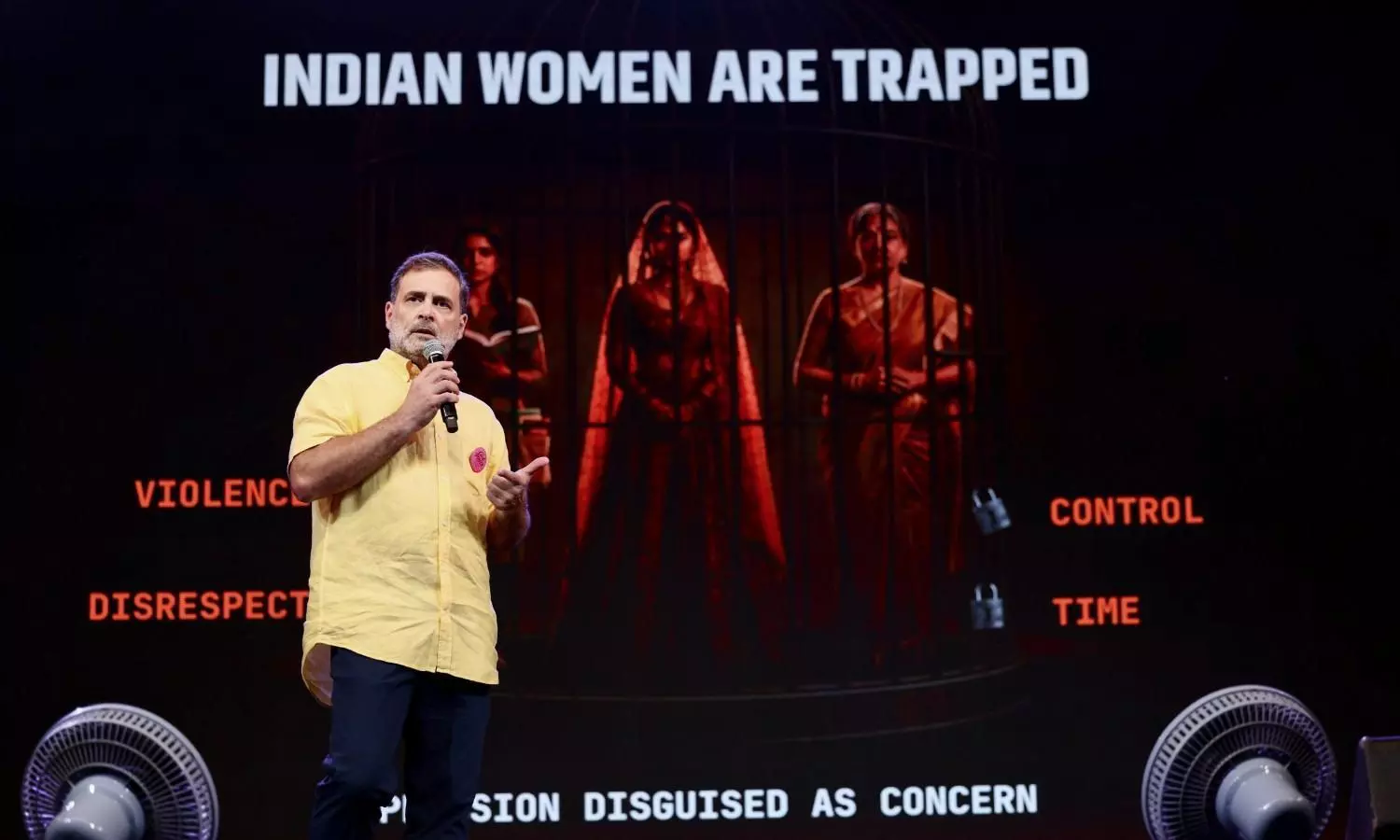
Leader of Opposition in the Lok Sabha Rahul Gandhi during the 'Chhatron ki Goonj' event in Pune on Saturday (August 22). Photo: PTI
With the BJP facing growing public anger, Rahul Gandhi’s attack on the RSS-Manusmriti link could become a far bigger ideological challenge for the ruling party
Former bureaucrat Vivek Katju has wondered in his article in The Indian Express on August 23 if the Congress Working Committee (CWC) decision to sing only the first two stanzas of the National Song Vande Mataram and not all five stanzas had the potential to turn into the second 'Shah Bano' moment for the party.
Katju bases his wonderment on the likelihood of the CWC move antagonising a large section of Hindus, like it had happened when the Rajiv Gandhi government had reversed the SC judgment upholding the supremacy of civil law over Muslim Personal Law to grant alimony to the divorced Muslim woman Shah Bano in 1986.
Two points to ponder
Katju's question is worth a response from two standpoints: how do Shah Bano and Vande Mataram cases compare in terms of their inherent Constitutional and moral underpinnings, and if the Vande Mataram position taken by the Congress has the same potential to damage it politically as the Shah Bano case had.
The answer to the first question is that the two issues differ in their Constitutional and moral underpinnings. Congress's Shah Bano move was not only a blatant case of Muslim appeasement but was also fundamentally at odds with the Constitutional ideals of India, viz, secularism, gender equity, and Directive Principles of State Policy enshrined in the Constitution by its makers as cherished goals to pursue.
It had sought to patronise the Muslim clergy that suppressed the rights of Muslim women.
Also Read: Rahul says women belong to themselves, rejects Manusmriti's prescription about their identity
The same, however, is not true of the Congress position on Vande Mataram. Its resolve to sing only two stanzas not only conforms to the Constitutional ideals of secularism and justice but also follows the conscious decision of the leading lights of India's freedom struggle, like Mahatma Gandhi, Rabindranath Tagore, and Jawaharlal Nehru.
Of course, the decision of those stalwarts can always be questioned on the ground that the song was one integrated whole and deserved to be evaluated by understanding its import in its entirety instead of being selective about its first two stanzas. It may be argued that the song, in its entirety, had religious overtones loaded in favour of Hindus and, as such, should have been entirely skipped.
RSS argument is flawed
Outwardly, the approach of taking whatever is acceptable and dropping whatever is not is logically problematic because, when applied to ancient scriptures like Manusmriti, the Rashtriya Swayamsevak Sangh (RSS) extends the same argument: Manusmriti also has many good things, so why reject it entirely?
The RSS argument, however, is flawed for the obvious reason that while Manusmriti's dominant theme is discriminatory and contains inhuman social and religious codes, Vande Mataram basically highlights the revolutionary spirit of the freedom struggle and the religious references in it don't betray any overarching discriminatory message.
Another serious problem with the RSS-BJP's Shah Bano argument against the Congress is that while Congress's Shah Bano misdemeanour was certainly unjust to Muslim women and a meek surrender to fundamentalist Muslims, it had caused no injustice to Hindus. In no way did it affect Hindus or their rights. So, what was the RSS-BJP's grievance? Did they mean to say that they should also be allowed to treat Hindu women much the same way as told in Manusmriti?
Also Read: Manusmriti: Why the ancient text continues to stir controversy
Compulsion to sing Vande Mataram in its entirety, however, affects Muslims as it agitates against their core religious beliefs.
So, while it is fine to accept Vande Mataram partially, Manusmriti deserves to be dumped lock, stock, and barrel, and doing so causes no loss to India's cultural dignity. In fact, it is the other way round - it rights a cultural wrong.
Thus, at the level of principle, singing only two stanzas of Vande Mataram was then and even now a very mature approach to nationalism and patriotism. Comparing it to the politically-fraught decision to reverse the SC's Shah Bano judgment is fundamentally fallacious.
BJP’s ‘Hindu vs Muslim’ losing its appeal
But, as Katju rightly states, politics is a game of perception, right or wrong. If the RSS-BJP manages to corner the Congress using the Vande Mataram issue, it could potentially damage the party's prospects, he feels.
But 2026 and 1986 are poles apart in terms of political situations and possibilities.
The Congress was at the peak of its popularity in 1984, having won a record 414 seats in the Lok Sabha under Rajiv Gandhi's leadership. But when the Congress lost the battle in 1989, the Shah Bano case wasn't the only debilitating factor. It did alienate liberal and Hindutva forces alike, but an attempt was also made to placate the Hindus by opening the gates of the Babri mosque for Hindu prayers. This only further alienated secular voters and did not help attract Hindu votes that had already shifted substantially to the BJP because of the party's Shah Bano mistake. As a result, the BJP increased its tally from just 2 in 1984 to 85 in 1989.
Also Read: Yogi slams Rahul over Manusmriti remarks, accuses him of defaming India
But the most crucial factor that saw the Congress fall from grace was the alleged Bofors scandal and a rebellion by Rajiv's frontline minister VP Singh. Add to it the unprecedented Opposition unity - the Left and the Right together supporting VP Singh to form the government.
The Congress of 2026 is an Opposition party whose graph is on the upswing and the BJP is on a downward slide since 2024, some State victories notwithstanding. The Jantar Mantar protests by Gen Z have clearly shown that the BJP in general and Prime Minister Narendra Modi in particular have lost a lot of ground insofar as their public appeal is concerned. Most importantly, it is now getting more and more evident that people are tired of BJP's communalism and are seeking answers to the problems of bread and butter. The Hindu vs Muslim project of the BJP is fast nearing the end point of its shelf life.
Congress’s existential challenge
The Congress that once fought shy of confronting the RSS ecosystem in the name of liberalism and even for the fear of losing Hindu votes has now unleashed an ideological war against it under Rahul Gandhi's leadership. This is less of a proactive choice and more of an existential challenge for the Congress - it will perish if it will not come clean on the BJP-RSS ideological challenge because the BJP-RSS ecosystem is presenting everything that it does in an ideological wrapper. So, the Congress has no choice but to confront it ideologically. There are no two ways about it.
Also Read: How Kharge's Manusmriti citation turned into a 20-min Rajya Sabha storm
True, there are pitfalls in this ideological surge because the other side are past masters in swaying popular emotions in the name of religion. Those pitfalls must be factored in and tackled, sometimes successfully and sometimes risking adverse political fallout. But there is no avoiding it anymore.
So, why not take it head-on? That probably seems to be at the back of Rahul Gandhi's and Congress strategists' minds.
BJP visibly rattled by public anger
The BJP is visibly rattled by a sudden spell of outpouring of public anger against the Modi regime. Modi himself is being fearlessly attacked by people on social media with lampooning memes, slogans, and caricaturish videos and write-ups following the Ram temple theft, NEET fiasco, and Jantar Mantar protests. It is also facing a severe backlash from its core vote bank of upper castes over UGC regulations issue and the newly-rising anti-quota stir.
This backdrop provides an ideal opportunity for the Congress to play an ideological gamble, as the then Opposition did, combining the ideological (Shah Bano and Hindu prayer access at Babri) with the governmental (Bofors) to unseat the Congress led by Rajiv Gandhi.
Gamble worth playing for the Congress
With a large number of Hindus likely disillusioned with the BJP under Modi, there is little likelihood of people getting swayed by the BJP's Vande Mataram attack on the Congress. That provides the Congress with an opportunity to push its own ideological position in an uninhibited manner.
It's a gamble worth playing and it is good that the Congress is finally playing it.
Rahul's latest salvo at the “Chhatron Ki Goonj” programme at Pune has the potential to make it the BJP's own Shah Bano moment. His portrayal of the BJP-RSS as followers of Manusmriti has put them in a fix. They can neither justify it nor can they disown it. Some of its leaders, including Uttar Pradesh Chief Minister Adityanath, have already spoken in support of Manusmriti.
Also Read: NCERT Class 9 textbook quotes Manusmriti verse on women's status in Vedic period
The growing upper caste discontent against UGC regulations and reservation policy and the possibility of OBCs, SCs, STs, and women getting antagonised by the BJP supporting Manusmriti can put the party in a Catch-22 predicament.
Rahul Gandhi has probably sensed this in time and is hence going straight for the BJP's jugular.
Clearly, leave aside Vande Mataram becoming the Congress's second Shah Bano moment. Rahul's Manusmriti pitch could well prove to be the BJP's own Shah Bano moment.
(The Federal seeks to present views and opinions from all sides of the spectrum. The information, ideas or opinions in the articles are of the author and do not necessarily reflect the views of The Federal)