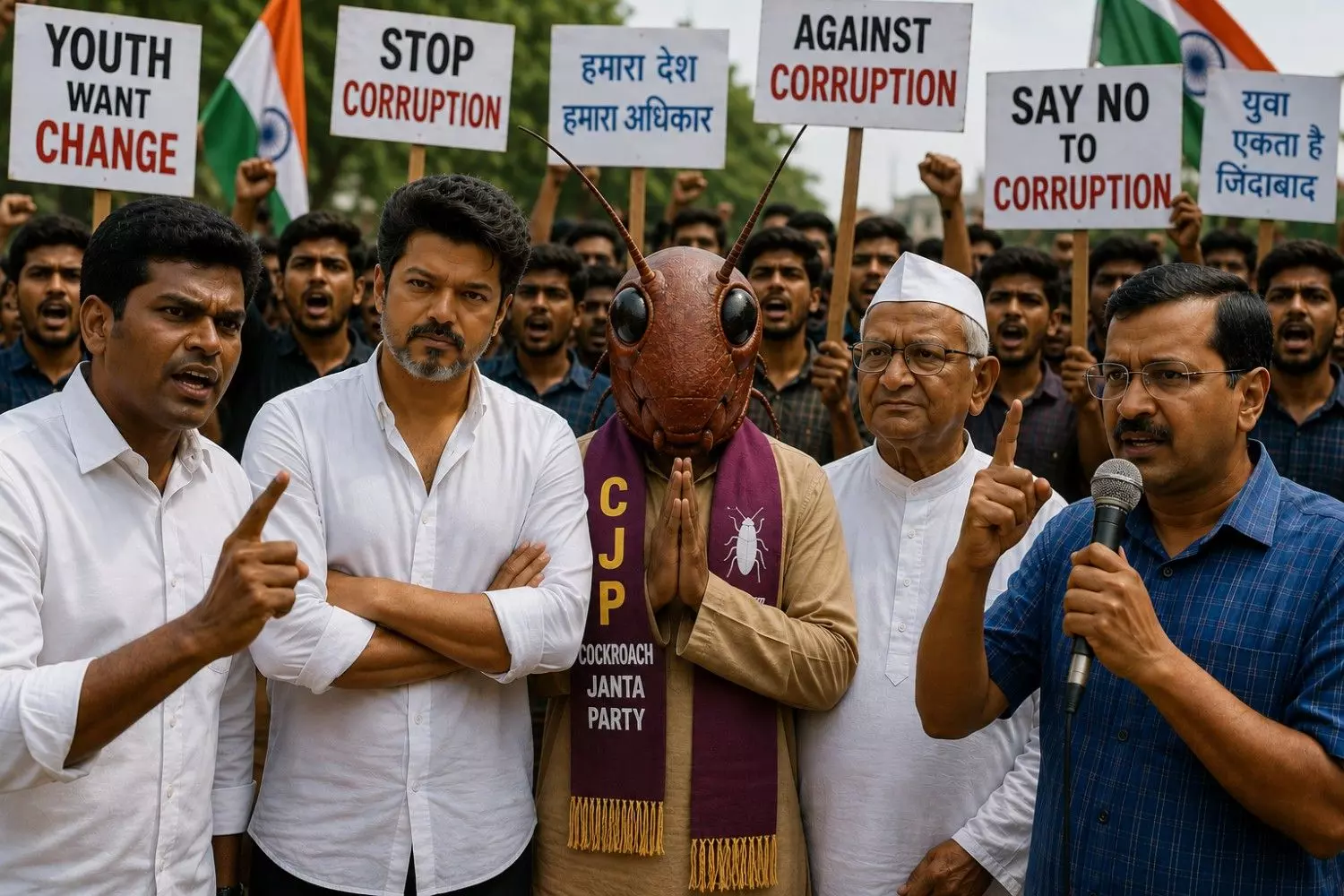
From Anna Hazare to Arvind Kejriwal to Joseph Vijay to K Annamalai and the Cockroach Janta Party, India has seen new political movements rising from time to time since 2011. (This is an AI generated image)
No to status quo? Why new political movements are luring India's youth, middle class
New political startups, like that of Annamalai and CJP, are targeting the 18-35 age bracket with promises of inclusivity and change

Political tremors from K Annamalai’s resignation from the Bharatiya Janata Party (BJP) continue to shake Tamil Nadu. Hours after his exit and announcement of a new political movement, several saffron party functionaries from the state — including the Tamil Nadu BJP vice-president Karu Nagarajan, state secretary Sumathi Venkatesh, and at least 14 other office-bearers — followed him out the door, exposing deep unrest within the southern state’s BJP chapter.
Also read: Can Annamalai's experiment succeed after Vijay's rise? | Talking Sense With Srini
Senior BJP leaders have tried to brush off the fallout, but Annamalai's political pitch is drawing attention for its own reasons. In launching his movement, the former state president of the BJP made a pointed appeal to young people and middle-class families, framing his vision as one of “inclusive politics”.
Latha Rajinikanth's initiative
It was only a few months ago that Latha Rajinikanth, wife of actor Rajinikanth, launched a platform called Makkal Medai, which also speaks the language of change and public participation. Rajinikanth himself launched a movement named Rajini Makkal Mandram in 2017; he wound it up in 2021, citing health reasons.
Economic liberalisation, the rise of start-ups, skill-based employment and the growth of a consumer economy have created aspirations among young Indians. Opportunities exist, but so does frustration.
Within a day after Annamalai quit the BJP, announcing the launch of his ‘We The Leaders’ movement on Friday (June 5), it saw enrolment close to 14 lakh people as active members. One among them, S Vimal, a 24-year-old graduate, told The Federal, “I believe taking part in a political movement is essential for me to get trained in politics. I do not want to stay away. I would like to know more about the political setup. Young people like me are interested in politics, but not many speak our language.”
The Cockroach Janta Party phenomenon
Around the same time, a similar political sensation was witnessed in the north, where several youth showed up in Jantar Mantar in Delhi on Saturday (June 6) to vouch their support for the Cockroach Janta Party (CJP). What started as a satirical social media movement has turned into a major online mobiliser with millions following it on social media.
The messaging is strikingly similar to that of several emerging political formations in recent times that appeal to youth, aspiring middle classes and first-time political participants.
Vijay's TVK; Anna Hazare, Kejriwal
The recent Assembly elections in Tamil Nadu saw the state’s familiar pattern of power changing hands between the two established Dravidian parties, ending with an entirely new outfit, Tamilaga Vettri Kazhagam, led by actor-politician Vijay, emerging as the main ruling party in a coalition.
Also read: Annamalai's new political movement: 'He cannot match Vijay's appeal'
More than a decade ago, Anna Hazare’s movement against corruption found a massive response, so did Arvind Kejriwal’s Aam Aadmi Party (AAP), which, though, got embroiled in a deep political turmoil as years progressed. However, the euphoria that these movements and the parties witnessed cannot be overlooked.
Political observers feel these are not coincidental.
P Ramajayam, assistant professor from the Centre for the Study of Social Exclusion and Inclusive Policy at Bharathidasan University, Tiruchirapalli, Tamil Nadu, told The Federal, “The themes are almost identical. They talk about change, inclusive politics, youth participation and questioning the status quo.”
'Youngsters, middle class most dynamic'
“These groups are targeting youngsters and the middle class because they represent the most dynamic and expanding sections of society."
According to him, the 18-35 age group remains the country's most significant demographic force. “India continues to possess one of the world's largest youth populations. Unlike ageing societies in parts of Europe, Japan and China, India still enjoys what economists describe as a demographic advantage,” he told this website, adding, “But this demographic strength comes with expectations. Economic liberalisation, the rise of start-ups, skill-based employment and the growth of a consumer economy have created aspirations among young Indians. Opportunities exist, but so does frustration.”
Ramajayam also pointed out that since many young people believe political decisions directly affect their economic future, political movements present themselves as vehicles through which these aspirations and anxieties can be addressed.
India has world's largest youth population
According to reports from the youth affairs ministry, India is home to the world's largest youth population, and over 50 per cent of the nation is below the age of 25, and roughly 65 per cent of the population is under the age of 35 years.
Without a deeper political understanding and a focus on core issues such as unemployment and class politics, these kinds of movements can spring up quickly and fade away just as fast.
A Tamil Selvan, a political critic and author who has extensively written on the intersection of culture, politics, and social history, explained on how the aspirations of youth and the middle class increasingly find expression in political spaces.
Also read: Fact check: No, Latha Rajinikanth didn't start Makkal Medai after Annamalai
He believes the attraction of youth-centric politics stems from a desire to mobilise a generation that often lacks a deeper political grounding.
“Young people have become a major target for political mobilisation. Many movements emerge claiming to represent change and youth aspirations. Some may survive, while others may disappear after a short period,” he told The Federal.
Hazare's movement, Kejriwal's AAP
“If you ask about Anna Hazare, many Gen Z youngsters may not even know who he is. Similar to the current movements, his movement inspired Arvind Kejriwal, and today the Aam Aadmi Party itself is facing turmoil. Without a deeper political understanding and a focus on core issues such as unemployment and class politics, these kinds of movements can spring up quickly and fade away just as fast,” he said.
Tamil Selvan argued that the appeal of such movements often rests less on ideology and more on perception. Young voters, particularly those entering political life for the first time, may be attracted by promises of transformation without necessarily examining the long-term political vision behind them.
The rise of educated, urban, digital middle class
When asked about how the middle class has emerged as another crucial target for political movements, experts say the growth of an educated, urban and digitally connected middle class has altered the political landscape.
Speaking to The Federal, political commentator A Marx listed out various reasons behind the focus on youth and middle-class families in politics. According to him, new political formations often seek support from groups that are dissatisfied with existing political arrangements but have not yet found a stable alternative.
“Whenever there is a perception that the established system is not addressing certain expectations, new formations attempt to occupy that space. Whether they succeed or fail is a different question. But their appeal is usually directed at sections seeking change,” he said.
Also read: Cockroach Janata Party: How a satire became Gen Z’s latest political movement | Capital Beat
Marx cautioned against judging such movements too quickly, arguing that democratic politics must allow room for experimentation and new voices.
According to him, as Tamil Nadu witnesses the emergence of new political platforms, the battle for the state’s political future is increasingly being fought for the attention of young voters and middle-class families.
“Whether these groups become the foundation of a new political era or merely the audience for another cycle of political experimentation remains to be seen. But political participation has increased in this era, and that has to be acknowledged. People who couldn’t digest the fact want to pose themselves as a fighter for inclusive politics,” he said.