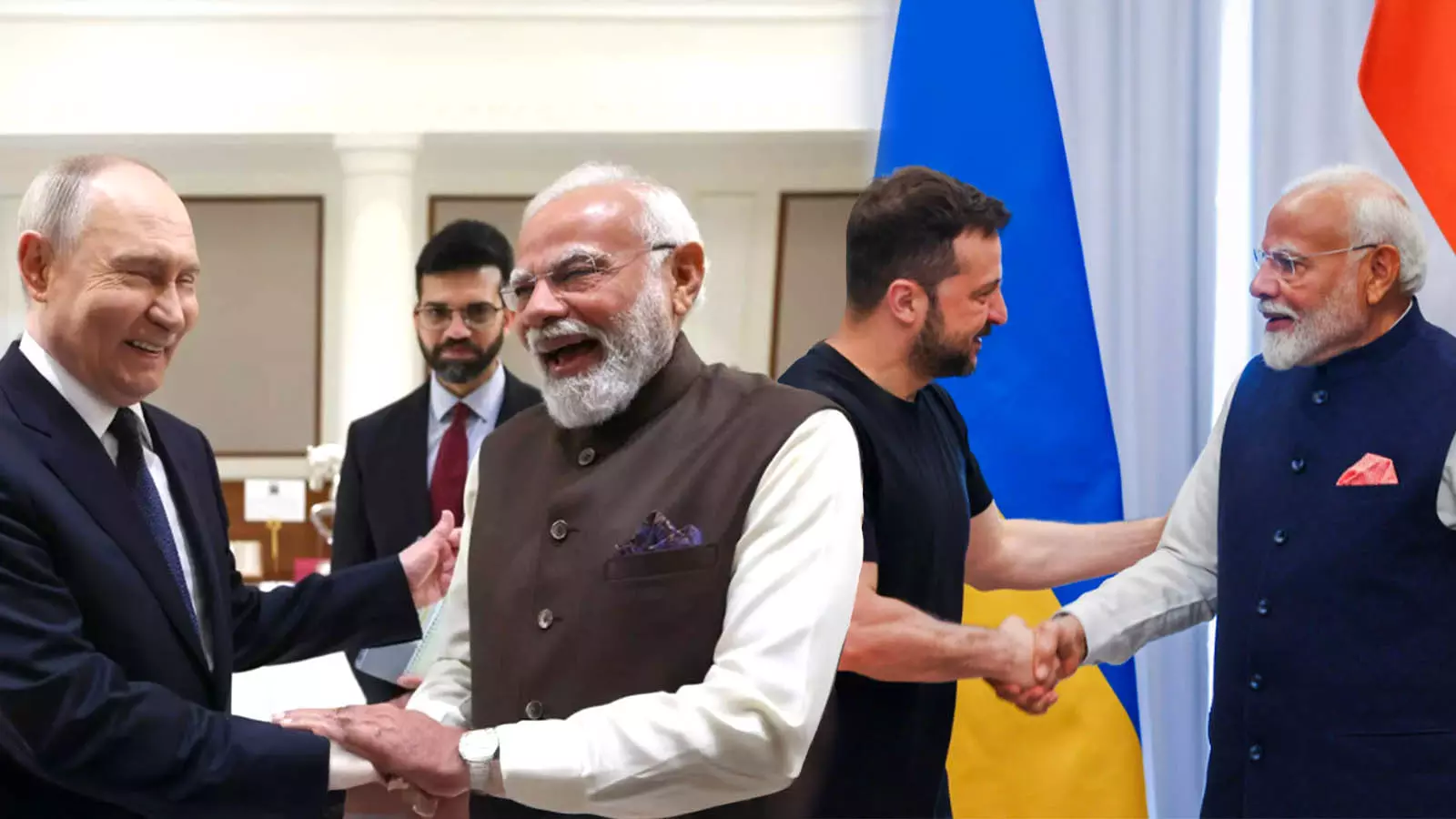
How India is reviving its Vishwaguru image with modest role in Russia-Ukraine peace talks
Resolute on its hands-off policy in war, New Delhi stays off negotiation table, but leverages relations with Putin and Zelenskyy to protect its seafarers and ensure grain supply to Global South

At a time when Brand Modi has taken somewhat of a beating, India's peace initiative in Ukraine can best be seen as an attempt to revive the image of the Vishwaguru for domestic consumption. It is well known that the major issues of territory, sovereignty, security, and peace in Europe will be dealt with by Russia and Ukraine, with the active involvement of the US and European leaders. India's role is limited and largely confined to taking practical steps like protecting Black Sea shipping lanes, keeping grain and energy supplies moving, and stopping attacks on energy infrastructure.
India’s concerns: Safety of Indians, shipping lanes
India is not a participant in the peace talks now underway in Abu Dhabi between Russia, Ukraine and the US. Members of the European Commission, European Council, German, French, and British security advisers and the NATO secretary general’s chief of staff are in Abu Dhabi but not taking part in the talks. They are there to advise and guide the Ukrainian delegation.
New Delhi has two immediate concerns: the welfare of Indian seafarers and the safety of commercial shipping.
“India is not present in Abu Dhabi, where the Russia-Ukraine peace negotiations are now taking place with the US as peace broker. India’s aim is modest. We are looking to protect our seafarers, who are severely affected by the war, and getting both sides to agree to allow a food corridor to help countries in the Global South overcome a shortage of grain,” says Kanwal Sibal, former foreign secretary.
Also read: Five ways the Russia-Ukraine war has changed the world forever
As Sibal points out, New Delhi has two immediate concerns: the welfare of Indian seafarers and the safety of commercial shipping. India is particularly concerned about attacks on tankers and commercial carriers, as it is the world's second-largest supplier of seafarers, after the Philippines. The wars in Ukraine and, especially, the conflict in the Strait of Hormuz have had a direct impact on Indians. New Delhi therefore hopes to persuade both warring factions to ensure that commercial shipping lanes are spared.
India’s ambition in Global South
By ensuring that the grain corridor is opened, India also wants to consolidate its position as the champion of the Global South. Russia and Ukraine are among the world's largest producers and exporters of grain, and any interruption in supplies affects the food security of vulnerable developing nations, particularly in Africa. At the same time, India wants to send a message to Europeans that it remains invested in Ukraine's security and to ensure there are no glitches in the final signing of the FTA next month. European leaders in the past have been critical of India’s pro-Moscow tilt.
Why Delhi should keep up its modest approach
“India's transition from advocating a negotiated settlement to putting forward concrete peace proposals reflects both a change in circumstances and a more confident assessment of its diplomatic leverage,” says Anil Wadhwa, former Indian ambassador to Italy. But he warns that India should be careful not to “overstate its capacity to broker a final settlement”. New Delhi’s modest objective must be to facilitate a political agreement and keep channels of communication open, adds Wadhwa.
Also read: India’s Russia-Ukraine peace push: Mediation or messaging?
As the conflict became increasingly prolonged, the economic consequences mounted. Amid disruption in food and energy supplies, and growing international polarisation, India saw an opportunity to translate its diplomatic access with both Moscow and Kyiv into something substantive. Modi’s repeated conversations with Russian President Vladimir Putin and his engagement with Ukraine’s President Volodymyr Zelenskyy gradually established the political space for a more active role.
India had refrained from taking a more direct role in the conflict. It felt that mediation would be premature unless both parties demonstrated a willingness to end the conflict.
“The turning point came with the deterioration of maritime security in the Black Sea in July 2025 when attacks on civilian shipping resulted in the death of Indian seafarers. This brought the conflict closer to India's direct national interests and provided a compelling reason to move beyond general appeals for peace,” says ambassador Wadhwa.
India resolute on hands-off policy
For the first three years of the Russia-Ukraine war, New Delhi kept its distance and was deliberately cautious. The Biden administration as well as European leaders were disappointed that India did not side with the West. Moreover, India was benefiting by lifting sanctioned Russian oil at discounted prices, much to the anger of NATO member states. External Affairs Minister S Jaishankar, however, later clarified that the Biden administration had given India the go-ahead to do so to stabilise international oil prices.
Watch | Why is India keen to end Ukraine-Russia war? Will its plan work?
Yet, India’s unwillingness to condemn Russian military action in Ukraine frustrated many in America and Europe. To relieve some of the pressure, Prime Minister Modi told Putin that “today's era is not an era of war,” during a meeting on the sidelines of the Shanghai Cooperation Summit in Uzbekistan in September 2022. Since then, this has become a part of India’s diplomatic lexicon on the Ukraine war. Modi’s advice to Putin helped to ease some of the criticism from the West.
Although Modi repeated this message during subsequent meetings with Putin, India refrained from taking a more direct role in the conflict. This was also because New Delhi felt that mediation would be premature unless both parties demonstrated a willingness to end the conflict.
Changed circumstances
However, circumstances have changed since the war began in 2022. New Delhi has built bridges with Zelenskyy, has excellent ties with Putin, and sees an opportunity to reinforce India's credentials as a country capable of contributing to the resolution of major international conflicts. Apart from this, Wadhwa says, “There is also a larger strategic calculation. India does not want the Russia-Ukraine conflict to become a permanent fault line in international politics, forcing countries to choose between competing geopolitical camps.”
However modest India's contribution, a final peace agreement between Russia and Ukraine would allow Brand Modi to reclaim the mantle of Vishwaguru, at least for domestic consumption.