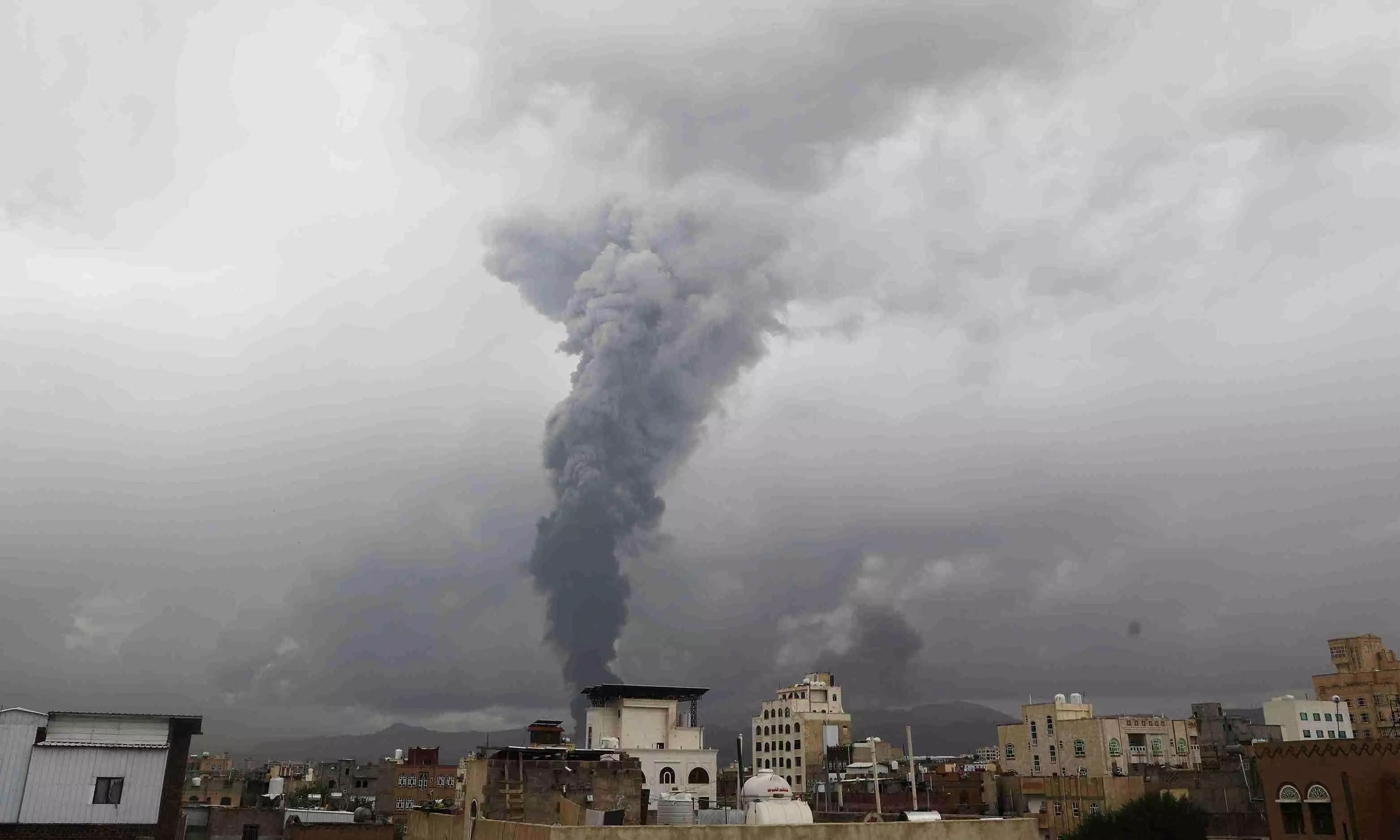
Why linking of two unrelated conflicts in the Gulf spells compounded trouble
The expanded war tests if unity is possible at all among the Muslim nations of the region, and if agreements like the Makkah pact are workable

The mixing up of Yemen’s Houthi-Saudi conflict with the US-Israeli war on Iran is akin to the linking of two unrelated tales inadvertently syncing with each other to come up with a new, more complex narrative that could potentially destabilise the region and rattle the rest of the world.
Yemen’s uprising
The vicious civil war in Yemen that drew in Saudi Arabia and the United Arab Emirates, backed by a Western coalition, was a direct consequence of the popular uprising, or the Arab Spring, in 2011.
At the time, Yemen was ruled by long-time president Ali Abdullah Saleh.
Also read: Saudi-Houthi clash opens new front in Gulf conflict, further imperils energy routes
The widespread protests in Yemen, influenced by similar ones in Tunisia and Egypt, were convenient to the Houthis, or the Ansar Allah, who had long fought an insurgency. They infiltrated the popular protests, gave it heft, which eventually resulted in Saleh being replaced by his deputy, Abdrabbuh Mansur Hadi, who was backed by Saudi Arabia.
Saleh’s return to Houthis
Once out of power, Saleh joined the Houthis as they advanced towards the capital Sanaa, eventually overthrowing the Hadi dispensation. Hadi, along with his entire ministry and other government officials, fled to Aden in the South. The Houthis took over power in the capital, and Saleh returned as president.
The Saudis then entered into negotiations with Saleh, and there was a distinct possibility of a compromise. But the Houthis saw this as a betrayal and assassinated Saleh. This resulted in war between the Houthis on one side and the Hadi-led government backed by Saudi Arabia. The UAE joined the Saudis, and a Western coalition including the UK and the US supported them with finance and weapons. The Houthis, on the other hand, were backed by Iran’s Islamist clergy.
For Iran, aligning with the Houthis was logical as part of Tehran’s axis of resistance. This axis also included Lebanon’s Hezbollah, Syria’s Bashar al-Assad and the Palestinian group Hamas. Other than Hamas, the axis was dominated by the Shia sect, which ruled Iran. From 2015, for seven years, the Saudi-led coalition pounded the Houthis, who fought back with Iranian help.
Humanitarian crisis
The war caused enormous damage to Yemen, and the UN termed it a humanitarian crisis. Nearly five million Yemenis were internally displaced due to the conflict. Half of the 41 million people in Yemen urgently needed aid, according to the UN.
Also read: Houthi attacks on Saudi: Drone shot down near Mecca; crown prince seeks Egypt's support
With no side appearing to win, a ceasefire ended the fighting in 2022. The Houthis were firmly ensconced in Sanaa, while the ousted Hadi government was berthed-off the coast of Aden. The UN recognised the Hadi dispensation as the legitimate government of Yemen.
New trigger
So, when the US and Israel attacked Iran on February 28 this year, the Houthis supported Iran, but they did not actively intervene to help Tehran. The catalyst that drew them into the Iran-US war was a chance occurrence. In July, a few days into a temporary Iran-US ceasefire, Tehran organised the funeral of its Supreme Leader Ayotollah Khameini, who had been assassinated by US strikes at the beginning of the war with Iran.
The government in Tehran sent in a civilian aircraft to Sanaa to bring in around 200 Houthi officials to attend the funeral. According to an agreed-upon condition, any flight over Yemeni airspace had to be with the permission of the Saudi-led coalition. But the Iranian airline disregarded the condition and landed in Sanaa, triggering protests from Riyadh. Once the funeral was done, and the airline was bringing back the Houthi officials in early July, Saudi Arabia fired on the airport in Sanaa, forcing the flight to land in Hodeidah, another Houthi-controlled airport nearby.
Ceasefire collapses
This incident triggered a fresh round of fighting between the Houthis and Saudi Arabia, effectively ending the four-year ceasefire. The Hadi-backed Yemeni government troops soon got into the fray, attacking the Houthis, and the civil war resumed.
For Iran, the resumption in fighting is militarily expedient. Tehran calculated that its allies, the Houthis, could replicate Iran’s siege over the Strait of Hormuz in the narrow Bab al-Mandab Strait that connects the Red Sea with the Gulf of Aden.
Also read: ‘US has abandoned us’: Why Gulf is rethinking Western ties
Though not as extensively used as the Strait of Hormuz, the Bab al-Mandeb was equally key to international shipping. Saudi Arabia, through its oil pipeline by land stretching from east to west was routing its oil supplies through the Bab al-Mandeb, amounting to around six million barrels per day. This strait is also equally crucial for freight transported from Europe to Asia and vice versa.
Global disruption
The Houthis have said they are only targeting Saudi-related freight and not others. But this is equally disruptive for nations in Asia that depend on Saudi oil, among other things. The Houthis might claim they are only targeting Saudi carriers, but the resulting uncertainty has already hit global oil supplies, with prices again shooting to over $100 per barrel.
Though the Houthis say they are targeting only the Saudis, both on land and sea, the concatenation has willy-nilly meant the opening of a second front in the US-Israeli war on Iran. Though Trump appears to have lost his appetite to continue the war, and has tried to extricate himself from it without losing face, circumstances beyond his control have negated his plans. This is one reason the US has stated it will not overtly jump in to join the fight against the Houthis, despite a Saudi request for Trump’s intervention.
US-UK support
However, US officials and the UK have said their personnel are in Riyadh with technical aid and other military-related assistance. Its not clear how helpful they have been as the Houthis have moved with great alacrity and occupied key areas at the mouth of the Bab al-Mandeb strait – to the disadvantage of the Saudis. At the time of this writing, the Houthis have, for the first time, in a while fired missiles into the Saudi capital Riyadh damaging oil facilities, and other infrastructure.
Also read: Iran war: How India is navigating the energy crisis
Amidst this, the much talked-about unity among the Muslim nations of the region proposed by Iran is in danger of coming apart even before it has taken off. So too the Makkah pact between Saudi Arabia, Pakistan and Turkey. While the agreement says an attack on any one is an attack on all three, and therefore legitimate for Turkey or Pakistan to come to the Saudis’ aid, nothing has happened so far, other than statements of support.
If the war continues, arising out of the siege of Hormuz and Bab al-Mandeb, among other things, it will make clear if unity is possible at all among the nations of the region, despite all being Muslim, and whether defence agreements like the Makkah pact are workable at all. For the rest of the world, however, it is back to a hand-to-mouth existence as far as fuel supplies are concerned.